
Are you paying attention?
As we get back into work and school for the year it is the perfect time to start developing good habits... or renew the good habits that have been let slide over the holidays.
The key to successful and productive practice is routine and quality. I'm not talking about the quality of the playing but rather the quality of the practice...
Continuing on with the theme of practice, as we get back into work and school for the year it is the perfect time to start developing good habits... or renew the good habits that have been let slide over the holidays.
The key to successful and productive practice is routine and quality. I'm not talking about the quality of the playing but rather the quality of the practice.
Sticking to a regular practice routine is important in that, for one thing, if there are long gaps between your practice sessions it's a bit like taking one step forward, two steps back, as you forget what you were doing last time, and certainly your muscles have forgotten what they learnt.
Apart from that though, a regular routine helps keep you motivated, it becomes part of your day, something that generally you should look forward to. And by practising regularly, you achieve a great deal more, and can see, or rather hear, the improvements in your playing.
Quality is a slightly more abstract concept when it comes to practice. Unless you are practising something in totally the wrong way, for example playing the wrong notes, I think almost any practice is of some value. But certainly some ways of practising are more effective than others.
It is important to really pay attention, at all times. As I have said in the previous post, when your concentration starts to fade it's probably time to stop.
When practising any instrument there are many things to think about: Notes, intonation, rhythm, dynamics, form, tone, phrasing etc...... it is hard to be thinking about them all at once. So to help keep our heads from overloading, focus on one thing at a time. It might be a big shift, some odd intervals, a passage of fast notes, or very slow notes, or it might be all of these; break it down into smaller chunks.
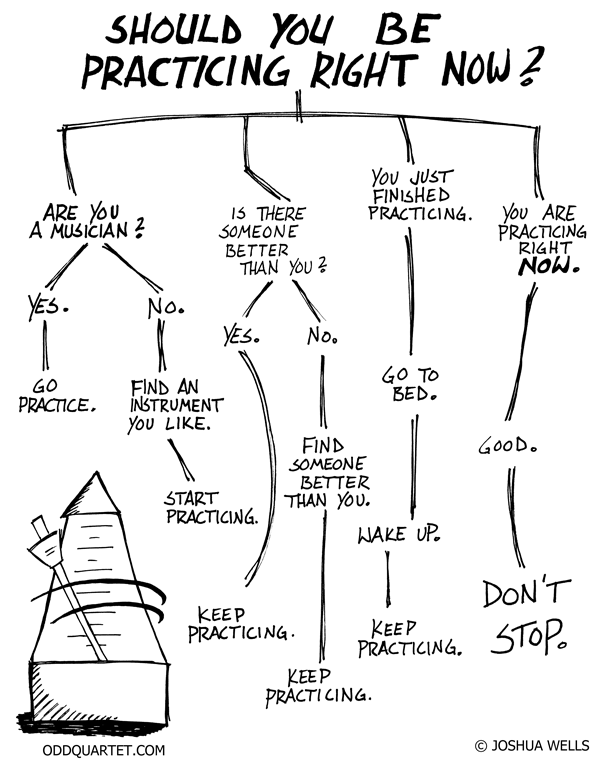
Perhaps quite a strict regime, but if you did follow this chart, you would get good fast!
- The shift or unusual intervals needs slow practice for intonation. Listen to a recording or play the notes on the piano of just that section, until it is set in your head. Really listen to the notes that you are playing. Sometimes, if you are really paying attention, bending the note slightly sharp then flat can help settle the true note into your ear. Once the intonation is solid, then start refining the sound, making sure the tone and dynamics are right. You might find that after adding dynamics you might need to work on the intonation again.
- For fast passages, once you have nutted out the intonation, start building up the speed. This really does require vigilant use of a metronome. Start slow, it seems obvious but you would be surprised, slow means slow, take the speed that you feel you can play it and reduce it by 5-10 notches. Now it's just repetition, gradually increasing the speed a few notches at a time (only when you have mastered the passage at the slower speed). You may find that you hit a wall at a certain speed, that's ok, you will gradually push it up further over time.
Practising with a dotted rhythm, and then the reverse rhythm is often very helpful in conjunction with the metronome.
These are just 2 examples of ways to practice specific elements or passages. Both involve much repetition and attention to detail. And that can be applied to all practice. The 3 time rule is also a good thing to stick by: to get something perfect 3 times in a row, is actually harder than it sounds, so you keep working it until you do.
The last thing I want to mention which I feel often gets neglected in favour of everything I have mentioned above, is the physical. Being aware of physical stance, posture, how you are using your hands, arms, face, is as important as the rest. You can't do the rest effectively without using your body in the right way. Pay attention to how it feels to produce the notes, do you have the right balance and weight in your arms for example, are you sitting (or standing) correctly. Notice how it feels when you get the notes right, not just how it sounds, it will make it easier to replicate next time.
This all seems like a lot of hard work I guess, and learning an instrument is, hard work, but also fun and rewarding and many other things besides. And remember you don't have to do it all at once. As I mentioned before, regular small practises are going to get you further than the occasional marathon. Alternate between the detailed practice and playing through (it keeps you in context of the bigger picture, and is usually more fun) and when time allows devote yourself to a big session.
Keep your goals in mind and remember nothing really worthwhile is particularly easy.
An Ear for Music - Part III
Learning an instrument can involve many physical challenges and it is often necessary to find a certain level of familiarity in navigating it before things like tone and accuracy can really be fine tuned. However, there are simple exercises that can be practised to simultaneously develop the ear that need only a little technical skill. These are just as important as learning where the notes are on the stave or where to put your fingers.
At the beginning, a new student's technical ability may not be strong enough to always play in tune. Learning an instrument can involve many physical challenges and it is often necessary to find a certain level of familiarity in navigating it before things like tone and accuracy can really be fine tuned. However, there are simple exercises that can be practised to simultaneously develop the ear that need only a little technical skill. These are just as important as learning where the notes are on the stave or where to put your fingers.
- Scales. These are critical in both technical training and ear training. A single octave up and down is achievable by most students after a few lessons. C major scale for example, having no sharps or flats, falls under the fingers easily. With guidance from a teacher, you can start to really hear the key of the scale, the tones and semitones. Remember 'Doe a Deer' from The Sound Of Music, this is a C major scale. Over time you progress to other scales D and F major etc. start to introduce minor scales, these have a different tonality again, the tones and semitones are different, and then increase to 2 octaves, and so on. There are many scales with increasing numbers of sharps and flats, and for a cellist, increasing technical difficulty.
Scales are not usually considered fun, but they are very useful and very necessary. Take them slowly, and really listen. It is important to adjust the notes as you go until they are in tune, if you can hear it's not in tune, that's great, but you need to be able to correct it too.
- Pitching Notes. Not all instrumentalists feel they can sing, but it is an important skill to develop for all musicians, even if you are never prepared to sing in front of anyone. You need to be able to pitch the notes in your head before you play them, otherwise once you have played the note and realised it's wrong , it's often too late. Brass players for example, must know how to pitch notes well as several notes can be made with the same combination of valves. When you sit music exams, there is a portion of the exams dedicated to Aural Tests. Whether doing an exam or not, these exercises are useful to practice these skills.
As a teacher I use simple exercises playing together with the student or using the piano. I have the student sing or play back a single note or short phrase. Progressing to finding intervals from a given note. So when you see the notes on the page you can have a very good idea of how it should sound when you play it. these can also be modified into fun games with younger students, using different media and tools, gives a variety to the lesson, and helps them to understand the written music better.
- Check. When you are practising at home by yourself it can be difficult to always be sure if you are in tune, as you are likely to have little to hear it in relation to. With stringed instruments we have open strings. When learning a new or difficult piece, look out for all the A's, D's, G's and C's (in the case of viola or cello) and each time you play these notes, check them with your open string, it may be at a different octave but you can clearly hear when the two notes are in tune.
When you are practising a big shift, use your note pitching to sing the interval (in your head) and then play the shift alone over and over until it is perfect every time.
It can also be useful is to play along with a recording from time to time. As mentioned in Part II, being very familiar with the piece played in full helps enormously to understand the tonality and intervals in the piece. When you play along with it , you will notice any notes that are not quite right. But this is not a substitute for careful and diligent practice.
From there it comes down to fine tuning each and every note. This takes time and patience, play the notes slowly, avoid vibrato, and listen really carefully. I find it sometimes helpful to bend the note a bit, roll my finger slowly back forth like a super slow-motion vibrato to force the note flatter and sharper, there will be a note somewhere in the middle that sounds just right, like fine tuning the radio.
A musicians ear is one of the most valuable things they have. At the end of the day it is down to the student to practice 'hearing' what they play, this actually goes for every musician at any level. It is one of those things you have to work at for yourself, no-one else can hear just what you are hearing, and it takes constant practice.
If you want some extra help there are a myriad of apps offering ear training, they generally test you on intervals, chords and other pitch related excersizes. Here is a review I found of 6 with varying prices and functionalities, but as I say there are loads of them, they will all help, just depends how far you want to take it.
6 Apps & Websites to get your Ear in Shape
Remember, even if you think you have a terrible ear, you can train it, it just takes time diligence and focus. I would love to hear of any other techniques that you might use, either for your own ear training or for your students. And I'm certainly open to any questions, this is a big and complex topic.
An Ear for Music - Part II
The foundations of the intonation that we hear is somewhat intuitive, it depends a lot on one's musical exposure. Listening to most western music, be it popular or classical, these combinations of sounds, intervals and chords will sound 'right' to your ear. If however you listen to a lot of jazz or world music your ear will likely be more attuned to different types of harmonies.
The foundations of the intonation that we hear is somewhat intuitive, it depends a lot on one's musical exposure. Most western music that we hear all around, is based around the diatonic scale, a musical convention stemming from Greek times. So listening to this, be it popular or classical, these combinations of sounds, intervals and chords will sound 'right' to your ear. If however you listen to a lot of jazz or world music your ear will likely be more attuned to different types of harmonies, hearing sounds that may not even exist in western music.

I grew up in a music filled household, listening to all sorts, from Beethoven to Bob Dylan, Marianne Faithful to the Memphis Jug Band. Family get-togethers usually devolved into a cacophony of irish tunes where someone yelled out the key and after some 'discussion' on the actual name of the reel, everyone would join in , mostly it was great, sometimes not so much. In all I was lucky to be exposed to so much music. But as I mentioned in Part 1, you can practice and train your ear to hear things better.
Practice hearing not just listening. For starters, getting your ear used to the sound of what you are attempting to play. The sound of the harmonies and intervals will become second nature after listening to a piece several times, so that when you play it you know when you are playing it right. It is always helpful to follow the music at the same time, for one thing it increases your concentration on what you are hearing, and it also gives a visual reference for the shape of the music and the intervals between the notes.
As additional training, I have found it very helpful to listen and play (or sing) along with all sorts of different music, on the radio, different EP's or singles that I like. Perhaps start off with the tune, but trying to find the harmonies is a great deal more beneficial. Find a long note that fits with everything else going on, when it no longer fits, find the next one and so on....you have now found the chords changes. Most of the time the most prominent note (probably the one that you found) is the tonic, the base note of the chord, the 3rd and 5th notes will also fit, these 3 notes make up the triad, the basic chord.
After a time the ear starts to pick out these notes more easily, and to eventually predict what the next notes are going to be. As a result, anything that you play, you are anticipating the notes and harmonies, you know where you are going and what it should sound like.
The next and final part will investigate some more practical exercises that should be incorporated into any music practice to actively improve intonation.
An Ear for Music - Part I
Having a good ear is crucial for all musicians. There are a lucky few who have perfect, or absolute, pitch. I am related to at least one of these people, but unfortunately, I was not lucky enough to inherit that particular gene. So, like most, I have had to learn to develop 'relative pitch'.
Having a good ear is crucial for all musicians. There are a lucky few who have perfect, or absolute, pitch. This means they can identify the name of any note, recognising a car horn as a 'D' for example, or instantly playing back a ring tone on the piano.
I am related to at least one of these people, but unfortunately, I was not lucky enough to inherit that particular gene. So, like most, I have had to learn to develop 'relative pitch'. This allows me to pitch intervals from a given reference note and to play notes in tune in relation to accompanying chords. The importance of being able to pitch notes and maintain accurate intonation is hopefully evident. No doubt as a teacher, a musician or even as a listener, you have heard at one time or other, singers or instrumentalists that are quite out of tune. The notes and harmonies clash, the tune does not sound right.
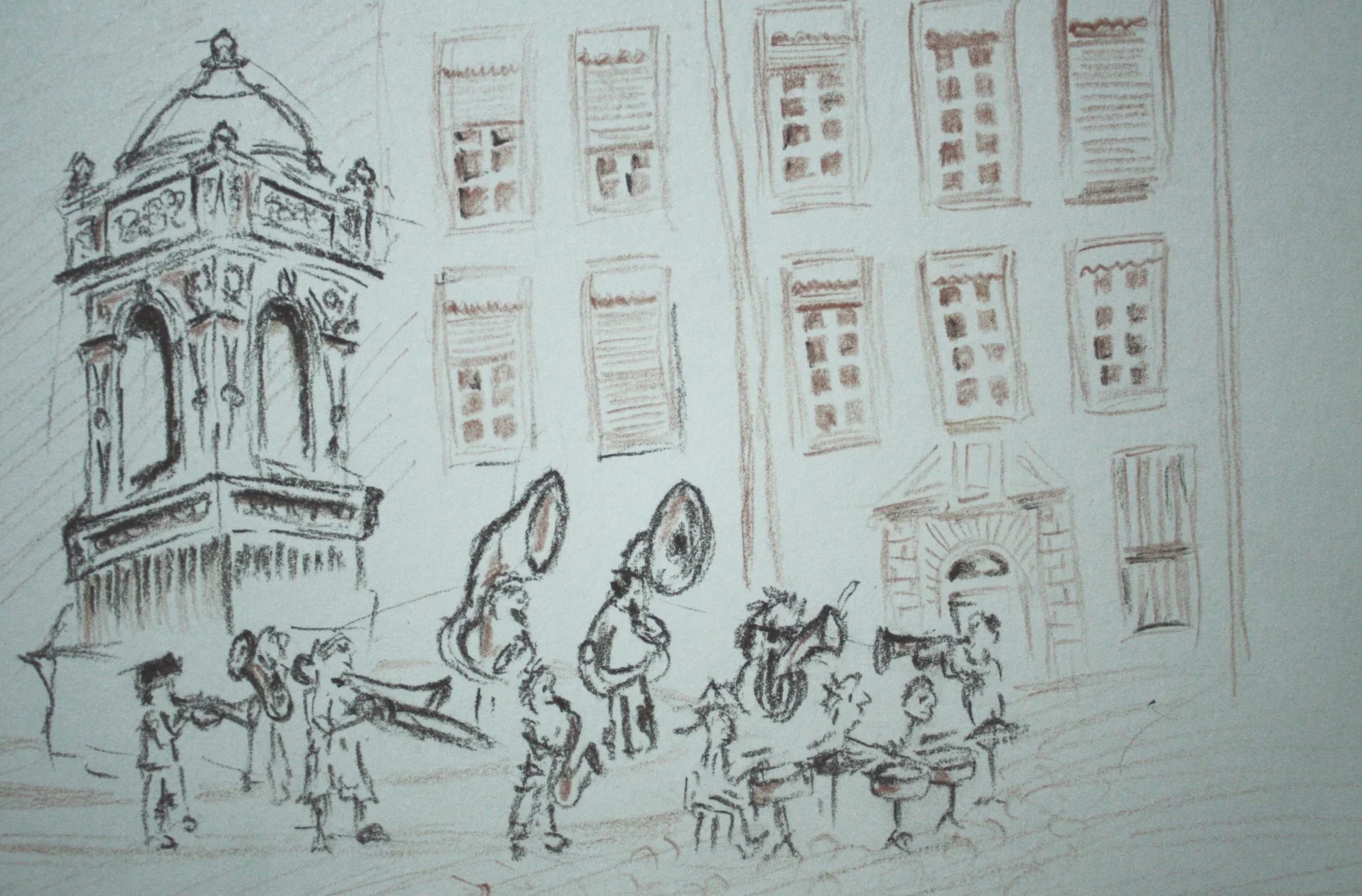
Sketch of street performers in Lyon - by J Khan (these guys were very in tune)
As someone that does not have the natural gift of perfect pitch, it takes vigilance to really listen and hear the notes, sometimes needing constant adjustment to get each note just right. One needs a lot of attention to detail, "near enough" is in fact not near enough. If you let incorrect tuning pass unaltered, your ear can get lazy and over time it can become harder to hear what is in tune and what is not. Inevitably from time to time we will let our attention slip but this must be overcome. The key is to be listening and training your ear as much as possible.
I don't profess to have all the answers and there is no silver bullet to fix an intonation problem, hearing when you are in tune is quite different from the execution of it on your instrument. But in Part 2 I will go into my discoveries improving my own intonation and experiences teaching others to improve their ear.