
Musical Energy and Playing with other Humans
This summer I had a few gigs, in itself nothing extraordinary. But I've been doing so much orchestral playing, that I forgot how much I dig playing in smaller groups. If there is a great spark between the musicians, it will set up a vibe for the event that everyone will love.
This summer I had a few gigs, in itself nothing extraordinary. But I've been doing so much orchestral playing, that I kind of forgot how much I dig playing in smaller groups.
It's not chamber music as such, don't get me wrong, that has its place, but when you're there at a wedding or a community function your job is to entertain people, creating a great atmosphere, not being intrusive, but also not necessarily being listened to - it's not really a performance in that sense, but if there is a great spark between the musicians, it will set up a vibe for the event that everyone will love. (Honestly I've done quartet gigs that there has been zero spark, and not only has the music not been great, but the guests hardly even noticed when we finished up)
This summer's gigs were great though. It started off catching up with my old friend Louise from the Beaumont Belles, she's recently come back from exploring Europe (and playing the odd harp along the way). So we hadn't really played together much for a long while, and it may have just been a few classic carols for a Christmas fete, but it was fun, and the visitors loved it, partly the harp has such a dominating presence, but also we both know what the other can do, how our sounds can weave together and when to let the other cut loose and run with it. That's the beauty of a duo really it's so easy to communicate and let the music flow with how you're feeling.
Hot on the heels of that came some pre-concert entertainment for audience members while they enjoyed drinks on the veranda. Myself and some friends, namely my brother Dave on guitar and his mate Earl on a variety of percussion. Again playing familiar Christmas songs, changing up the styles, for example, my personal highlight, a ska version of Rudolph the Red Nosed Reindeer...pretty silly but really fun - and credit must go to those two, I was really along for the ride, we weren't taking it super seriously, but they really know what they're doing, enjoying themselves and making a great sound and the atmosphere of the event being as it was familial and relaxed, the audience LOVED it, it set them up for a really good show.
Finally, in the new year, I was asked to fill in at a wedding with other members of The Black Quartet. I've played with a couple of them before but not since the Aotea Youth Orchestra days. It was great catching up with them again. These folks are fabulous musicians, so much energy and connection between them, so coming in like that, for the most part, it was pretty easy to gel in - there were, if I'm honest a couple of numbers where it became apparent I wasn't entirely match fit on my sight reading (....where does that freakin' repeat go back to?!?), but aside from that it all went pretty well.
And it would have been even better had there not been 30kn winds playing havoc with the pages and at one critical moment (as the happy couple walked off down the aisle) knocked my entire folder clean off the stand! Happily my improvisational skills have improved since the old Aotea days. But it's been that long since I've played an outdoor wedding - I didn't even think about pegs, should know better really.
I think at the end of the day, playing gigs like these, with different people, in different places, gives us a bit more freedom to express ourselves. You have to connect with the other players at quite a fundamental level, read the crowd to an extent and deal with unexpected environmental forces. Playing in a larger group in an orchestra or a show is great too, I love the energy, the bigger the better, but it is more prescriptive, we need to follow the conductor, manifest his (or her) interpretation of the work, the performance is a lot more formalised.
Whereas when you are playing in a small group, particularly with people you know well and play with often, you have the liberty to express yourself more freely. Take your emotions of the moment and send out a tear jerking version of O Holy Night, for example, or equally feed off the others energy with a croony version of Embraceable You. The whole experience is a lot more collaborative, and the energy can be a lot more direct, between the players, through the music and out to the guests - a bit more grass roots I guess. And if you are having a good time, so will the guests, even if they are not particularly paying attention.
Performance can take on so many forms it's hard to decide which I like to play best - on reflection, if the collective energy is there it doesn't matter what it is.
Music Literacy for all
Most classical musicians will learn to read music before or in parallel with learning their instrument. But it can be quite challenging, there are so many new and unfamiliar things to be thinking about. So, sometimes it gets lost, the theory bit that is. Many, especially the younger ones, just want to get on with the 'fun' bit - Playing. But as with many things, without some theoretical foundation, most people will be limiting themselves in the long run.
I had the great fortune recently to have some training in the Kodaly approach to music teaching. Now I am often quite skeptical of anything calling itself a "method", I find they can be contrived and rigid; good for young children to quickly learn to play an instrument, but in the same way a lemon juice and cayenne diet will shed pounds fast - it's not really a long term solution.
I discovered Kodaly is sometimes wrongly referred to as a "method" but practitioners expiate this misunderstanding, explaining that "approach" is a more accurate word.
Zoltan Kodaly pulled together many elements from musical traditions, education traditions, his own and others experiences. Because learning music has multi faceted developmental advantages, it teaches discipline, reading, writing, arithmetic, artistic expression, and so on; learning as a child helps develop effective thought processes, learning as an adult, it helps to reevaluate your thought processes.
Learning this new approach, I was challenged to reevaluate my own thought processes, both as a player and as a teacher. It was encouraging to see I had already been adopting some of the techniques, and others that had always shied away from, seemed ot make sense and have their place.
To me the Kodaly approach to music teaching is wider, and more inventive than traditional theory, which, lets be honest, can be very dull, particularly for kids (I used to dread Sunday afternoons, the theory books would come out as my mother dragged my brother and I unwillingly through the next chapter).
By breaking it into movements, sounds and other basic elements we are familiar with, often based around folk songs our mother might have sung to us, the theory of music becomes something we can relate to.
Kodaly is quoted to have said,
“Regarding when to start music education ‘Nine months before the birth of the child,’ ..moreover.. ‘nine months before the birth of the mother.’”
Music is steeped in tradition, and tradition is steeped in music. Every culture has musical roots that are entwined in the history of those people. Often times today in busy lives of a digital age, many of those traditions start to get lost.
I have spoken a lot about the music as sound in previous posts, practicing, listening, accuracy, feel ect. But not much about the music as a thing.
Most classical musicians will learn to read music before or in parallel with learning their instrument. But it can be quite challenging, there are so many new and unfamiliar things to be thinking about. So, sometimes it gets lost, the theory bit that is. Many, especially the younger ones, just want to get on with the 'fun' bit - Playing. But as with many things, without some theoretical foundation, most people will be limiting themselves in the long run.
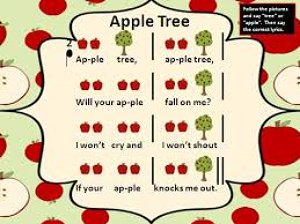
Here are some examples, in my experience, of how understanding the music can be an advantage and improve your performance:
Sight Reading - the better you understand the written music the better you can read it. Producing rhythms more accurately, pitching intervals. You can play a piece of music without the laborious task of transcribing it by ear, and by memory.
Improvising - of course you can do this by ear, but unless you're fairly extraordinarily talented it will be a lot of trial and error. At least for me, it's a whole lot easier to read a chord chart and understand what notes can go where and how the chords fit together in a sequence.
Ensemble playing - if you can understand what is written on the page and structure of the music you can be much more sensitive and effective as an ensemble player, knowing when to bring out important bits or stand back and let others take the lead.
Composing - If you can understand the technical side of how music is written, you are better equipped to compose more interesting and complex pieces of music, to get the sound you want just right.
As I mentioned, in learning how to learn music, and therefore how to teach it, I have been thinking a whole lot more about what the music means, seeing what I hear, hearing what I see. I have become much more sensitive to those fundamental building blocks of what makes up the music.
So getting back to Kodaly:
- Start simple, gradually building on each component, rhythm, pitch etc. so that the whole thing is not so daunting. Folk songs are the ideal place to begin, simple melodies and nursery rhymes that we are familiar with and are easy to pick up.
- Don't necessarily begin straight away with the music as it is written on paper. Using different shapes and colours, physical items you can use to build the music, other props, 'toys' and games to allow us to literally feel the music, and to see it written as something we can relate to. For example hearts indicating the beat, tugging on lycra that little arms can feel the pulse or passing a ball around the circle to show the need for a steady beat.
- Repetition. Using the same song to demonstrate at different times various aspects of the music, one time you might simply look at the pulse, another time perhaps the rythm and a third time the pitch. Equally, doing the same or similar activity with different songs. Always reinforcing the ideas, until they are second nature.
You can read more about the approach at these interesting links:
http://www.britishkodalyacademy.org/kodaly_approach.htm
http://kodaly.hu/zoltan_kodaly/kodaly_concept
http://www.kodaly.org.au/kodaly-concept/musicianship-tools/
Kodaly's intention was primarily to teach children, but of course it works for almost everyone. We all have different learning styles and being varied and diverse in our approach allows us to connect with the concepts regardless. Some of my adult students have been pleasantly surprised when playing with coloured ice-block sticks, rhythmic notation has suddenly made so much more sense.
I believe everyone can benefit from some music theory, no matter what your experience. Don't get put off by the thought of 'theoretical' study. There are so many ways to approach reading and understanding music. And if you're teaching think outside the box and let your imagination run wild. You will be amazed at what you can achieve.
Are you Listening?...Now I'll begin
When we really listen to music, we are paying attention, it's not just going on in the background while we think of what we are having for tea or ticking things off the To Do list. We notice the rhythm and harmonies, changes in key or tempo.
When you are playing the music, you must be aware of all these things as well as create them.
It takes concentration...
If you have read my previous posts, you will know how crucial listening is. Of course we are talking about music, so this might seem obvious, but listening is a lot different from hearing.
I've been playing all sorts of different things recently with lots of different people; good musicians, students, a whole mixture. The common thread of whether the ensemble and the music works is the level of listening that is going on. A bunch of people playing instruments at the same time does not an ensemble make.
Small groups, especially when talking about classical music, are often referred to as an 'ensemble'. This comes from the French meaning 'together'. When everyone is listening, and reacting, the music comes together, it becomes music not just notes, the different parts bounce off each other and blend, and a musical energy is created. Essentially all the feeling and emotion from music can be thought of as energy.
The word there that makes the difference is 'reacting'. When we really listen to music, we are paying attention, it's not just going on in the background while we think of what we are having for tea or ticking things off the To Do list. We notice the rhythm and harmonies, changes in key or tempo.
When you are playing the music, you must be aware of all these things as well as create them.
It takes concentration:
- Listen to everything that is going on around you (in the music that is)
- Fit in with the rhythm, pitch and dynamics of the other players. If you have sheet music it should all be written there for you, but it is often elastic, especially tempo and dynamics.
- React to what you are hearing, if another part has the lead (or tune), follow, if you have it, lead the others.
- Anticipate the changes, you can hear when things are building, harmonies often lead into one another. When reading music always be looking a bar ahead.
Think of it as a jigsaw puzzle where each person has only some of the pieces, everyone must put the right pieces in the right spot for it to all join together and make a picture.
Each players pieces are made up of their own intonation, tone, rhythm, dynamics, expression etc. even lyrics.
When all the pieces fit, you have some great music.
As I mentioned in an earlier post Ear Training Part II what you hear and can react to depends on what you are familiar with, there are so many different rhythmic patterns and harmonies that are involved in creating the right feel for any given piece of music. Classical, pop, jazz etc all have different rules and conventions that make up the texture and style of the music.
If we are not familiar with that particular style it can be very difficult to fit in with it. You can be listening and concentrating but it can still be difficult to slot your part into the puzzle.
It takes time, in the same way as learning a new language. If you have ever been in a foriegn country, even having studied your phrase book, you can't differentiate where one word ends and the next begins. After a while your ear becomes familiar with the sounds and you can start understanding more of the words.
Listen to recordings, listen to the other parts, listen to how your part fits in with the other parts, listen out for cue notes, beats or words. Take notice of the harmonies, where are the parts working together, where are they doing their own thing, where are they heading?
Pay attention to the changes in energy, it would be dull if it were the same the whole way through. there are ups and downs, louds and softs, angry parts, peaceful parts, happy and sad parts, take note of how these make you feel and then replicate it.
For musicians who don't often play in a group, there is not always the same need or opportunity to develop these accute listening skills. For example;
- A pianist can play in his own style and the feel will be consistent, he can always keep in time with himself,
- A singer can have one or more instrumentalists accompanying her who will follow her, and how she interpretes every phrase.
In my opinion every musician should hone their listening skills, being aware of everything going on, to be able to react and fit in with the other parts. I do admit it is a case of practice, and it is hard to do that if you are not putting it into practice, so to speak.
But you will become a better musician for it.
Practice makes better ... eventually
Practice is an interesting thing, there are good ways and bad ways to do it, there are also different opinions on what is the best way. I came to the realisation over the last 12 months or so that I needed to brush up on my practice technique and give it the time that it needed. Practice is as much psychological as physical, keep bringing your concentration back to what you are trying to achieve. Only practice as long as you can maintain your full attention on the notes you are working on...
Practice is an interesting thing, there are good ways and bad ways to do it, there are also different opinions on what is the best way. When you take up something new there is a steep learning curve, everything is uncharted territory. as you get better at it, the basic elements you learnt at the start become easier, even second nature, that you no longer think of them. This improvement continues more gradually until you reach a certain point where you can achieve many things, albeit in a mediocre way, with little to no practice. Of course this happens slowly over time, and along the way somewhere you lose the ability to practice with the same attention and vigour as when you started.
I have come to this realisation myself over the last 12 or so months, a somewhat rude awakening, I knew deep down that I was not practicing to the best of my ability, but most of what I played was 'good enough' with the bare minimum of work, my repertoire I kept to the same old favourites I had played for years.
It wasn't until I found myself in the situation of wanting to tackle some much more complex repertoire, and simultaneously (for an entirely different project) needing to learn music by ear and improvise, that I realised I needed to brush up on my practice technique and give it the time that it needed, rather than allocating arbitrary amounts of time I felt I could reasonably take out of my schedule.
In concentrating my efforts on quality practice where it was needed, and no longer simply running through from the top every time, religious use of a metronome, meticulously learning small chunks at a time and really listening to the quality and intonation of each and every note, practice time can easily expand to several hours at a time. My concentration span quickly grew and so long as my hands could hold out I can keep going to a point where improvement has plateaud for the day. Very quickly the results of this quality practice have shown a vast improvement over the years of mediocrity that preceded it.
Quality practice is as much psychological as physical. Listen intently to everything that you play, hold yourself to the highest of standards. Perfection is generally impossible to achieve however it makes for an ideal target point. I think this is hardest to instil in younger people, children do need encouragement and can easily become disenchanted with music if they feel they are not improving, they often need instant gratification of some kind or else it becomes too hard and they can get bored. Having said this though, constant praise is not the answer here either, there needs to be a balance where a job well done is recognised but equally where areas for improvement are kindly pointed out otherwise in the long term the student will not develop the self criticism necessary to achieve greater things.
“Simplicity is the final achievement. After one has played a vast quantity of notes and more notes, it is simplicity that emerges as the crowning reward of art.”
A lot of what is needed in good practice is down to mind over matter. Keep bringing your concentration back to what you are trying to achieve. Only practice as long as you can maintain your full attention on the notes you are working on. In every practice session the improvement of the technique or passage you are trying to perfect plateaus at some point. You must pay attention and notice when this occurs, move on to a different passage and come back to it later. And never try to run before you can walk. Having recently taken the step to relearn the piano as part of becoming a better musician, I know full well the frustration when you hit a road block and suddenly it gets hard. Take a breath, slow it down, baby steps, it will come eventually.
Most of all enjoy it. Playing music is amazing, but we all have to practice constantly to play our best. It is a life long journey. Relish every improvement, every notch up on the metronome, let yourself take great satisfaction for each passage mastered, but at the same time being aware that is is never really mastered - 'you've got the notes, now work on the tone'. Be sure to never get complacent, and know that the sky is the limit and each day of good practice you are one step closer.
The next time I will talk about what in my experience are the best ways to approach practicing.
An Ear for Music - Part II
The foundations of the intonation that we hear is somewhat intuitive, it depends a lot on one's musical exposure. Listening to most western music, be it popular or classical, these combinations of sounds, intervals and chords will sound 'right' to your ear. If however you listen to a lot of jazz or world music your ear will likely be more attuned to different types of harmonies.
The foundations of the intonation that we hear is somewhat intuitive, it depends a lot on one's musical exposure. Most western music that we hear all around, is based around the diatonic scale, a musical convention stemming from Greek times. So listening to this, be it popular or classical, these combinations of sounds, intervals and chords will sound 'right' to your ear. If however you listen to a lot of jazz or world music your ear will likely be more attuned to different types of harmonies, hearing sounds that may not even exist in western music.
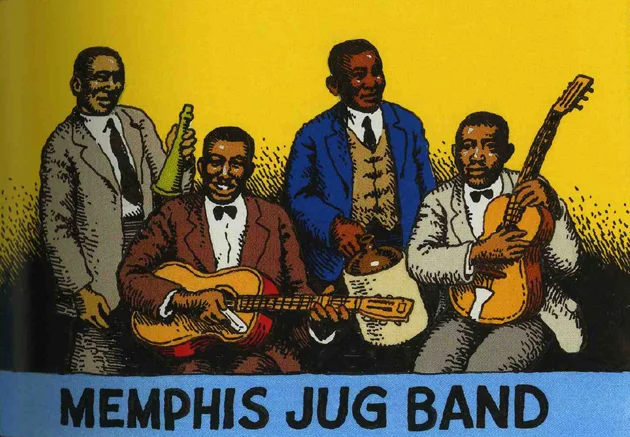
I grew up in a music filled household, listening to all sorts, from Beethoven to Bob Dylan, Marianne Faithful to the Memphis Jug Band. Family get-togethers usually devolved into a cacophony of irish tunes where someone yelled out the key and after some 'discussion' on the actual name of the reel, everyone would join in , mostly it was great, sometimes not so much. In all I was lucky to be exposed to so much music. But as I mentioned in Part 1, you can practice and train your ear to hear things better.
Practice hearing not just listening. For starters, getting your ear used to the sound of what you are attempting to play. The sound of the harmonies and intervals will become second nature after listening to a piece several times, so that when you play it you know when you are playing it right. It is always helpful to follow the music at the same time, for one thing it increases your concentration on what you are hearing, and it also gives a visual reference for the shape of the music and the intervals between the notes.
As additional training, I have found it very helpful to listen and play (or sing) along with all sorts of different music, on the radio, different EP's or singles that I like. Perhaps start off with the tune, but trying to find the harmonies is a great deal more beneficial. Find a long note that fits with everything else going on, when it no longer fits, find the next one and so on....you have now found the chords changes. Most of the time the most prominent note (probably the one that you found) is the tonic, the base note of the chord, the 3rd and 5th notes will also fit, these 3 notes make up the triad, the basic chord.
After a time the ear starts to pick out these notes more easily, and to eventually predict what the next notes are going to be. As a result, anything that you play, you are anticipating the notes and harmonies, you know where you are going and what it should sound like.
The next and final part will investigate some more practical exercises that should be incorporated into any music practice to actively improve intonation.
An Ear for Music - Part I
Having a good ear is crucial for all musicians. There are a lucky few who have perfect, or absolute, pitch. I am related to at least one of these people, but unfortunately, I was not lucky enough to inherit that particular gene. So, like most, I have had to learn to develop 'relative pitch'.
Having a good ear is crucial for all musicians. There are a lucky few who have perfect, or absolute, pitch. This means they can identify the name of any note, recognising a car horn as a 'D' for example, or instantly playing back a ring tone on the piano.
I am related to at least one of these people, but unfortunately, I was not lucky enough to inherit that particular gene. So, like most, I have had to learn to develop 'relative pitch'. This allows me to pitch intervals from a given reference note and to play notes in tune in relation to accompanying chords. The importance of being able to pitch notes and maintain accurate intonation is hopefully evident. No doubt as a teacher, a musician or even as a listener, you have heard at one time or other, singers or instrumentalists that are quite out of tune. The notes and harmonies clash, the tune does not sound right.
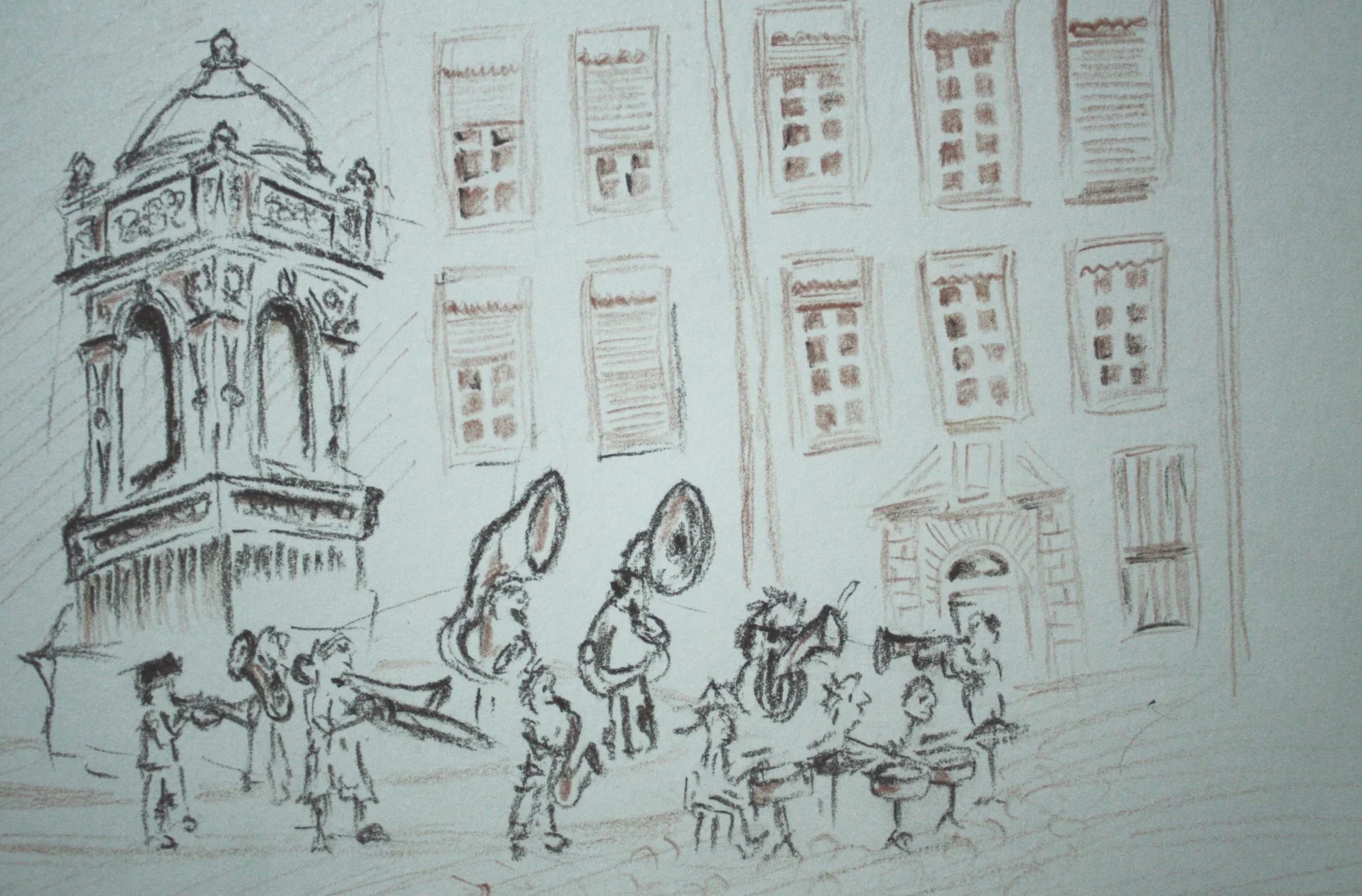
Sketch of street performers in Lyon - by J Khan (these guys were very in tune)
As someone that does not have the natural gift of perfect pitch, it takes vigilance to really listen and hear the notes, sometimes needing constant adjustment to get each note just right. One needs a lot of attention to detail, "near enough" is in fact not near enough. If you let incorrect tuning pass unaltered, your ear can get lazy and over time it can become harder to hear what is in tune and what is not. Inevitably from time to time we will let our attention slip but this must be overcome. The key is to be listening and training your ear as much as possible.
I don't profess to have all the answers and there is no silver bullet to fix an intonation problem, hearing when you are in tune is quite different from the execution of it on your instrument. But in Part 2 I will go into my discoveries improving my own intonation and experiences teaching others to improve their ear.
What is it to be a Musician?
The intention of this blog is to share my experiences, ideas and advice to help you to become a better musician. To share techniques and philosophies on how you can improve your playing both physically and mentally.
The intention of this blog is to share my experiences, ideas and advice to help you to become a better musician. To share techniques and philosophies on how you can improve your playing both physically and mentally.
Despite having performed in orchestras and bands since a young age, and having taught since my late teens, for most of my life playing cello has been primarily for pleasure. And this is why I still play. Recently I have decided to embark on a journey to build a career as a cellist.
I really respect people that have become successful musicians, working their way up, scraping together enough to get by, and they keep at it. There are musicians that I know who have made themselves indispensable, be it as a writer/performer, an accompanist, or a backing musician. People want them, for their entertainment, recital or recording. I want to be one of these people.
Being a professional cellist is hard work, don't imagine that it's not. It takes years of lessons and ongoing practise to learn an instrument and advance your technique and musicality. There's always new things to learn and elements to refine. At times there seems to be an element of disdain from other regular 9-5ers who believe that playing music is just a hobby, we do it for fun. But these people may not understand the time and effort that goes into perfecting your art. Of course it is enjoyable, we couldn't do it if it wasn't. One needs to be in the right head space to really make the most of practice time, to really be able to convey those emotions and express what you mean to say with the music.
And this is what it's all about, expressing yourself, expressing passion. Composers have a message of their own to get across, but it is you who is interpreting that message and presenting it in your own words, so the listener can understand. Your job is to invoke memories and emotions, to transport them to another place, to entertain them. You do this through your playing.
If you have persistence and dedication to music, you will develop the tools and techniques to be able to express yourself through playing. Your passion and enjoyment for playing music will provide the motivation to perform and share your art with audiences. Music is there to bring people together. And this is what it is to be a musician.