
Top Tips for Starting Online Music Lessons - Things I've Learned
This year has seen lockdown and social distancing measures put in place that have put many on a learning curve to deliver services in new ways. Face to face music lessons are usually a very personal experience. Here I share some tips from what I’ve learned in a month of doing online cello lessons, trying to keep motivation levels up and making the most of what we have.
“We are living in unprecedented times” and while there may be now some light at the end of the tunnel regarding lockdown, I suspect the COVID-19 pandemic will continue having an effect on our day to day lives for some time to come. Doing our bit, maintaining physical distancing, minimising travel will all help towards the greater good of our community, in not undoing our efforts so far.
That said, keeping some notion of routine, work and other activities, going during lockdown is very important, at the same time it can be challenging.
For me the first couple of weeks was ok, I'm normally out and about so much it was a welcome reprieve to stay at home. But life must go on somehow, and I have been lucky enough to be able to continue, to some extent, my teaching practice remotely.
I offered those who could and wanted to, lessons via Zoom. Having briefly dipped into online lessons in the past I found certain functions in Zoom are more favourable than Skype for example.
But it has still been quite a big learning curve for me and my students, and continues to be after the initial novelty has worn off. I have found there are a few things to really consider in order to make the most out of online music lessons.
#1 BE PREPARED
I cannot stress this enough, and not just regarding content but also the setup.
Find a place with as few distractions as possible.
Making this your lesson location helps with the routine, like "going" to a lesson.Position yourself
Somewhere that is well lit (facing the light, not in front of it) and putting yourself in the frame, not too far, keeping all the important things in view, fingers and bow etc.Set up early
From time to time there are inevitably technical issues that come up and if you find them out in advance you might just have a chance to solve them before the start of the lesson.Zoom has some easily customisable settings that improve performance during a music lesson:
Turn off the video enhancements to allow more bandwidth for the sound, for example any HD option or 'Touch up my Appearance', these can be un-checked in Video Settings, or Meeting Settings if using the mobile app.
Also important to 'Enable Original Sound'. This can be found under Audio Settings -> Advanced (or again directly in Meeting Settings on the app). This disables the echo cancellation and audio enhancing features, which tend to filter out instrumental sounds, particularly the low register in the cello.
Have material prepared in advance
It goes without saying really that teachers need to have copies of the students existing material on hand to reference during lessons.New material
I myself have the majority of my teaching material in books, scanning it takes time, and this should be sent to the student in advance so that they can print it out or have it ready digitally.Sight reading
Have it scanned and ready to pull up in a shared screen (but checking first what device the student is using, this doesn't work so well on a mobile phone)
#2 GET CREATIVE
With an online platform we don't get the same connection we are used to in face to face lessons. So we do have to think of new or adapted ways to keep inspiring and motivating each other, as well as ways to problem solve remotely where often we would get more hands on.
Given how visuals and sound can be more impaired over a video conferencing platform we have to make more effort to be very clear and concise (and talk slower) when giving instruction.
Setting specific goals for the lesson is always a good thing to do, but in this format it feels like we can be more effective limiting it to maybe one global goal, rather than chopping it up too much.
We can then think of novel ways of getting this understood when physical demonstrations aren't going to be as effective.
From a students (or parents) perspective it is important to point out any problems that you have noticed so that these can be addressed - it's not always evident from the other end of the camera.
Finally, get inspired by trying new things, most of us like some sort of routine, but when that can't happen, things that we normally do can start to feel too hard, too isolated. So trying something completely new can be a way to find a new perspective, and gives us some motivation to get past this.
Creating fun new resources, an animated PowerPoint to play along with, little activities to do in between lessons, can be great for younger students.
Exploring new techniques.
Encourage students to recording themselves playing, as a quartet using an app like Acapella, or play along with a backing track or a drum loop.
Try your hand at improvisation or even writing a tune. Teach some tips and tricks how to get started.
The possibilities are many and students will feel challenged and empowered, and will come out of it much better off even if it differs from the regular program.
The main thing is staying connected - to music, to the instrument and to each other.
Then, once we get through the other side together, our love and appreciation of the arts will be stronger than ever.
Further Reading: The Strad: How to set yourself up as an online string teacher
If you found this post useful please remember to click the like button, drop me a comment below or subscribe to the feed.
Keep Well, Keep Safe and Be Kind.
How I practice - A Guide to Maximising your Time
Over the summer break I worked out a good routine and schedule for my practice, so now it's easier to drop back into it as time allows.
There are lots of tips and tricks online about effective practicing, but here I describe what a my practice sessions actually look like - the nuts and bolts if you will - sometimes I find it helps to see what those ideas look like in a practical sense, to then adapt it to your own practice.
So the Easter holidays have arrived and the first school term is done. While I do miss the kids (and the income) I do not miss the endless traffic jams I face each day driving around Auckland.
The best thing about the break though - ample time to get back into some solid practice.
This term has been super busy, especially trying to fit in work on my side business (Tricot et Toile) around classes and performances. Regular practice kind of took a back seat. Luckily over the summer I worked out a good routine and schedule for my practice, so it's easier to drop back into it when everything else cools off a bit.
It's easy to find lots of tips and tricks online about practicing and how to practice specific things in more detail, but I haven't found much describing what a good practice session actually looks like - the nuts and bolts if you will - sometimes I find it helps to see what those ideas look like in a practical sense, to then adapt it to your own practice.
Typically, depending on the time I have, I'll do 1 or 2 chunks of 1.5 - 2 hours each -they go a bit like this:
- Tuning (2 mins) - It's important to spend the time to tune properly, 'near enough' is not going to do your intonation any good. I try whenever possible to tune by ear to a concert A, my other strings in perfect fifths. Using the tuner is quicker for sure, but after a while it makes your ear lazy.
- Warm up Scales (10-15mins) - When short on time it's tempting to skip this part, but even just 4 or 5 minutes makes the work you do from then on so much more effective. Scales are such a great way to get you physically and mentally in the zone. I find it's also a good indicator of the day I'm having, if I can crack into it or if I'll need to take things more slowly. I tend to switch between all different types of scales and patterns to keep it interesting.
- Studies (10-20mins each) - I usually have 2 or 3 that I work on at a time. I might spend 1 or 2 weeks looking at it before going on to something else. Studies are an excellent way to target specific areas of technique and develop or maintain skills that are perhaps not as often addressed in the repertoire. Currently I'm working through some Dotzauer studies, but I also like Sevcik and Werner.
- Repertoire (1 hour approx.) - Depending on time and how much there is to cover, I usually divide it up, working 15-20mins on each part. For example:
15 -20 mins each on 2 movements of Symphony
20 mins on Overture
or
15 mins each various excerpts
15 mins each 2 sections of Concerto
This way I can cover a large amount of repertoire, spending time on certain areas or aspects of the music. Rotating through everything over a series of practice sessions. I will of course periodically dedicate a longer time in order to run a whole work or larger section.
When doing 2 sessions in one day. I've found I work best doing one session in the morning, then at least 2 or 3 hours where I can get on with some other work, admin, lesson prep etc. Make something to eat and then return to my cello later in the afternoon. The structure I follow is basically the same but I will vary the material. This way I have more energy and focus, as opposed to doing it all in one hit.
When time is limited, an abridged version of the schedule will leave out the studies and I will be much more selective about choosing the parts of repertoire needing the most attention, either based on technical difficulty and/or performance deadline.
Around 95% of my practice is spent with a metronome.
The most important thing I've found is the quality of practice above quantity. If I'm really focusing, correcting things, listening and feeling everything, the practice is far more effective. For me, I do this better thinking in terms of small chunks. If I sit down for an hour and half to practice just as it comes, it's far too easy to whittle away the time without really achieving much
At a master class with Richard Aaron, professor of cello at Julliard, I remember him saying he'd get his student to set the timer for every 6 minutes and then note down what they had done in that time. Making you hyper aware and accountable for every minute spent. Whilst I'm not quite that disciplined, a little time pressure certainly keeps me focused and motivated.
Here are a couple of nice resources with further tips for good practice:
BBC Bitesize guides - this is aimed at school aged students but the concise pointers can apply to everyone.
Creative Commons article: This longer article goes more in depth with ideas and advice around effective practice techniques.
I hope this inspires and motivates you to work out the best most positive and sustainable practice regime for you. Please do let me know if this was useful and fell free to share any ideas or questions you might have.
Developing Technique - How, When and Why?
Is 'good' technique imperative to being a successful instrumentalist, or merely a means for artistic musical expression? Considering both my own and my students techniques I find myself somewhat conflicted. Does the effort of prioritising technical mastery find itself at odds with taking the journey through enjoyable and inspirational repertoire?
I have been thinking lately about the importance of technique. Is it imperative to being a successful instrumentalist, or merely a means to an end - that of artistic musical expression?
Following various discussions with colleagues and other teachers, considering both my own and my students techniques I find myself conflicted.
Of course I want my students to develop good technique. But prioritising mastery of technical aspects at the cost of moving through enjoyable and inspirational repertoire? Perhaps this philosophy will never produce any virtuosos, but I do believe music is more about creativity, expression, and sharing and enjoying the art than being technically accurate.
Personally I feel, as a teacher I need to strike the right balance with each student between developing the technical aspects and building a repertoire that is fun and musically satisfying. This varies depending on age, motivations and learning style.
There are differing opinions on when children should start learning, but whatever the age, a child's developmental stage must be catered for. At 6 motor skills and cognitive skills are still developing, gross motor skills come before fine motor skills (which are mostly used in instrumental playing). By 8 or 9 the child should have reasonable dexterity - a good judge could be in handwriting. Yet children are, of course, still developing, things like the fine motor skills are still being refined. On top of this, we all develop at varying rates, a young student may not be physically able to correctly manipulate the bow for example - right at this moment in time, it's just not happening - but that isn't to say that it never will.
I believe little exercises and gentle corrections of technique repeated over the weeks and months will set it in place in the long term. Considering also, social development, young students are starting to find their independence and their own self confidence. Music can help this flourish, but we must balance the criticism with commendation, that students don't lose interest or become frustrated or insecure in their own ability.
For adult beginners I believe the same applies, albeit from a slightly different perspective. In respect to the physical, movements might be more restricted, fingers for example that have never made these movements may find it hard to form the correct shape and to work independently as required. That's not to say you can't teach an old dog new tricks so to speak, it just might take longer, you might need to find some work-arounds. Of course I wouldn't intentionally ignore practicing good technique, but for most adult students, the goal is to do something for themselves, to have fun and enjoy playing. At the start it can be challenging, everything is so new, and as an adult student you must be 100% self motivated, not the same as for the youngsters who have parents reminding them to practice!. So with that in mind, there needs to be some satisfaction in playing right from day one. Finding that balance between technical requirements, enjoyable repertoire and a sense of ongoing improvement, otherwise it becomes a chore, while other commitments and responsibilities take over.
In both cases, particularly considering beginners, the importance of technique is to allow us to achieve a variety of good sounds, and without pain or injury. But there is no one size fits all way of playing. Even among great musicians, beyond certain cornerstones, there are many different ideas about how to achieve certain sounds. Our technique should be allowed to evolve as does our musicianship. Besides, we are all built differently so it would follow that we move around our instruments differently too.
I would tend to approach the development of technique in a slow-burn kind of way, over time muscles will get used to certain movements as the player starts to get the feel for how they can achieve the sounds they want to make. The bottom line - it should feel natural and without tension.
In the meantime working through a variety of repertoire that is at both challenging and satisfying. And, as time goes by we make constant adjustments and improvements. If we turn the learning into an iterative process it seems to me that the brain can come to grips with the new movements. The new ideas musical and technical have time to brew and mature in parallel.
I may be wrong, but I'm not convinced that labouring technique is necessarily that effective. Music is an art after all so I consider that nurturing the enjoyment and musical expression of emotions to be a more pertinent endeavour for the developing musician. A student who is enjoying music is always prone to more and better practice. It's all in finding the right balance for the student I guess.
Please share your thoughts on this in the comments below, it's a worthwhile discussion to have and helps me to improve what I do.
5 Things to do with a Metronome
For some, the metronome is the bane of their existence, something to be groaned at. But not me, for me it's one of the most useful tools I have for a good practice session. These are my top 5 creative uses to get the best out of that little ticking box.
For some, the metronome is the bane of their existence, something to be groaned at. But not me, for me it's one of the most useful tools I have for a good practice session. And particularly after attending a series of masterclasses at Waikato University where Richard Aaron from Juilliard was one of the visiting professors, he really reignited my creativity when it came to getting the best use out of that little ticking box.
Here is my top 5 ways to make the most out of your metronome.
5. A classic method of use, it's an oldie but a goodie. Setting the beat to a specific tempo that is required, so you know you are playing the piece at the right speed. In the case that the correct tempo cannot yet be achieved - set a slower tempo and gradually working it up. Gets the job done, simple as that.
4. Set the metronome to click on the smallest denomination. For most things semi-quavers should do the trick - but if the piece has demi-semi quavers for example you'd want to set it for that. This method forces you to subdivide accurately. It really helps suss out tricky rhythms, and to place notes well, for example with dotted rhythms, and even when there are a lot of longer notes , it's easy to get complacent and a bit elastic when it comes to changing notes - the metronome won't let you get away with it.
Having an internal pulse is super important and especially in orchestral playing, this is a great way to practice so it sets you up with solid subdivisions when it comes to following the conductor and keeping the section tight.
It's worth mentioning that this way of practice can be a little off putting at first, especiallly at quicker tempos (the metronome can turn into some sort of machine gun sound effect) but when you work up to it gradually, the subdivisions become more of a 'feeling' than hearing each and every click.
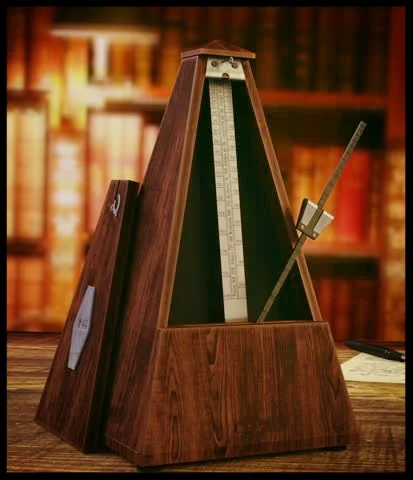
3. The metronome beats only on the first beat of the phrase. This will mean usually 4 bars, but depending on the music you could get away with 2, 3 or more. This is sort of an extension on number 4. It really tests your internal pulse and rhythm of the piece. Obviously the longer the phrases are the harder it is to land at the same time as the metronome. It helps identify phrases that might be dragging, or rushing. It also allows for some more musical shaping than the previous method, while still keeping a steady pulse. But be warned it sounds a lot easier than it is.
2. Set the metronome to alternative rhythms. I've been experimenting with this method since learning about finding and playing different jazz rhythmic feels. The main idea is to set some sort of irregular click going, something different to the main pulse and even sub-divisions, for example off beat quavers, a swung (tripletised) rhythm, a dotted rhythm or even something as simple as beat 2 and 4. In the first instance setting any alternative click to a piece will help solidify the rhythm, if for no other reason than it messes a bit with your head and you have to really concentrate on placing notes correctly.
More interesting though, is if you look really closely at the piece, where do the phrases lie, what is the rhythmic shape, what is the style and feel of the piece. Then choose a setting that fits into one of those elements.
I'll explain; for example if a piece makes a feature of triplets, setting a swung click will feed into those triplets and everything else will have to be carefully placed and fit into that same feel, unifying the whole theme, rather than the triplets sticking out.
Another example; a piece has a straight rhythm nothing unusual, but there are several semiquaver runs that start on the second half of the beat, stick on an off beat click, the runs will then start on a click, and everything else will move along with that same sort of syncopated feel.
Now these are just examples, and not everything will really work, but try some different things and you might find that some alternative rhythmic feel might inject a spark into the piece which is just what it needed.
1. Set the metronome clicks really really far apart. This one is taken directly from Richard Aaron's masterclass, and quite frankly it's genius, ever since, I have been using it often with many of my young students, his advice: to practice this regularly from an early age and it will develop a stellar internal pulse.
So the idea is to space out the clicks far apart, maybe 4 bars or more apart, then you listen to a couple, try and work out some subdivisions that work so you can clap on the next click - for most people, this is really hard. The trick is to keep a quick and steady internal pulse going in between each click keeping track of how many 'beats' or bars are in between. - Give it a go!
The students I've been doing this with haven't got it spot on yet, but they have improved dramatically at keeping a steady rhythm and following the beat in orchestra.
Remember - the metronome is your FRIEND. My advice would be to get a metronome that has many different functions, so you can set different rhythms, subdivisions and turn on and off beats and has the biggest range of speeds available.
A great app I use is Pro Metronome, has heaps of functions I need for free, and a heap more for purchase - the best thing, that you only purchase the bits you want, and not the ones you don't. Its available on the iTunes store and on Android.
And if you have any other nifty tricks you like to use , let me know in the comments section, I always love to learn new ways to make the most of my metronome!
String Theory
Not so long ago I invested in a whole set of new strings. Cello strings tend to last a fairly long time but price can be prohibitive. I started doing some research and there are so many to choose from and a wealth of information available, it can be confusing. I had to figure out what sort of sound I wanted and how that related to the technical aspects.
Not so long ago I invested in a whole set of new strings. Cello strings tend to last a fairly long time and the price can, I find, be prohibitive to change them more often than absolutely necessary.
That said, having broken my A string and realising I hadn't put new D, G or C strings on since, well, I couldn't remember, I decided it must be time for a whole new set.
At that moment it dawned on me, I'd only ever used 2 types of strings:
Jarger - that my first teacher had recommended to me - A (dolce), D & G (med), C (forte)
and Larsson - which the wonderful Luthier in Shrewsbury, West Midlands, where I bought George, put on for me when he set it up. (yes, my cello's name is George) - I used the same gauges as the Jarger for each string.
I had been noticing there was an edge on the upper register, it was sometimes difficult to get the sound warm enough to my liking and the A could be too bright and didn't balance well with the D, so not ideal.
So I started doing some research, firstly for a supplier. Strings in New Zealand are very expensive - even with postage I could be saving around 30% on what I could buy here by purchasing from the US or Europe. But that goes for a lot of things, I guess it often comes down to market size.
Then it was deciding what strings?
There are so many to choose from and a wealth of information available, from manufacturers, retailers, independant reviews....
At first glance this can be confusing, its hard to relate the technical aspects with the musical results, there are so many variables, core material, winding material, gauge. The information is there but I found I was going to have to filter and consolodate it to be able to understand and actaully make a choice.
“distringit librorum multitudo ”
So...from the back of my mind I dug up and dusted off what I learned in wave mechanics and dynamics when I studied physics - and worry not, I shan't try to explain much of any of that or for that matter quantum physics as this posts title suggests (as if I could!)
However the basics as I see it are:
- Strings must vibrate to make a sound
- The frequency (speed) of the vibration creates the pitch - you will probably be familiar with concert A being 440Hz.
- The amplitude (how wide the string vibrates) and rigidity affect the sounds tone.
Softer strings will produce a warmer more mellow tone, and are more sensitive to play (this can be an advantage and disadvantage) and harder strings are brighter and can have more stability in tone.
A lighter gauge string (thinner in diameter) will vibrate more freely, making the sound easier to start, but also brighter and possibly more delicate sounds can be produced
A heavier gauge string (thicker in diameter) can be harder to start the sound and get vibration, but there can be more depth to the sound, with a big and solid tone.

With all this to consider, figuring out what sort of sound I wanted was not as easy as I thought. I like a big sound, a big mellow sound, but a sound that rings out when I need it to. I want good responsiveness but also stability and evenness. - So basically the best of both worlds. - Most importantly though warm and big.
Now, reading as many descriptions and reviews as I could with these criteria in mind. I found combining different types of strings can work well to get a particular sound optimised across the various registers. There are some sites that sell mixed sets . As far as I could find cello-strings.com sells the widest range of combos to suit different requirements, and by buying a set you get a much better price than buying them individually.
So I decided on the CS-131 set, combining Thomastik Tungsten Spirocore medium C and G and Pirastro Passione light A and medium D strings. Only the A and D strings have an option to select the gauge.
I personally found their service very good, the strings arrived within about a week (almost quicker than local post) and right away I got to replacing the old with the new.
Initially, I was quite taken aback as the A and D not only felt really soft, almost like an elastic band, but the sound was ultra mellow, you would have said there was a practice mute on. Of course having read the reviews and the instructions on the envelope, I knew that the sound would take a while to settle in, but I wasn't quite prepared for how extreme this settling process could be.
On the other end of the scale, the medium C was considerably lighter than the heavy gauge, again, I knew this was to be expected, but it's funny what you get used to. Then putting them side by side, the diameter of the new string was, to the eye, half that of my old string. To play, the string was much more sensitive than I was used to, and having more or less never played on anything but a heavy gauge string, I kept over playing it. I was turning the amp up to 11 ... but the knob doesn't go that far ... as it were.
As time has gone on, everything has evened out. The A has essentially lost most of it's real mellowness (after several weeks) but is still sweet and well balanced with the D. The only down side is that it's extremely sensitive to rosin build up, which gives it a harsh edge, so I find I need to be a bit more sensitive on the A and clean it often, the same to a lesser extent on the D.
Not surprisingly given the lighter gauge of the C, it is a lot easier to play, particularly in the higher positions, which in the past I tried to avoid, it was never a clean sound - just too hard to hold the strings down past 4th position. It does require more bow sensitivity, but I've gotten used to that eventually, better still I can get a good resonant sound without so much effort, meaning that playing softly I can be a bit freer with the bow, it could be easy to get a choked sound with the heavier string.
Finally, with this new balance of strings the overtones are amazing, At first it was disconcerting, particularly between the G and C, the other string would be vibrating so much I may as well have been playing both. As with everything it has settled a bit, but there is still an awesome resonance, I know how to control it a bit more at least now. At certain gigs I've had since the new strings went on I'd have comments on the volume of my playing... but I really wasn't hardly doing anything ... all those overtones resonating everywhere acting like a big amplifier through the wooden floors.
I guess the moral of all this is to try something new. Even when you think there' not much to be improved, the right balance of strings might surprise you. Every instrument is different and the strings that suit one instrument may not another. Think hard about the sound you want and where it might be lacking, but be prepared to make changes to your playing style to adapt to the new resonances and characteristics of your new strings. Also...be prepared to not necessarily get it right first time - I know in my case, next time I will be trying a medium weight A string, and possibly D, that it might be a bit less sensitive and have a bit more body and 'grunt'.
Don't forget to share your own experiences with trialing new strings in the comments below
New Year's Resolution: A Practice Plan
New years resolutions that get made in the relaxed and festive 'bubble' of the holiday season, inevitably get forgotten, once the all the parties are over and the reality of life returns.
The antidote might be to make an actual plan - something to work towards and a way to get there. And what better than a plan for practice?
Last January I wrote about giving the practice routine a shake up and how simply going through the motions is simply not enough to see real progress. And I feel that despite periods of extreme time constraints, I have managed to keep up a level of focus, efficiency and precision with the way I practice.
Now, it seems any new years resolutions that get made in the relaxed and festive 'bubble' of the holiday season, inevitably get forgotten, are too hard or become totally impractical once the all the parties are over and the reality of life returns.
The antidote to this might be to not make a resolution as such, those idealist and far fetched notions; make an actual plan - something to work towards and a way to get there. And what better than a plan for practice?
Over the break, it's a great time to reflect on what you want to achieve in the year. I have had some time to do this and so far ... so good (albeit only 5 days in...)
So here we go (and actually write it down... you'll be able to refer back to it through the year and give yourself a big pat on the back when you've smashed them out at the other end of it)
1. Work out the top 3 things you want to work on, or rather think you need to improve.
If this plan is going to last a whole year it is better to be generalised things that you can work on in may different ways and apply to different things.
A year might seem a long time to work on something, but in the scheme of things, we spend many years trying to perfect our playing, so focusing on certain aspects of technique for one year is not so outrageous.
2. Brainstorm all the specific elements of that technique that are causing difficulties.
Try and be as specific as possible here, this will help focus the work to be done in the right places. Remember to think about physiological and psychological elements as well as the physical or musical elements of the technique itself.
Considering as many 'causes' or issues as possible to do with the technique can help dig down to the root of the issue, and to address the fundamental aspects making this technique difficult. we can also find links between the physiological, metal and physical elements.
3. Note down some ideas on which excersizes can be used to target these techniques.
This can be a small list to start with and can develop over time as the technique develops and improves.
REMEMBER - Scales can address a multitude of sins.
4. Consider what repertoire you can work on that will compliment your work on each specific technique.
Often we choose repertoire we want to play and then work on the appropriate technique according to those works. By turning it round we can search out new repertoire and find works that we might not normally approach, putting into practice the techniques we are working on.
This is a great exercise to plan and improve our own work, but also to do for/with students.
Often we get stuck into nutting out exam pieces, orchestral and school ensemble repertoire, and sometimes certain techniques can get neglected if they don't often arise often enough.
For new students, have these technical goals be a mixture of things the student struggles with and techniques that they really enjoy or come somewhat naturally. That way, the years work can include addressing difficult or challenging areas as well as advancing the mastery of others.
You can see here a list I made for my own practice regime, other areas to look at could include things like, sound/tone production, vibrato, rhythm and pulse, shifting, physical tensions, coordination, musical interpretation etc.
When considering a plan for more established students it would be helpful to look at all their strengths and weaknesses and shortlist what needs the most attention and is most relevant to what they are currently working towards.
We all know that making a plan to reach our goals is a great way to keep ourselves on track. All we need is for once to just stick with it!!
Music Literacy for all
Most classical musicians will learn to read music before or in parallel with learning their instrument. But it can be quite challenging, there are so many new and unfamiliar things to be thinking about. So, sometimes it gets lost, the theory bit that is. Many, especially the younger ones, just want to get on with the 'fun' bit - Playing. But as with many things, without some theoretical foundation, most people will be limiting themselves in the long run.
I had the great fortune recently to have some training in the Kodaly approach to music teaching. Now I am often quite skeptical of anything calling itself a "method", I find they can be contrived and rigid; good for young children to quickly learn to play an instrument, but in the same way a lemon juice and cayenne diet will shed pounds fast - it's not really a long term solution.
I discovered Kodaly is sometimes wrongly referred to as a "method" but practitioners expiate this misunderstanding, explaining that "approach" is a more accurate word.
Zoltan Kodaly pulled together many elements from musical traditions, education traditions, his own and others experiences. Because learning music has multi faceted developmental advantages, it teaches discipline, reading, writing, arithmetic, artistic expression, and so on; learning as a child helps develop effective thought processes, learning as an adult, it helps to reevaluate your thought processes.
Learning this new approach, I was challenged to reevaluate my own thought processes, both as a player and as a teacher. It was encouraging to see I had already been adopting some of the techniques, and others that had always shied away from, seemed ot make sense and have their place.
To me the Kodaly approach to music teaching is wider, and more inventive than traditional theory, which, lets be honest, can be very dull, particularly for kids (I used to dread Sunday afternoons, the theory books would come out as my mother dragged my brother and I unwillingly through the next chapter).
By breaking it into movements, sounds and other basic elements we are familiar with, often based around folk songs our mother might have sung to us, the theory of music becomes something we can relate to.
Kodaly is quoted to have said,
“Regarding when to start music education ‘Nine months before the birth of the child,’ ..moreover.. ‘nine months before the birth of the mother.’”
Music is steeped in tradition, and tradition is steeped in music. Every culture has musical roots that are entwined in the history of those people. Often times today in busy lives of a digital age, many of those traditions start to get lost.
I have spoken a lot about the music as sound in previous posts, practicing, listening, accuracy, feel ect. But not much about the music as a thing.
Most classical musicians will learn to read music before or in parallel with learning their instrument. But it can be quite challenging, there are so many new and unfamiliar things to be thinking about. So, sometimes it gets lost, the theory bit that is. Many, especially the younger ones, just want to get on with the 'fun' bit - Playing. But as with many things, without some theoretical foundation, most people will be limiting themselves in the long run.
Here are some examples, in my experience, of how understanding the music can be an advantage and improve your performance:
Sight Reading - the better you understand the written music the better you can read it. Producing rhythms more accurately, pitching intervals. You can play a piece of music without the laborious task of transcribing it by ear, and by memory.
Improvising - of course you can do this by ear, but unless you're fairly extraordinarily talented it will be a lot of trial and error. At least for me, it's a whole lot easier to read a chord chart and understand what notes can go where and how the chords fit together in a sequence.
Ensemble playing - if you can understand what is written on the page and structure of the music you can be much more sensitive and effective as an ensemble player, knowing when to bring out important bits or stand back and let others take the lead.
Composing - If you can understand the technical side of how music is written, you are better equipped to compose more interesting and complex pieces of music, to get the sound you want just right.
As I mentioned, in learning how to learn music, and therefore how to teach it, I have been thinking a whole lot more about what the music means, seeing what I hear, hearing what I see. I have become much more sensitive to those fundamental building blocks of what makes up the music.
So getting back to Kodaly:
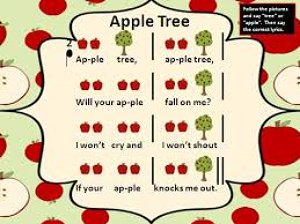
- Start simple, gradually building on each component, rhythm, pitch etc. so that the whole thing is not so daunting. Folk songs are the ideal place to begin, simple melodies and nursery rhymes that we are familiar with and are easy to pick up.
- Don't necessarily begin straight away with the music as it is written on paper. Using different shapes and colours, physical items you can use to build the music, other props, 'toys' and games to allow us to literally feel the music, and to see it written as something we can relate to. For example hearts indicating the beat, tugging on lycra that little arms can feel the pulse or passing a ball around the circle to show the need for a steady beat.
- Repetition. Using the same song to demonstrate at different times various aspects of the music, one time you might simply look at the pulse, another time perhaps the rythm and a third time the pitch. Equally, doing the same or similar activity with different songs. Always reinforcing the ideas, until they are second nature.
You can read more about the approach at these interesting links:
http://www.britishkodalyacademy.org/kodaly_approach.htm
http://kodaly.hu/zoltan_kodaly/kodaly_concept
http://www.kodaly.org.au/kodaly-concept/musicianship-tools/
Kodaly's intention was primarily to teach children, but of course it works for almost everyone. We all have different learning styles and being varied and diverse in our approach allows us to connect with the concepts regardless. Some of my adult students have been pleasantly surprised when playing with coloured ice-block sticks, rhythmic notation has suddenly made so much more sense.
I believe everyone can benefit from some music theory, no matter what your experience. Don't get put off by the thought of 'theoretical' study. There are so many ways to approach reading and understanding music. And if you're teaching think outside the box and let your imagination run wild. You will be amazed at what you can achieve.
Are you paying attention?
As we get back into work and school for the year it is the perfect time to start developing good habits... or renew the good habits that have been let slide over the holidays.
The key to successful and productive practice is routine and quality. I'm not talking about the quality of the playing but rather the quality of the practice...
Continuing on with the theme of practice, as we get back into work and school for the year it is the perfect time to start developing good habits... or renew the good habits that have been let slide over the holidays.
The key to successful and productive practice is routine and quality. I'm not talking about the quality of the playing but rather the quality of the practice.
Sticking to a regular practice routine is important in that, for one thing, if there are long gaps between your practice sessions it's a bit like taking one step forward, two steps back, as you forget what you were doing last time, and certainly your muscles have forgotten what they learnt.
Apart from that though, a regular routine helps keep you motivated, it becomes part of your day, something that generally you should look forward to. And by practising regularly, you achieve a great deal more, and can see, or rather hear, the improvements in your playing.
Quality is a slightly more abstract concept when it comes to practice. Unless you are practising something in totally the wrong way, for example playing the wrong notes, I think almost any practice is of some value. But certainly some ways of practising are more effective than others.
It is important to really pay attention, at all times. As I have said in the previous post, when your concentration starts to fade it's probably time to stop.
When practising any instrument there are many things to think about: Notes, intonation, rhythm, dynamics, form, tone, phrasing etc...... it is hard to be thinking about them all at once. So to help keep our heads from overloading, focus on one thing at a time. It might be a big shift, some odd intervals, a passage of fast notes, or very slow notes, or it might be all of these; break it down into smaller chunks.
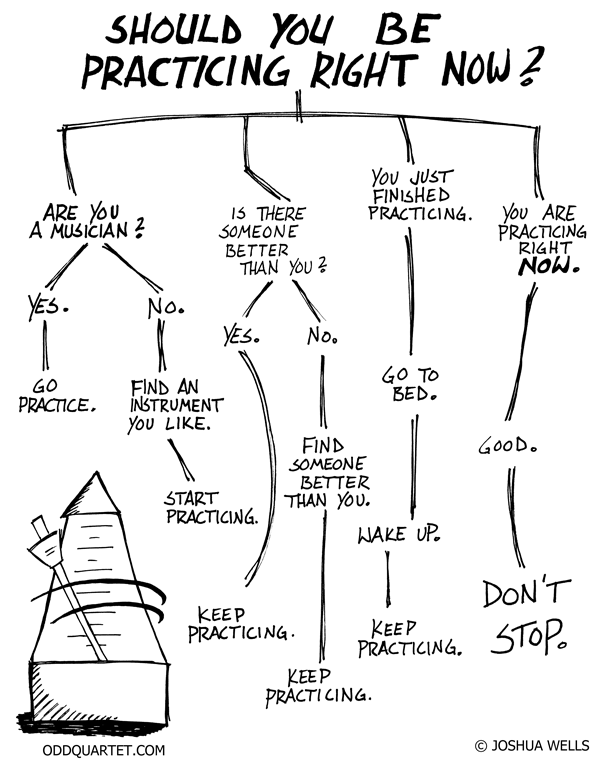
Perhaps quite a strict regime, but if you did follow this chart, you would get good fast!
- The shift or unusual intervals needs slow practice for intonation. Listen to a recording or play the notes on the piano of just that section, until it is set in your head. Really listen to the notes that you are playing. Sometimes, if you are really paying attention, bending the note slightly sharp then flat can help settle the true note into your ear. Once the intonation is solid, then start refining the sound, making sure the tone and dynamics are right. You might find that after adding dynamics you might need to work on the intonation again.
- For fast passages, once you have nutted out the intonation, start building up the speed. This really does require vigilant use of a metronome. Start slow, it seems obvious but you would be surprised, slow means slow, take the speed that you feel you can play it and reduce it by 5-10 notches. Now it's just repetition, gradually increasing the speed a few notches at a time (only when you have mastered the passage at the slower speed). You may find that you hit a wall at a certain speed, that's ok, you will gradually push it up further over time.
Practising with a dotted rhythm, and then the reverse rhythm is often very helpful in conjunction with the metronome.
These are just 2 examples of ways to practice specific elements or passages. Both involve much repetition and attention to detail. And that can be applied to all practice. The 3 time rule is also a good thing to stick by: to get something perfect 3 times in a row, is actually harder than it sounds, so you keep working it until you do.
The last thing I want to mention which I feel often gets neglected in favour of everything I have mentioned above, is the physical. Being aware of physical stance, posture, how you are using your hands, arms, face, is as important as the rest. You can't do the rest effectively without using your body in the right way. Pay attention to how it feels to produce the notes, do you have the right balance and weight in your arms for example, are you sitting (or standing) correctly. Notice how it feels when you get the notes right, not just how it sounds, it will make it easier to replicate next time.
This all seems like a lot of hard work I guess, and learning an instrument is, hard work, but also fun and rewarding and many other things besides. And remember you don't have to do it all at once. As I mentioned before, regular small practises are going to get you further than the occasional marathon. Alternate between the detailed practice and playing through (it keeps you in context of the bigger picture, and is usually more fun) and when time allows devote yourself to a big session.
Keep your goals in mind and remember nothing really worthwhile is particularly easy.
An Ear for Music - Part III
Learning an instrument can involve many physical challenges and it is often necessary to find a certain level of familiarity in navigating it before things like tone and accuracy can really be fine tuned. However, there are simple exercises that can be practised to simultaneously develop the ear that need only a little technical skill. These are just as important as learning where the notes are on the stave or where to put your fingers.
At the beginning, a new student's technical ability may not be strong enough to always play in tune. Learning an instrument can involve many physical challenges and it is often necessary to find a certain level of familiarity in navigating it before things like tone and accuracy can really be fine tuned. However, there are simple exercises that can be practised to simultaneously develop the ear that need only a little technical skill. These are just as important as learning where the notes are on the stave or where to put your fingers.
- Scales. These are critical in both technical training and ear training. A single octave up and down is achievable by most students after a few lessons. C major scale for example, having no sharps or flats, falls under the fingers easily. With guidance from a teacher, you can start to really hear the key of the scale, the tones and semitones. Remember 'Doe a Deer' from The Sound Of Music, this is a C major scale. Over time you progress to other scales D and F major etc. start to introduce minor scales, these have a different tonality again, the tones and semitones are different, and then increase to 2 octaves, and so on. There are many scales with increasing numbers of sharps and flats, and for a cellist, increasing technical difficulty.
Scales are not usually considered fun, but they are very useful and very necessary. Take them slowly, and really listen. It is important to adjust the notes as you go until they are in tune, if you can hear it's not in tune, that's great, but you need to be able to correct it too.
- Pitching Notes. Not all instrumentalists feel they can sing, but it is an important skill to develop for all musicians, even if you are never prepared to sing in front of anyone. You need to be able to pitch the notes in your head before you play them, otherwise once you have played the note and realised it's wrong , it's often too late. Brass players for example, must know how to pitch notes well as several notes can be made with the same combination of valves. When you sit music exams, there is a portion of the exams dedicated to Aural Tests. Whether doing an exam or not, these exercises are useful to practice these skills.
As a teacher I use simple exercises playing together with the student or using the piano. I have the student sing or play back a single note or short phrase. Progressing to finding intervals from a given note. So when you see the notes on the page you can have a very good idea of how it should sound when you play it. these can also be modified into fun games with younger students, using different media and tools, gives a variety to the lesson, and helps them to understand the written music better.
- Check. When you are practising at home by yourself it can be difficult to always be sure if you are in tune, as you are likely to have little to hear it in relation to. With stringed instruments we have open strings. When learning a new or difficult piece, look out for all the A's, D's, G's and C's (in the case of viola or cello) and each time you play these notes, check them with your open string, it may be at a different octave but you can clearly hear when the two notes are in tune.
When you are practising a big shift, use your note pitching to sing the interval (in your head) and then play the shift alone over and over until it is perfect every time.
It can also be useful is to play along with a recording from time to time. As mentioned in Part II, being very familiar with the piece played in full helps enormously to understand the tonality and intervals in the piece. When you play along with it , you will notice any notes that are not quite right. But this is not a substitute for careful and diligent practice.
From there it comes down to fine tuning each and every note. This takes time and patience, play the notes slowly, avoid vibrato, and listen really carefully. I find it sometimes helpful to bend the note a bit, roll my finger slowly back forth like a super slow-motion vibrato to force the note flatter and sharper, there will be a note somewhere in the middle that sounds just right, like fine tuning the radio.
A musicians ear is one of the most valuable things they have. At the end of the day it is down to the student to practice 'hearing' what they play, this actually goes for every musician at any level. It is one of those things you have to work at for yourself, no-one else can hear just what you are hearing, and it takes constant practice.
If you want some extra help there are a myriad of apps offering ear training, they generally test you on intervals, chords and other pitch related excersizes. Here is a review I found of 6 with varying prices and functionalities, but as I say there are loads of them, they will all help, just depends how far you want to take it.
6 Apps & Websites to get your Ear in Shape
Remember, even if you think you have a terrible ear, you can train it, it just takes time diligence and focus. I would love to hear of any other techniques that you might use, either for your own ear training or for your students. And I'm certainly open to any questions, this is a big and complex topic.