
Top Tips for Starting Online Music Lessons - Things I've Learned
This year has seen lockdown and social distancing measures put in place that have put many on a learning curve to deliver services in new ways. Face to face music lessons are usually a very personal experience. Here I share some tips from what I’ve learned in a month of doing online cello lessons, trying to keep motivation levels up and making the most of what we have.
“We are living in unprecedented times” and while there may be now some light at the end of the tunnel regarding lockdown, I suspect the COVID-19 pandemic will continue having an effect on our day to day lives for some time to come. Doing our bit, maintaining physical distancing, minimising travel will all help towards the greater good of our community, in not undoing our efforts so far.
That said, keeping some notion of routine, work and other activities, going during lockdown is very important, at the same time it can be challenging.
For me the first couple of weeks was ok, I'm normally out and about so much it was a welcome reprieve to stay at home. But life must go on somehow, and I have been lucky enough to be able to continue, to some extent, my teaching practice remotely.
I offered those who could and wanted to, lessons via Zoom. Having briefly dipped into online lessons in the past I found certain functions in Zoom are more favourable than Skype for example.
But it has still been quite a big learning curve for me and my students, and continues to be after the initial novelty has worn off. I have found there are a few things to really consider in order to make the most out of online music lessons.
#1 BE PREPARED
I cannot stress this enough, and not just regarding content but also the setup.
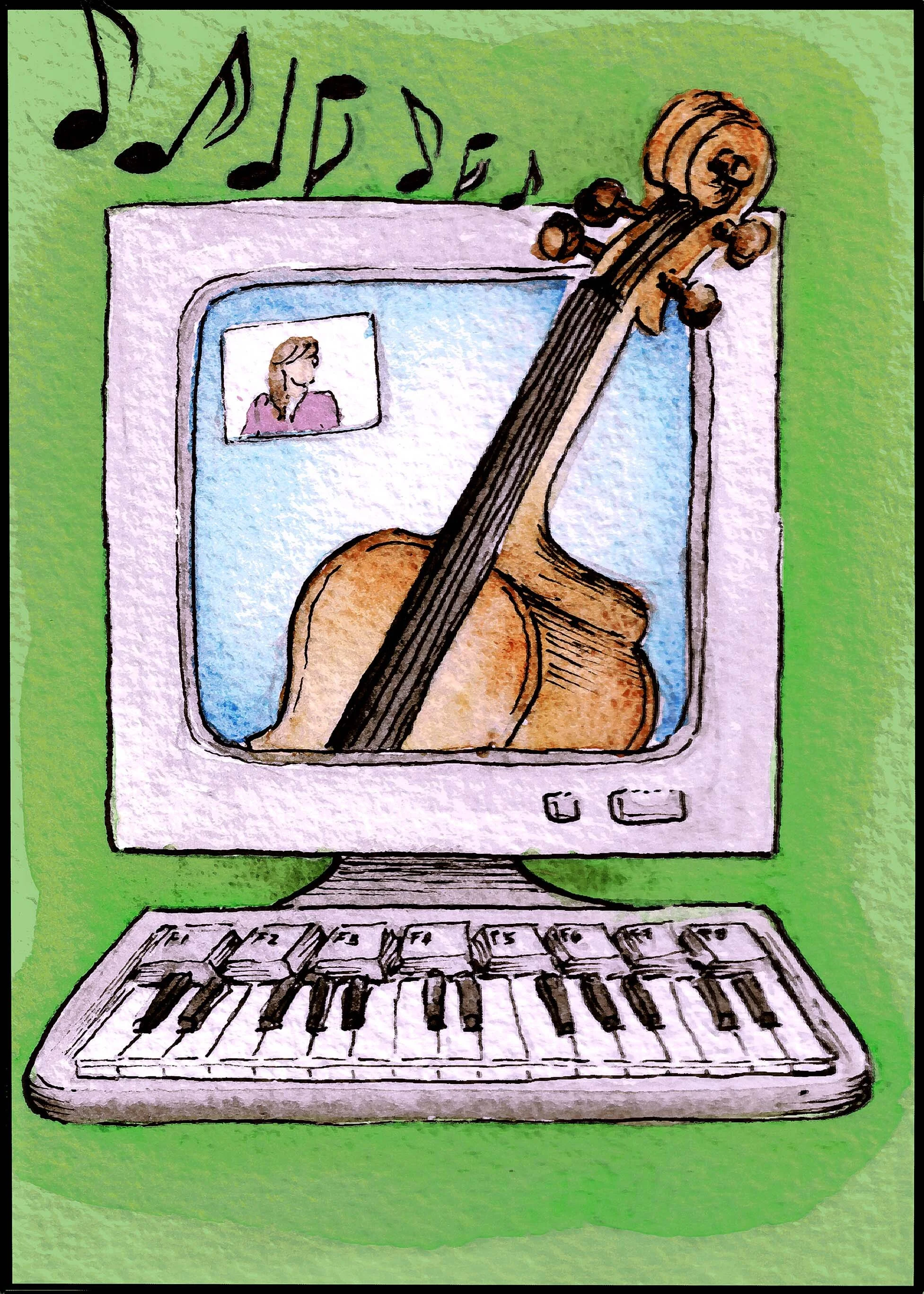
Find a place with as few distractions as possible.
Making this your lesson location helps with the routine, like "going" to a lesson.Position yourself
Somewhere that is well lit (facing the light, not in front of it) and putting yourself in the frame, not too far, keeping all the important things in view, fingers and bow etc.Set up early
From time to time there are inevitably technical issues that come up and if you find them out in advance you might just have a chance to solve them before the start of the lesson.Zoom has some easily customisable settings that improve performance during a music lesson:
Turn off the video enhancements to allow more bandwidth for the sound, for example any HD option or 'Touch up my Appearance', these can be un-checked in Video Settings, or Meeting Settings if using the mobile app.
Also important to 'Enable Original Sound'. This can be found under Audio Settings -> Advanced (or again directly in Meeting Settings on the app). This disables the echo cancellation and audio enhancing features, which tend to filter out instrumental sounds, particularly the low register in the cello.
Have material prepared in advance
It goes without saying really that teachers need to have copies of the students existing material on hand to reference during lessons.New material
I myself have the majority of my teaching material in books, scanning it takes time, and this should be sent to the student in advance so that they can print it out or have it ready digitally.Sight reading
Have it scanned and ready to pull up in a shared screen (but checking first what device the student is using, this doesn't work so well on a mobile phone)
#2 GET CREATIVE
With an online platform we don't get the same connection we are used to in face to face lessons. So we do have to think of new or adapted ways to keep inspiring and motivating each other, as well as ways to problem solve remotely where often we would get more hands on.
Given how visuals and sound can be more impaired over a video conferencing platform we have to make more effort to be very clear and concise (and talk slower) when giving instruction.
Setting specific goals for the lesson is always a good thing to do, but in this format it feels like we can be more effective limiting it to maybe one global goal, rather than chopping it up too much.
We can then think of novel ways of getting this understood when physical demonstrations aren't going to be as effective.
From a students (or parents) perspective it is important to point out any problems that you have noticed so that these can be addressed - it's not always evident from the other end of the camera.
Finally, get inspired by trying new things, most of us like some sort of routine, but when that can't happen, things that we normally do can start to feel too hard, too isolated. So trying something completely new can be a way to find a new perspective, and gives us some motivation to get past this.
Creating fun new resources, an animated PowerPoint to play along with, little activities to do in between lessons, can be great for younger students.
Exploring new techniques.
Encourage students to recording themselves playing, as a quartet using an app like Acapella, or play along with a backing track or a drum loop.
Try your hand at improvisation or even writing a tune. Teach some tips and tricks how to get started.
The possibilities are many and students will feel challenged and empowered, and will come out of it much better off even if it differs from the regular program.
The main thing is staying connected - to music, to the instrument and to each other.
Then, once we get through the other side together, our love and appreciation of the arts will be stronger than ever.
Further Reading: The Strad: How to set yourself up as an online string teacher
If you found this post useful please remember to click the like button, drop me a comment below or subscribe to the feed.
Keep Well, Keep Safe and Be Kind.
The year in review
A new year has begun, and I find it's a good time to reflect on how everything has been going, things that worked, things that didn't. I feel that this year, things have started to turn a corner in terms of work, but the big thing which I struggled with most this year was my brain. Mental health issues can be a big barrier to success, an obstacle on the journey. But with the right support and techniques there can be ways through, implementing those is top of the list for 2018.
A new year has begun, and I find it's a good time to reflect on how things have been going, things that worked, things that didn't. I embarked on this journey around 3 years ago now - how time flies - making the move from an office job, with long hours, that I no longer enjoyed, to put my efforts into this passion that I have had since I was small.
It certainly hasn't been easy. I sometimes miss the regular salary, routine and office banter, but if those were the pros, the list of cons would be much longer.
Leaving it all behind to focus on music hasn't always been sunshine and roses though. But, I have to remember that this is a journey, and journeys take time, the road can be windy and there can be many obstacles.
However, I feel that this year, things have started to turn a corner. Music is largely a business of personal networks. Jobs come through recommendations and word of mouth. These networks can take a while to build, but the more you prove yourself and become known within the right circles the more calls you get. And I have been getting more calls, with any luck this will continue growing in 2018.
My teaching practice has also been growing this year, and I have had some really fabulous students, who are just such a pleasure to teach. It reminds me that this is what its all about, seeing the little improvements in playing, development musically and as a person, and seeing the enjoyment that they get out of playing music. I have lost a few too, sadly, mainly due to external life factors, but it's all swings and roundabouts, hopefully a time comes where they can once again explore the world of music.

Artwork inspired by the song
"Many Rivers to Cross" (1969) by Jimmy Cliff
The big thing that I realised this year and which I struggled with most is that I, myself, my brain, is a barrier, an obstacle on the journey.
Thankfully mental health is getting more talked about in recent times, it was a big issue in the recent election here in New Zealand, more efforts are being put in to healthcare and support for those suffering. But I personally, still feel that it's not something we can freely talk about, fear of stigmatism, misunderstanding, pity, none of which are useful. When these reactions are in our working environments, well, I know first hand the repercussions of revealing a mental health condition at work....really not good..... so I don't....So even this is hard.
Mental health issues are not uncommon among musicians, perhaps the defective wiring in our brain is also what makes us lean towards artistic forms of expression.
But, it's a two sided coin. Being freelance means I can manage my own timetable and make it work for me, I can take on the work I want to do, and I am doing something I am passionate about. The flip side is financial pressures, self-management and promotional pressures. I really underestimated what it takes to create those networks, developing a (good) reputation, not to mention the study required to continually improve as a teacher, and of course my own practice regime. Challenging at the best of times, let alone on the days when, plagued with doubts, your self-esteem has gone out the window, you are suffering intense social anxiety and can barely manage to get yourself out of bed.
The effort can be exhausting, but I am so happy that focusing on a good lesson or having a great rehearsal or concert is a ray of sunshine on a gloomy day. I think there are some key factors to focus on:
1. Working out what it is you want to be doing, in the short, medium and long term. - set some goals to keep you on track.
2. Set a good routine as best as you can to keep well and working towards those goals.
2a. Schedule in time for relaxation and excersize, things that are totally unrelated to work.
3. Practice activities to help keep positive and have realistic expectations on yourself.
So this is my plan for 2018: Set achievable goals, create a realistic routine to get things done, prioritise exercise (this one is critical for me), be more consistent with practice, work efficiently but don't underestimate the time to complete things, read more books.
The road may be long, there are many rivers to cross, but I really believe that if you want something you will find a way to get there, eventually, in some shape or form. Despite the inevitable competition among musicians, we are all linked through this art form and we need to support each other. Please feel free to share your own experiences in the comments below.
The journey continues....
Online Yoga Class Review - Musicians recommendations
A few weeks back, having grown a little tired of my current yoga program, I started exploring some of the different yoga channels on YouTube, just to mix it up a bit.
I found this one great channel and wanted to share it because there are a couple of routines that I have found so useful to relieve some of the stresses and tensions of playing.
Last year I wrote a piece about keeping fit and how important it is for playing music to avoid injury and pain related to long hours of work and the repetitive movements. If you want to, you can read the whole thing here Just Do It - How and why to get fit and play music.
A few weeks back, having grown a little tired of my current yoga program, I started exploring some of the different yoga channels on youtube, just to mix it up a bit.
I found this one great channel and wanted to share it because there are a couple of routines that I have found so useful to relieve some of the stresses and tensions of playing.
Last year I tore a ligament in my wrist and after many weeks in a brace I lost alot of strength and had to do a number of exercises the physio gave me to strengthen it, which did the trick nicely. I did find though that the wrist was getting tight, especially after a lot of playing. Happily once I started doing this routine, Yoga for Wrists & Fingers, most of that tightness has gone.
I try to do it regularly before and/or after a practice session or rehearsal. It really stretches out through the whole hand and fingers, wrists and forearms, leaving the hands much more nimble and elastic, just how we want them to be. All in the space of 11 and a half minutes!
DO BE CAREFUL, when we're using our hands all the time we need them to be in tip top condition, don't over do it by trying to push past your edge where it starts to be painful, especially with the last couple of poses, it can be easy to go too far. Over time the flexibility will increase and its just not worth the risk of wrecking your hands.

The other fantastic routine I found targets another area many musicians have trouble with, that is the upper back and shoulders. I find most Yoga routines focus largely on the lower body and core, and posture in general, but not necessarily really digging into that area which really holds a lot of the tension (despite our best efforts) when we play.
Yin Yoga for Neck, Shoulder & Upper Back Tension Relief really pulls everything back into place. Its a very slow and meditative practice where you breathe deeply and just sink into each pose without forcing it. I find it amazing to do just before bed, it's very relaxing, releasing tension in the neck and shoulders, not to mention in the mind as well.
I tried a number of different peoples yoga classes on YouTube and they each have their own style and merits. I like the pace of Yoga with Kassandra , she gives clear and succinct instructions for each pose without unnecessary chatter, allowing you to focus on the pose and your own breath. Always giving a variety of options to suit different levels of flexibility, the classes are simple but at the same time cover a good range of poses that you finish with an all over zen feeling, particularly after the Yin Yoga Classes. (One night after a Yin Yoga for Sleep session, I did actually end up sleeping unintentionally on my yoga mat! - pfff who needs beds)
The only slight down side is the music that pauses sometimes between loops, but that being said, it is fairly unobtrusive.
If you are looking for some exercises that will relieve some of the tension and pain in any of these areas, particularly if you are sitting for long periods at rehearsals for example, I would really recommend giving these a go, I think you will find they really hit the spot.
Remember if you like these posts, to subscribe to the RSS feed by clicking the link at the bottom and always feel free to leave comments, I love to hear your thoughts.
Mindfulness for Musicians
Most of us know music is an artistic, emotional and often spiritual expression of ourselves. Listening to music can get us excited, cheer us up, it can equally be relaxing and conciliatory.
Playing music can be a reprieve from the daily grind but we can put enormous pressure on ourselves, and this can result in a lot of tensions and anxiety relating to our music.
There has been a lot of publicity about 'Mindfulness' in recent times, I find the idea of focus in the moment and non-judgmental awareness fits in very well in music practice.
Most of us know music is an artistic, emotional and often spiritual expression of ourselves. Listening to music can get us excited, cheer us up, it can equally be relaxing and conciliatory.
Playing music can be a reprieve from the daily grind, it can lift our spirits and be an emotional outlet. But as musicians, whether starting out or trying to make a living, we can put enormous pressure on ourselves, and this can result in a lot of tensions and anxiety relating to our music.
There has been a lot of publicity about 'Mindfulness' in recent times. It has become trendy, seems like everyone is jumping on the bandwagon so to speak. While I do not agree with all of it, having read bits and pieces on meditation, mainly from a Buddhist tradition, along with various ideas and strategies to improve mental health, I find the idea of focus in the moment and non-judgmental awareness fits in very well in music practice.
In today's world of constant pressures of work and life, everything moves so fast we hardly get time to notice. Mindfulness brings back to us this awareness of ourselves and our surroundings, experiencing every moment. Giving us a break from worrying about the past or the future.
Music too is like this, a great piece of music can hold our attention and draw us in to the moment. The cliche of the 'tortured artist', isn't always too far from the truth. There are many things that can be easier to express through art or music than actual words, for whatever reason. But we can still find ourselves putting pressure on ourselves to practice more, to perform better, and this can get very frustrating, to the point that it's no longer enjoyable, or good... the more frustrated we get the worse it sounds.

Incorporate some 'mindful' activities to combat these moments:
BREATH
Practice breathing,
1. While still and;
2. While slowly making the movements that you use to play.
Unless you actually need to breath to play, for example, singers, wind or brass players where the music is going to determine much of your breathing pattern. Others such as string players, pianists, guitarists, percussionists, harpists etc... we must make a conscious effort to breath.
Try this: Play a simple exercise such as a scale. Practice breathing, much as you would control your breath whilst running long distance, time your breath in and out with the movement of the bow or per octave.
As you do this, feel every movement, notice every muscle, how it moves, if it is holding tension, is your weight distributed evenly, is the weight being transferred as it should be into the instrument.
As you notice each of these things, try to adjust them, release the tense muscles, transfer the weight, economise and optimise your effort, control the movements.
The next thing you will be noticing is the quality of the sound as you make these adjustments, hopefully it is improving, but perhaps at times it is not, continue adjusting, focusing your attention on that area.
Note that this is contrary to the main principle of mindfulness; being that you notice all , but make no judgement. But, in order to improve our playing, the practice session must have some critical objective judgement involved. Use specific and descriptive words when you do this exercise ie. the notes could be more smooth, or the sound more even. Try to avoid pejorative terms.
This can in some sense be likened to the practice of a walking meditation. Noticing the movement and feel of muscles and senses.
FOCUS
A lot of meditation practice is about discipline, focus and concentration. This certainly holds for music practice too.
- Try to make sure you have as little distractions as possible that may interrupt your flow.
- Set an alarm for a certain amount of time to work on an activity. This is especially useful if you have limited time available to practice and makes sure that you can cover everything you want to and don't get stuck on one particular thing. For example working away at a particularly difficult exercise, the alarm goes to remind you to move on: you avoid getting to a point of frustration and start to undo your good work by over-working it.
- Try to notice how many times your mind drifts away from what you are playing during each exercise or piece. Even the fact of deciding to do this can help focus your mind on what you are playing, and if you notice there is more drifting than focusing, you might have done enough for the day.
- All this focus can make for very good quality practice, but it can be mentally tiring. Take little breaks, just for a minute, stand up, walk around, then get back into it. And... know when your done - if you've lost concentration it can be counter productive. (See previous point). You know your ow limits and how long you can maintain effective concentration on one activity.
VISUALISE
Visualisation is as important in practice stages as in performance and it is a two fold concept:
1. Visualise in your mind how the piece is going to sound, how does the very first note begin, hear it in your mind, think of the pulse and rhythm the tone and dynamics. Visualise the movement of your bow and fingers and hear the sound that is produced. take a couple of good deep breaths, feel everything relax in.
2. Visualise the piece in your mind before you start , feel the surroundings, you are aware of your audience yet not thinking about them. Draw on your musical inspiration from some imagery you can associate with the music. Focus on any accompaniment to bring your attention to the music. Always be thinking about the line you are playing, not worrying about a really hard bit on the next page or that high note you missed a few bars back, absorb yourself in what is happening now.
PERSERVERE
Almost everything is difficult at some point and there are times for all of us that certain things seem well beyond our capabilities. Perhaps they are, but it doesn't help to throw in the towel. As my mother often says, "take a deep breath, and get on with it".
Well... yes, easier said than done in the context of practicing. But do BREATH, deeply and slowly feel the air through your nostrils, filling your lungs and breathing out feel everything relax and sink down. As many times as you need, then go back to what you were working on, but this time taking it back a notch, break it down, processing every movement and note with a careful awareness.
Even if it is not as fast or loud or whatever it needs to be, as it was before, you are still better off. Psychologically, you finish the session playing it well, you feel better about coming back to it next time.

If all his is very unfamiliar to you Mindfulness in Plain English by Venerable Henepola Gunaratana is a very good, easy to read and practical book to get you started.
Also check out your local Buhddist Temple, they often have meditation and mindfulness courses or will welcome you to attend a session. You don't hve to buy into all of it, but you will get enough understanding of the practice to apply it to your own practice.
Just Do It - How and Why to get fit and play music
Musicians are athletes of a sort. Producing music can be extremely physically demanding, not in the same sense as a marathon runner or a footballer, but it can nonetheless be very demanding on our body. So when i comes to getting fit, the 'Why' is easy; improved physical well being, improved mental well being, better stamina, endurance, focus, alertness, strength. All things that are certainly useful when faced with a grueling rehearsal and performance schedule.
The 'How' is not so straightforward to answer....
Musicians are athletes of a sort. Producing music can be extremely physically demanding, not in the same sense as a marathon runner or a footballer, but it can nonetheless be very demanding on our body. So when i comes to getting fit, the 'Why' is easy; improved physical well being, improved mental well being, better stamina, endurance, focus, alertness, strength. All things that are certainly useful when faced with a grueling rehearsal and performance schedule. The 'How' is not so straightforward to answer, it depends a lot on us as individuals as to what we need and like to do. One thing is sure, when we are plying music, sitting or standing for long periods of time using the many muscles in our arms and hands and each instrument uses different muscles. But they tend to be the smaller more delicate muscles and the essentially repetitive nature of the movements, if we're not careful and don't do it correctly or without adequate training and fitness we can do ourselves serious injury.
Here's an interesting interview about just that thing with some of New Zealand's leading musicians:
http://www.radionz.co.nz/national/programmes/secretlife/audio/201760118/the-secret-life-of-musical-injuries
In the last few years I have made it priority to get, and stay fit, and I must say I feel great, I'm more alert, have more energy. And, having had problems with my hands in the past from bad posture and overuse, I am very aware of keeping good form when I am playing, and exercising. However a recent lapse of concentration combined with over-enthusiasm at Bootcamp has left me with a wrist injury. And a brace for 6 weeks to go with it. All being a big wake up call that I do have to take care of myself.
This has made me reflect on how important good exercise is and how we mustn't push the limits too far when we rely on our hands in particular to play.
With everything in our body being connected, we can do various types of exercice on different muscle groups and see beneficial results in other areas as well. For example, improving our cardio fitness can have many benefits to our health, and is generally not too risky on our playing. Cardio, or cardiovascular exercise, is the kind that really gets our heart pumping. Something like running, skipping, or stairs for example will quickly increase your heart rate. Getting the blood pumping round efficiently, gets more oxygen going round. Better circulation can help us play faster, longer, all the things that any other athlete will benefit from with an increase of oxygen in the blood.
Cardio is also great for your brain, keeping you sharp and focused, not to mention the increase in 'happy' hormones in the brain, which are always useful to get through a grueling practice routine.
Certainly mix it up, it's more effective if your body doesn't have a chance to get used to doing one thing all the time. So it's a good idea to combine some strength and endurance training with the cardio. You don't need massive weights to improve your strength, body weight exercises do just as fine, we really don't need massive guns to play the cello and working with too heavy weights can do serious damage, but some good muscle tone in our arms can help a lot. Endurance training is great, if we are going to survive hours of practice and rehearsal. And throwing in a bit of high intensity intervals will improve recovery rates. It's all about being in the best physical condition we can to be able to put in the energy we need to into our performances.
On of the most important things however is posture and balance. When sitting or standing for long periods of time rehearsing, we are exerting a lot of energy, but we remain for the most part stationary. With bad posture, weak balance and core strength there are many things that can go wrong over a long period of time, neck or back injury, overuse syndrome, trapped nerves .... these can be extremely serious especially when performing essentially repetitive movements for long periods of time.
I would recommend at least doing some Yoga or Pilates. Or if you're keen, do it as well as the outdoor training!
I must stress that it's super important to do these types of positions correctly, so going to some classes to begin with is a good idea. I have practiced both Pilates and Yoga but at the moment I'm enjoying the calming and mental stamina of Yoga. It is excellent for stretching out.... well, everything.... releases built up tension in your back and shoulders, builds core strength, balance and most importantly of all, awareness of your body and form. So that in time, through long rehearsal sessions you can be noticing any tensions that are building up, and relaxing, rel time, so that it does not become a bigger problem later on. Yoga also works well on improving breathing, and breath control, which is essential for every musician, and is often, especially with string players, neglected.
If you have particular issues related to playing it is worth investigating the Alexander Technique. Many musicians use this to correct bad playing position and other strains and long term injuries. Here is a link to some further information:
http://alexandertechnique.com/
For me, many of the principles of Yoga align with those of the Alexander technique, however Yoga does not have the same level of hands on reconditioning with an experienced person showing you how to hold and position yourself, and of course it's much more targeted in its approach.
At the end of the day it's a personal choice. But for general well being, we all should practice some physical activity. It improves your physical and mental health, helps you play better, longer and faster. We must though, look after ourselves, if we do too much and injure our hands it can be a long recovery, and all the tiny and repetitive movements required to play music can have unexpected outcomes if we don't maintain good balance and posture.
So, just get on with it... the hardest part is always putting on your running shoes.
Here are some other interesting articles with varying opinions to help you decide what type of exercise is best for you.
http://billplakemusic.org/2014/04/10/fitness-and-exercise-for-musicians-choose-wisely/
https://blog.key-notes.com/a-musicians-fitness-routine.html