
Review - Metronome App - Pro Metronome for iOS
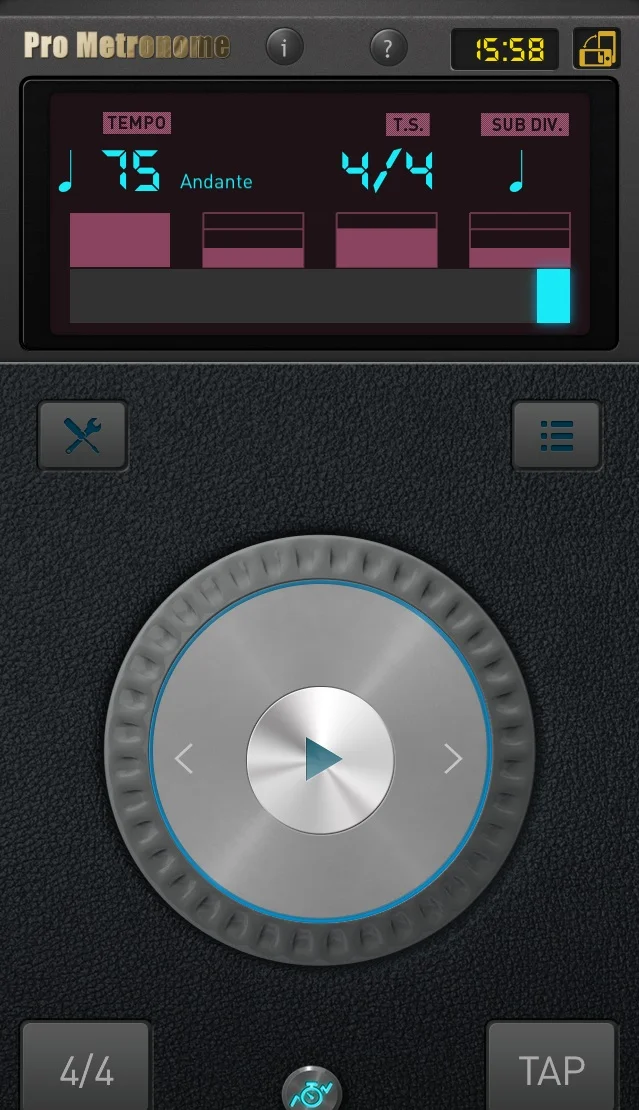
Given that I talk a lot about using a metronome I wanted to tell you about the Metronome App that I use: Pro Metronome by EUMLab
I have looked for other metronomes which can do everything I want, but I can't find one except for Pro Metronome.
So, given that I talk A LOT about using a metronome (often to the sound of student groans) I thought I ought to tell you about the Metronome App that I use: Pro Metronome by EUMLab
Midway through last year my ancient iPhone was dying a slow and painful death. I couldn't quite justify a whole new phone at the time, so I started looking for a metronome which could do everything I wanted it to do, basically what Pro Metronome does - I couldn't find one, at least not without costing me a fortune.Eventually I had to bite the bullet and got myself a shiny iPhone 6 SE - the first thing I installed was...Pro Metronome.
It has a fairly comprehensive set of basic features:
- 13 different sounds + mute/light only so chances are you'll find something you can works with.
- You can set the number of beats (1-16) and time signature (any note length from semibreve down to demi-semi quaver - whole notes to 32nd note)
-Each beat can be controlled individually with 3 levels of sound as a regular beat, sub accent or accent, you can also mute any beats.
- Alongside the beat display, there is a visual light display that can be customised in several ways , from only flashing on accented notes to flashing different colours on all the different levels of beat. Personally I prefer the pendulum mode as when I'm working with some tricky rhythms it gives me some visual anticipation for the next beat.
- Pro Metronome features an impressive speed range from 10-500bpm, combine that with the ability to mute beats and it's really gives a lot of scope to play around - super useful when your trying to work on your internal pulse.
The App has a number of paid add-on features, that you can buy as a bundle (NZ$6.99) but you can also purchase individually (from NZ$1.69), which I think is really good of EUM to do this as I don't necessarily want to pay for features I'm not going to use.
-Sub Divisions:
I use this all the time, as the name suggests, it lets you hear different subdivisions to the beat. There are up to 16 rhythmic variations to choose from, including off beats, syncopations and triplets.
I find this really useful for speed control, rhythmic accuracy and what I call cognitive confusion (I'm sure there's a proper term but I can't find it) where in order to play something straight and even, you practice against an alternative rhythm making it harder to play in time, so when you play again normally it feels easy.
You can also overlay a regular beat click using the accent levels. For example I might set the subdivision to offbeat semi-quavers and set an accent on just the first beat of the bar to keep my own internal beat in check.
With such a large number of combinations, there is something for every style.
-Practice Mode
Another useful paid feature I recently started using. I find it very useful for practising short exercises or passages that are easily repeatable.
I have been mostly using Automator - you can set the duration for each tempo by time or bars, then pick a start tempo and a target tempo and the increment which to increase each round. It then gives you an approximate time to complete. This is great to use as a warm up on a scale or short repeatable exercise, a bit like a musical beep test (but more satisfying and less competitive than the gym version). The only improvement I'd like to see here is that when you press start there be a count in. Using it for a continuous warm up activity, between pressing the start button and having my bow ready to play I miss the first couple of beats - but not a huge issue when I start slow and will be repeating it many times anyway.
The Warm Up setting is a bit more fiddly, for my purposes at least. Here you can set a tempo and then set multiple sections where you choose a multiplier for the tempo (faster or slower) and a time. Given that the things I play have a set number of bars, setting the time is not as useful. It does indicate how much time equals a bar at the given speed, but I found you still have to do a bit of maths so that rounding doesn't catch you out and you have to skip the last half beat of the bar.
It is still a very useful tool, and you do have a bit more control than automator to speed things up and slow down as you wish.
Other paid features are available like Polyrhythm, letting you play multiple rhythms simultaneously and Rhythm Trainer which mutes certain bars to train your internal pulse, but I haven't used these. There is also a tone generator, but I have a specialist Tuner app which I'm very happy with.
On the whole I find the app very user friendly and intuitive with swiping and tapping both getting you to the different menus. The tempo is easily controlled, with multiple manners to adjust it, including a TAP button. The display is clear and simple, and most importantly the sound is loud and clear. I would definitely recommend this app to anyone wanting to work a bit more seriously with the metronome.
You can download Pro Metronome from the App Store
For Android and iOS
If you found this post useful please click the like button below. If you have any questions or comments about this or any other metronomes do leave a comment underneath, I’d be happy to open up the conversation.
I do reviews for practice tools, concerts and other things from time to time, so subscribe to my feed to get the latest updates.
2018 - A Year to Remember?
Another year has come to an end, 2019 has dawned. I always find this a good time to reflect, looking on what went well and what could be iimproved. This past year, there have been many ups and downs, but highlight of the year, was playing the Saint-Saens Cello Concerto with the Philharmonic Society Orchestra.
Another year has come to an end, 2019 has dawned. I always find this a good time to reflect, the warmer weather is here, we are stuffed full of treats from Christmas and probably indulging in a few wines in the back yard.
As I recall this past year, there have been many ups and downs, my teaching practice took off, there were many interesting performances, and, having set substantial goals for myself, I was very motivated to practice.
A highlight early on in the year, was playing in the theatrical piece "Think of a Garden", met some fabulous people, played some interesting music and was honoured to be involved in such a dramatic production.
To get some of the lowlights out of the way. I was a little what one might call 'a victim of my own success'. I was called upon at the last minute to take over cello lessons at 2 new schools, that alongside an increase in private students and a period of intense rehearsals, I was totally exhausted, resulting in a (very minor) car accident, it was the shock more than anything. At the time I was averaging around 220km per week in my Honda Logo, such a great little workhorse. It got a much needed wake up call, that we cannot do everything and we need to make sure we are looking after ourselves, especially when our schedule is full to bursting.
Another thing of equal parts plus and minus, was that surges of new private students meant that I actually had to make a waiting list and even turn some people away. I did consider extending my hours, but decided it would be counterproductive - I didn't want to risk any more accidents!
I guess THE highlight of the year, was playing the Saint-Saens Cello Concerto with the Philharmonic Society Orchestra in August. I'm the type of person that needs concrete goals to work towards, and for a performance musician, that means... performance. I can learn a particular piece, or work on technique, but if I don't have the culpability of actually performing soething in front of an audience, I find it difficult to stay motivated.
Believe it or not, this is the first time that I have learnt a work of this magnitude in its entirety and to performance level. There is an awful lot of work involved. Which I put in over a long period of time. My timetable as it is, this seemed the most reliable plan of attack, not to mention a work like this needs an element of maturity, much like a good Bordeaux, to be truly at its best.

In preparation, I found it best to look at it from many angles, the concerto, while not in movements as such, has several distinct sections, which can be worked on as bite size chunks. Rhythm, tone, style and speed were all elements that needed attention. There was a lot of work done with the metronome, which paid off in the end as far as the orchestra were concerned, however some may have considered it a bit too square.
In the process I sought out to have some lessons. Sometimes you just need someone else to point things out. Andrew Joyce, principal cellist in the NZSO, was so inspiring, his enthusiasm and passion emanates in all directions. He was very helpful in giving some ideas for the quick passages, preparing the left hand better and deciding on some phrasing right from the outset, often this is something I add in later on, especially for technically tricky bits. I also had the pleasure of working with Edith Salzmann, cello professor at the University of Auckland. She too was very encouraging, pointing out how there comes a point where we should shift the focus from the left hand to the bow, the fingers can do their thing essentially on autopilot, and sound production will be optimal. She also advised me on the importance of 'leading' the orchestra.
As the concert date drew nearer there were many times of doubt and nerves, but finding the will to keep chipping away, I knew somehow it would all come together.
The performance itself was the most emotionally and physically draining thing I think I've ever done. By no means perfect (at the previous rehearsal, I'd peaked too soon), but good enough. The audience loved it, I was literally trembling at the end, played a short encore of Bach Sarabande from Suite II, then as recent tradition dictates (round the cellists I know) I joined the back of the orchestra for the second half - a symbolic effort only, as my brain had crashed entirely.
In the days following a serious come-down ensued.
So now looking ahead...
As far as performance goals, I do have something in mind and will certainly be sharing that with you as it unfolds.
My main goal for 2019 is to keep on top of my timetable, being rigourous with planning and organisation, so that I minimise risk of things falling through the cracks, also benefitting my students, and being careful not to take on too much. And, just as importantly, keeping fit and healthy, more regular exercise (also for my poor somewhat neglected dog), and eating healthy which also requires forethought and preparation especially on those rehearsal heavy weeks.
As always if you enjoyed this post please click the like button at the bottom and subscribe to my feed. If you'd like to share your goals for the coming year or you have any questions, just add them in the comments section below, I love to know what your big plans are for 2019. Let's make this another great year to remember.

Review - Johannes Moser plays Shostakovitch with the NZSO
This last month I've had the good fortune to be able to satiate my appetite for the works of Shostakovitch. This past weekend, German-Canadian cellist Johannes Moser and the NZSO performed a phenomenal rendition of Shostakovitch Cello Concerto No. 1.
This last month I've had the good fortune to be able to satiate my appetite for the works of Shostakovitch. Firstly with the Borodin String Quartet on their New Zealand tour, with a fabulous performance of Shostakovitch String Quartet no.9 at Auckland’s Town Hall. On this occasion I was lucky enough to get seats in the circle overlooking the stage, here we could really feel a part of the drama, the serious determination and passion really gave the impression blood had been spilled. I was particularly drawn in by the extraordinary cello solo accompanied only by the light tremolo of the upper strings.
I then attended this past weekend's performance of the Shostakovitch Cello concerto performed by Johannes Moser and the NZSO.
Once again at the Auckland Town Hall, the city’s premiere classical venue. Tickets are pricey though, especially with all the added fees, so this time we were at the back of the stalls, but it didn’t matter, the sound was great and although I do like to observed peoples technique, I couldn’t help but be overwhelmed by the energy, even at that distance.
The concert started with the Borodin Overture to Prince Igor. This was a delightful entree, as with any fine meal, the entree should be not too heavy but enough to whet your appetite for the main course, this did exactly that. As someone said to me, it could have been the soundtrack to a western, it did have that kind of feel.
Johannes entered the stage to great applause wearing all black, his top, half something shiny (vinyl maybe?), reminiscent, I thought, of Star-trek, a welcome variant to the traditional tails. My thoughts were that this guy is a bit of a rock star, I would not be disappointed.
This first concerto by Shostakovitch was written for Mstislav Rostropovitch in 1959, who remarkably memorized it in just 4 days. There is so much complexity both technically and emotionally in this work, listening to it I find myself being put through the ringer, to play it, undoubtedly even more so.
From the first opening theme, the passion and vigour with which Johannes plays is evident. He is an extraordinarily physical payer, but not in a forced or pretentious way. He appears to be enacting the music, he and his instrument are one being, and the sound and energy is mind-blowing. Fairly near the opening, one particularly wide and energetic bow release knocked the concertmasters stand, recovery was instantaneous, there was an authenticity to it, sometimes unexpected stuff happens, I like that.
The second movement follows with a dreamy folk like melody, where the first movement was smacking you in the face repeatedly, this has a weeping, heartfelt type of intensity. Johannes transitions seamlessly between the light, almost hopeful and innocent themes, to those darker and more intense, his presence soaring above the orchestra even in the most delicate of moments.
The movement culminates in the theme once again but this time as flawless and haunting harmonics. When I’ve taught my young students to play harmonics for the first time often their reaction is that they sound scary, like a horror movie. I don’t recall ever hearing them that way, until now. It was terrifying!
Clearly not everyone around me was as transfixed, with all the shuffling and wriggling and squeaking chairs, it was quite off putting.
The cadenza which follows essentially takes the form of an unaccompanied third movement. Critic Lev Ginzburg reportedly described it as a monologue-recitative and a deep meditation. I really felt it, more so in this performance than any recording I've heard, perhaps that is the magic of live performance. This was a truly magical performance, I was mesmorized (restless wrigglers notwithstanding)
I'm not sure if it was written to be comical, but the jumping five note runs leading in to the 4th movement lead me to start giggling. I wonder if it was more a reaction to the nervous energy, the way some people start laughing as a defence mechanism when witnessing something gruesome. Johannes and the NZSO had me so immersed in this music that this type of visceral reaction was inevitable.
The final movement burst forth with the same, if not more, raw passion and energy as the first. There was a fabulous connection between the soloist and the orchestra. Johannes physically connected with the a players, they were connected as people as well as through the music, we don't always see that, and it really elevates the overall experience.
At the conclusion, to a rapturous applause, the only word I could utter rhymed with duck, it was such a phenomenal performance, I was otherwise speechless.
The encore came shortly after, apparently to "clear the air" They played Elegy by John Williams, indeed a very beautiful work, still full of sadness and anguish. But on second thought anything lighter and more uplifting would have been incongruous.
The second half the NZSO played selections from Prokofiev's Ballet Romeo and Juliet. I am a big fan of Prokofiev and love to hear the Dance of the Knights. But for me there was something lacking in this as a programme choice, despite the intention as a stand-alone work, it felt disjointed and long. I would have preferred maybe one of Prokofiev's Symphonies to keep the momentum going.
All credit to the NZSO it was a massive play and under the baton of Peter Oundjian, his debut performance with the orchestra, they gave us a stunning evening out.
Courtesy of RNZ National
After the weekend of concerts, Johannes did a great interview on RNZ with Kathryn Ryan that you can listen to here. What in interesting person, his character clearly comes through in his playing.