
Top Tips for Starting Online Music Lessons - Things I've Learned
This year has seen lockdown and social distancing measures put in place that have put many on a learning curve to deliver services in new ways. Face to face music lessons are usually a very personal experience. Here I share some tips from what I’ve learned in a month of doing online cello lessons, trying to keep motivation levels up and making the most of what we have.
“We are living in unprecedented times” and while there may be now some light at the end of the tunnel regarding lockdown, I suspect the COVID-19 pandemic will continue having an effect on our day to day lives for some time to come. Doing our bit, maintaining physical distancing, minimising travel will all help towards the greater good of our community, in not undoing our efforts so far.
That said, keeping some notion of routine, work and other activities, going during lockdown is very important, at the same time it can be challenging.
For me the first couple of weeks was ok, I'm normally out and about so much it was a welcome reprieve to stay at home. But life must go on somehow, and I have been lucky enough to be able to continue, to some extent, my teaching practice remotely.
I offered those who could and wanted to, lessons via Zoom. Having briefly dipped into online lessons in the past I found certain functions in Zoom are more favourable than Skype for example.
But it has still been quite a big learning curve for me and my students, and continues to be after the initial novelty has worn off. I have found there are a few things to really consider in order to make the most out of online music lessons.
#1 BE PREPARED
I cannot stress this enough, and not just regarding content but also the setup.
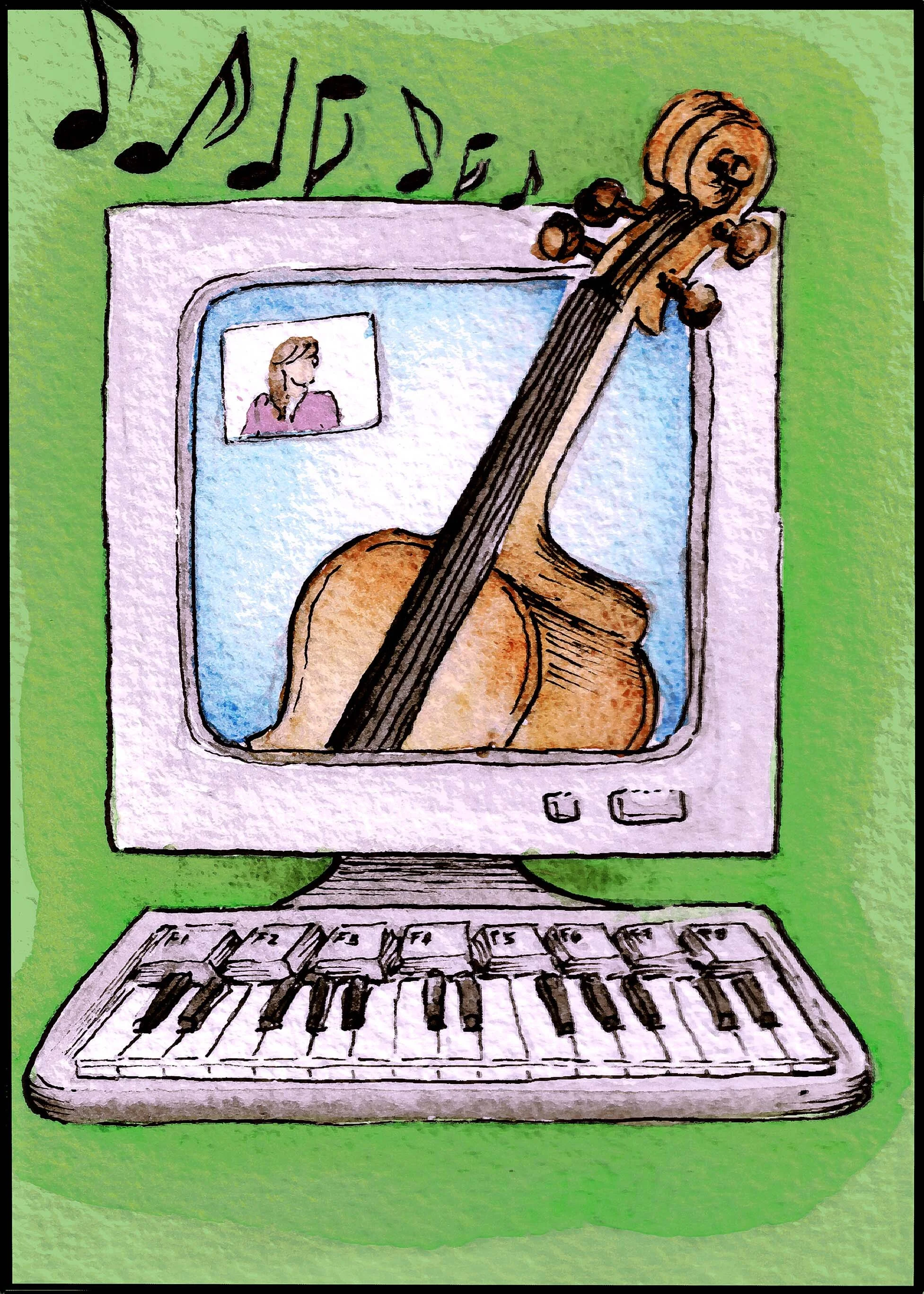
Find a place with as few distractions as possible.
Making this your lesson location helps with the routine, like "going" to a lesson.Position yourself
Somewhere that is well lit (facing the light, not in front of it) and putting yourself in the frame, not too far, keeping all the important things in view, fingers and bow etc.Set up early
From time to time there are inevitably technical issues that come up and if you find them out in advance you might just have a chance to solve them before the start of the lesson.Zoom has some easily customisable settings that improve performance during a music lesson:
Turn off the video enhancements to allow more bandwidth for the sound, for example any HD option or 'Touch up my Appearance', these can be un-checked in Video Settings, or Meeting Settings if using the mobile app.
Also important to 'Enable Original Sound'. This can be found under Audio Settings -> Advanced (or again directly in Meeting Settings on the app). This disables the echo cancellation and audio enhancing features, which tend to filter out instrumental sounds, particularly the low register in the cello.
Have material prepared in advance
It goes without saying really that teachers need to have copies of the students existing material on hand to reference during lessons.New material
I myself have the majority of my teaching material in books, scanning it takes time, and this should be sent to the student in advance so that they can print it out or have it ready digitally.Sight reading
Have it scanned and ready to pull up in a shared screen (but checking first what device the student is using, this doesn't work so well on a mobile phone)
#2 GET CREATIVE
With an online platform we don't get the same connection we are used to in face to face lessons. So we do have to think of new or adapted ways to keep inspiring and motivating each other, as well as ways to problem solve remotely where often we would get more hands on.
Given how visuals and sound can be more impaired over a video conferencing platform we have to make more effort to be very clear and concise (and talk slower) when giving instruction.
Setting specific goals for the lesson is always a good thing to do, but in this format it feels like we can be more effective limiting it to maybe one global goal, rather than chopping it up too much.
We can then think of novel ways of getting this understood when physical demonstrations aren't going to be as effective.
From a students (or parents) perspective it is important to point out any problems that you have noticed so that these can be addressed - it's not always evident from the other end of the camera.
Finally, get inspired by trying new things, most of us like some sort of routine, but when that can't happen, things that we normally do can start to feel too hard, too isolated. So trying something completely new can be a way to find a new perspective, and gives us some motivation to get past this.
Creating fun new resources, an animated PowerPoint to play along with, little activities to do in between lessons, can be great for younger students.
Exploring new techniques.
Encourage students to recording themselves playing, as a quartet using an app like Acapella, or play along with a backing track or a drum loop.
Try your hand at improvisation or even writing a tune. Teach some tips and tricks how to get started.
The possibilities are many and students will feel challenged and empowered, and will come out of it much better off even if it differs from the regular program.
The main thing is staying connected - to music, to the instrument and to each other.
Then, once we get through the other side together, our love and appreciation of the arts will be stronger than ever.
Further Reading: The Strad: How to set yourself up as an online string teacher
If you found this post useful please remember to click the like button, drop me a comment below or subscribe to the feed.
Keep Well, Keep Safe and Be Kind.
How I practice - A Guide to Maximising your Time
Over the summer break I worked out a good routine and schedule for my practice, so now it's easier to drop back into it as time allows.
There are lots of tips and tricks online about effective practicing, but here I describe what a my practice sessions actually look like - the nuts and bolts if you will - sometimes I find it helps to see what those ideas look like in a practical sense, to then adapt it to your own practice.
So the Easter holidays have arrived and the first school term is done. While I do miss the kids (and the income) I do not miss the endless traffic jams I face each day driving around Auckland.
The best thing about the break though - ample time to get back into some solid practice.
This term has been super busy, especially trying to fit in work on my side business (Tricot et Toile) around classes and performances. Regular practice kind of took a back seat. Luckily over the summer I worked out a good routine and schedule for my practice, so it's easier to drop back into it when everything else cools off a bit.
It's easy to find lots of tips and tricks online about practicing and how to practice specific things in more detail, but I haven't found much describing what a good practice session actually looks like - the nuts and bolts if you will - sometimes I find it helps to see what those ideas look like in a practical sense, to then adapt it to your own practice.
Typically, depending on the time I have, I'll do 1 or 2 chunks of 1.5 - 2 hours each -they go a bit like this:
- Tuning (2 mins) - It's important to spend the time to tune properly, 'near enough' is not going to do your intonation any good. I try whenever possible to tune by ear to a concert A, my other strings in perfect fifths. Using the tuner is quicker for sure, but after a while it makes your ear lazy.
- Warm up Scales (10-15mins) - When short on time it's tempting to skip this part, but even just 4 or 5 minutes makes the work you do from then on so much more effective. Scales are such a great way to get you physically and mentally in the zone. I find it's also a good indicator of the day I'm having, if I can crack into it or if I'll need to take things more slowly. I tend to switch between all different types of scales and patterns to keep it interesting.
- Studies (10-20mins each) - I usually have 2 or 3 that I work on at a time. I might spend 1 or 2 weeks looking at it before going on to something else. Studies are an excellent way to target specific areas of technique and develop or maintain skills that are perhaps not as often addressed in the repertoire. Currently I'm working through some Dotzauer studies, but I also like Sevcik and Werner.
- Repertoire (1 hour approx.) - Depending on time and how much there is to cover, I usually divide it up, working 15-20mins on each part. For example:
15 -20 mins each on 2 movements of Symphony
20 mins on Overture
or
15 mins each various excerpts
15 mins each 2 sections of Concerto
This way I can cover a large amount of repertoire, spending time on certain areas or aspects of the music. Rotating through everything over a series of practice sessions. I will of course periodically dedicate a longer time in order to run a whole work or larger section.
When doing 2 sessions in one day. I've found I work best doing one session in the morning, then at least 2 or 3 hours where I can get on with some other work, admin, lesson prep etc. Make something to eat and then return to my cello later in the afternoon. The structure I follow is basically the same but I will vary the material. This way I have more energy and focus, as opposed to doing it all in one hit.
When time is limited, an abridged version of the schedule will leave out the studies and I will be much more selective about choosing the parts of repertoire needing the most attention, either based on technical difficulty and/or performance deadline.
Around 95% of my practice is spent with a metronome.
The most important thing I've found is the quality of practice above quantity. If I'm really focusing, correcting things, listening and feeling everything, the practice is far more effective. For me, I do this better thinking in terms of small chunks. If I sit down for an hour and half to practice just as it comes, it's far too easy to whittle away the time without really achieving much
At a master class with Richard Aaron, professor of cello at Julliard, I remember him saying he'd get his student to set the timer for every 6 minutes and then note down what they had done in that time. Making you hyper aware and accountable for every minute spent. Whilst I'm not quite that disciplined, a little time pressure certainly keeps me focused and motivated.
Here are a couple of nice resources with further tips for good practice:
BBC Bitesize guides - this is aimed at school aged students but the concise pointers can apply to everyone.
Creative Commons article: This longer article goes more in depth with ideas and advice around effective practice techniques.
I hope this inspires and motivates you to work out the best most positive and sustainable practice regime for you. Please do let me know if this was useful and fell free to share any ideas or questions you might have.
2018 - A Year to Remember?
Another year has come to an end, 2019 has dawned. I always find this a good time to reflect, looking on what went well and what could be iimproved. This past year, there have been many ups and downs, but highlight of the year, was playing the Saint-Saens Cello Concerto with the Philharmonic Society Orchestra.
Another year has come to an end, 2019 has dawned. I always find this a good time to reflect, the warmer weather is here, we are stuffed full of treats from Christmas and probably indulging in a few wines in the back yard.
As I recall this past year, there have been many ups and downs, my teaching practice took off, there were many interesting performances, and, having set substantial goals for myself, I was very motivated to practice.
A highlight early on in the year, was playing in the theatrical piece "Think of a Garden", met some fabulous people, played some interesting music and was honoured to be involved in such a dramatic production.
To get some of the lowlights out of the way. I was a little what one might call 'a victim of my own success'. I was called upon at the last minute to take over cello lessons at 2 new schools, that alongside an increase in private students and a period of intense rehearsals, I was totally exhausted, resulting in a (very minor) car accident, it was the shock more than anything. At the time I was averaging around 220km per week in my Honda Logo, such a great little workhorse. It got a much needed wake up call, that we cannot do everything and we need to make sure we are looking after ourselves, especially when our schedule is full to bursting.
Another thing of equal parts plus and minus, was that surges of new private students meant that I actually had to make a waiting list and even turn some people away. I did consider extending my hours, but decided it would be counterproductive - I didn't want to risk any more accidents!
I guess THE highlight of the year, was playing the Saint-Saens Cello Concerto with the Philharmonic Society Orchestra in August. I'm the type of person that needs concrete goals to work towards, and for a performance musician, that means... performance. I can learn a particular piece, or work on technique, but if I don't have the culpability of actually performing soething in front of an audience, I find it difficult to stay motivated.
Believe it or not, this is the first time that I have learnt a work of this magnitude in its entirety and to performance level. There is an awful lot of work involved. Which I put in over a long period of time. My timetable as it is, this seemed the most reliable plan of attack, not to mention a work like this needs an element of maturity, much like a good Bordeaux, to be truly at its best.

In preparation, I found it best to look at it from many angles, the concerto, while not in movements as such, has several distinct sections, which can be worked on as bite size chunks. Rhythm, tone, style and speed were all elements that needed attention. There was a lot of work done with the metronome, which paid off in the end as far as the orchestra were concerned, however some may have considered it a bit too square.
In the process I sought out to have some lessons. Sometimes you just need someone else to point things out. Andrew Joyce, principal cellist in the NZSO, was so inspiring, his enthusiasm and passion emanates in all directions. He was very helpful in giving some ideas for the quick passages, preparing the left hand better and deciding on some phrasing right from the outset, often this is something I add in later on, especially for technically tricky bits. I also had the pleasure of working with Edith Salzmann, cello professor at the University of Auckland. She too was very encouraging, pointing out how there comes a point where we should shift the focus from the left hand to the bow, the fingers can do their thing essentially on autopilot, and sound production will be optimal. She also advised me on the importance of 'leading' the orchestra.
As the concert date drew nearer there were many times of doubt and nerves, but finding the will to keep chipping away, I knew somehow it would all come together.
The performance itself was the most emotionally and physically draining thing I think I've ever done. By no means perfect (at the previous rehearsal, I'd peaked too soon), but good enough. The audience loved it, I was literally trembling at the end, played a short encore of Bach Sarabande from Suite II, then as recent tradition dictates (round the cellists I know) I joined the back of the orchestra for the second half - a symbolic effort only, as my brain had crashed entirely.
In the days following a serious come-down ensued.
So now looking ahead...
As far as performance goals, I do have something in mind and will certainly be sharing that with you as it unfolds.
My main goal for 2019 is to keep on top of my timetable, being rigourous with planning and organisation, so that I minimise risk of things falling through the cracks, also benefitting my students, and being careful not to take on too much. And, just as importantly, keeping fit and healthy, more regular exercise (also for my poor somewhat neglected dog), and eating healthy which also requires forethought and preparation especially on those rehearsal heavy weeks.
As always if you enjoyed this post please click the like button at the bottom and subscribe to my feed. If you'd like to share your goals for the coming year or you have any questions, just add them in the comments section below, I love to know what your big plans are for 2019. Let's make this another great year to remember.

The Best Song(s) ever Written
Even the most innovative of artists has influencers, those that have gone before that have been an inspiration. As musicians, when we interpret a piece of music, we must draw on our own experiences to find our inspiration.
I find it really interesting to know what music people choose to listen to and I wanted to share some of my music choices, turns out it's a very eclectic range.
Most of our sensory perception is relative to what we know, take wine tasting for example, you are unlikely to find the pomegranate notes in your Zinfandel if you have never experienced an actual pomegranate.
The same goes for art, the emotional reaction we have to a painting or a piece of music is not necessarily the same as that of the artist when they were creating it. Going one step further, even the most innovative of artists has influencers, those that have gone before that have been an inspiration.
As a musician, when we play a piece of music, of course we try to understand the story the composer was trying to tell. But interpreting this as ourselves we must draw on our own experiences and find our own inspiration.
I find it really interesting to know what music people choose to listen to, if any. I think it tells a lot about a person. For me, there is an eclectic range of things I like to listen to, depending on my mood. Then other things, I might not put the record on, but I love to play.
I wanted to share some of my music choices, it's harder than it sounds, there is so much great music out there, and such a vast array of styles...how to choose? Well it made me think of Nick Hornby's book 'High Fidelity' (a good read by the way) The main character and his buddy in the record store pass the time making 'Top 5' lists. so I thought I'd give it a crack. Starting with the top 5 genres. Here goes...
Top Five country/folk songs:
- Simple Twist of Fate - Bob Dylan
- Cowboy Take me away - The Dixie Chicks
- Oh my Sweet Carolina - Ryan Adams
- The Night they Drove old Dixie Down - The Band
- A Man Needs a Maid - Neil Young
Top 5 Classical works:
- Cello Concerto in E minor Op. 85 - Edward Elgar
- Adagio for Strings - Samuel Barber
- Piano concerto in A minor Op.16 - Edvard Grieg
- Symphony No. 7 in C# minor Op. 131 - Prokoffiev
- Symphony No. 5 in E minor Op. 64 - Tchaikovsky
Top Five Rock songs
- November Rain - Guns 'n Roses
- Hallelujah - Jeff Buckley
- Angie - Rolling Stones
- Venus in Furs - The Velvet Underground
- Brothers in Arms - Dire Straits
Top 5 Blues:
- Bell Bottom Blues - Derek and the Dominos
- Still got the Blues - Gary Moore
- Many Rivers to Cross - Jimmy Cliff / Blind Boys of Alabama
- Cosmic Blues - Janis Joplin
- Change is Gonna Come - Otis Redding
Top 5 Alt-Rock/Pop Tracks
- Tom Traubert's Blues - Tom Waits
- Paranoid Android - Radiohead
- Lonesome Tears - Beck
- Into my Arms - Nick Cave & the Bad Seeds
- Hope There's Someone - Anthony and the Johnsons
Top 5 Albums (to be listened to complete, beginning to end)
- Drella - Lou Reed and John Cale
- The Last Waltz - The Band
- Berlin - Lou Reed
- The Rise & Fall of Ziggy Stardust & the Spiders of Mars - David Bowie
- Infidels - Bob Dylan
So it was considerably more difficult than I thought to narrow it down that much, You might find some of the categories a bit dubious but so often I find it hard to put them in a box. Plus there were so many great songs and artists, folks like Phil Spectre, Amy Winehouse , Ben Harper, Aretha Franklin, Björk, The Cars, that didn't quite make the cut. But that's I guess the beauty of the top 5, you really have to think about the song and what it has that merits it being there. Many of these made it because of a personal connection or memory or they have these epic instrumental arrangements.
Maybe you are familiar with some of these, maybe you've never listened to any of them. Either way it would be great for you to share your Top 5 'Somethings' in the comments below. I'd love to find out what inspires us in different ways as musicians, plus I always enjoy discovering new music I've never listened to before.
Developing Technique - How, When and Why?
Is 'good' technique imperative to being a successful instrumentalist, or merely a means for artistic musical expression? Considering both my own and my students techniques I find myself somewhat conflicted. Does the effort of prioritising technical mastery find itself at odds with taking the journey through enjoyable and inspirational repertoire?
I have been thinking lately about the importance of technique. Is it imperative to being a successful instrumentalist, or merely a means to an end - that of artistic musical expression?
Following various discussions with colleagues and other teachers, considering both my own and my students techniques I find myself conflicted.
Of course I want my students to develop good technique. But prioritising mastery of technical aspects at the cost of moving through enjoyable and inspirational repertoire? Perhaps this philosophy will never produce any virtuosos, but I do believe music is more about creativity, expression, and sharing and enjoying the art than being technically accurate.
Personally I feel, as a teacher I need to strike the right balance with each student between developing the technical aspects and building a repertoire that is fun and musically satisfying. This varies depending on age, motivations and learning style.
There are differing opinions on when children should start learning, but whatever the age, a child's developmental stage must be catered for. At 6 motor skills and cognitive skills are still developing, gross motor skills come before fine motor skills (which are mostly used in instrumental playing). By 8 or 9 the child should have reasonable dexterity - a good judge could be in handwriting. Yet children are, of course, still developing, things like the fine motor skills are still being refined. On top of this, we all develop at varying rates, a young student may not be physically able to correctly manipulate the bow for example - right at this moment in time, it's just not happening - but that isn't to say that it never will.
I believe little exercises and gentle corrections of technique repeated over the weeks and months will set it in place in the long term. Considering also, social development, young students are starting to find their independence and their own self confidence. Music can help this flourish, but we must balance the criticism with commendation, that students don't lose interest or become frustrated or insecure in their own ability.
For adult beginners I believe the same applies, albeit from a slightly different perspective. In respect to the physical, movements might be more restricted, fingers for example that have never made these movements may find it hard to form the correct shape and to work independently as required. That's not to say you can't teach an old dog new tricks so to speak, it just might take longer, you might need to find some work-arounds. Of course I wouldn't intentionally ignore practicing good technique, but for most adult students, the goal is to do something for themselves, to have fun and enjoy playing. At the start it can be challenging, everything is so new, and as an adult student you must be 100% self motivated, not the same as for the youngsters who have parents reminding them to practice!. So with that in mind, there needs to be some satisfaction in playing right from day one. Finding that balance between technical requirements, enjoyable repertoire and a sense of ongoing improvement, otherwise it becomes a chore, while other commitments and responsibilities take over.
In both cases, particularly considering beginners, the importance of technique is to allow us to achieve a variety of good sounds, and without pain or injury. But there is no one size fits all way of playing. Even among great musicians, beyond certain cornerstones, there are many different ideas about how to achieve certain sounds. Our technique should be allowed to evolve as does our musicianship. Besides, we are all built differently so it would follow that we move around our instruments differently too.
I would tend to approach the development of technique in a slow-burn kind of way, over time muscles will get used to certain movements as the player starts to get the feel for how they can achieve the sounds they want to make. The bottom line - it should feel natural and without tension.
In the meantime working through a variety of repertoire that is at both challenging and satisfying. And, as time goes by we make constant adjustments and improvements. If we turn the learning into an iterative process it seems to me that the brain can come to grips with the new movements. The new ideas musical and technical have time to brew and mature in parallel.
I may be wrong, but I'm not convinced that labouring technique is necessarily that effective. Music is an art after all so I consider that nurturing the enjoyment and musical expression of emotions to be a more pertinent endeavour for the developing musician. A student who is enjoying music is always prone to more and better practice. It's all in finding the right balance for the student I guess.
Please share your thoughts on this in the comments below, it's a worthwhile discussion to have and helps me to improve what I do.
The year in review
A new year has begun, and I find it's a good time to reflect on how everything has been going, things that worked, things that didn't. I feel that this year, things have started to turn a corner in terms of work, but the big thing which I struggled with most this year was my brain. Mental health issues can be a big barrier to success, an obstacle on the journey. But with the right support and techniques there can be ways through, implementing those is top of the list for 2018.
A new year has begun, and I find it's a good time to reflect on how things have been going, things that worked, things that didn't. I embarked on this journey around 3 years ago now - how time flies - making the move from an office job, with long hours, that I no longer enjoyed, to put my efforts into this passion that I have had since I was small.
It certainly hasn't been easy. I sometimes miss the regular salary, routine and office banter, but if those were the pros, the list of cons would be much longer.
Leaving it all behind to focus on music hasn't always been sunshine and roses though. But, I have to remember that this is a journey, and journeys take time, the road can be windy and there can be many obstacles.
However, I feel that this year, things have started to turn a corner. Music is largely a business of personal networks. Jobs come through recommendations and word of mouth. These networks can take a while to build, but the more you prove yourself and become known within the right circles the more calls you get. And I have been getting more calls, with any luck this will continue growing in 2018.
My teaching practice has also been growing this year, and I have had some really fabulous students, who are just such a pleasure to teach. It reminds me that this is what its all about, seeing the little improvements in playing, development musically and as a person, and seeing the enjoyment that they get out of playing music. I have lost a few too, sadly, mainly due to external life factors, but it's all swings and roundabouts, hopefully a time comes where they can once again explore the world of music.

Artwork inspired by the song
"Many Rivers to Cross" (1969) by Jimmy Cliff
The big thing that I realised this year and which I struggled with most is that I, myself, my brain, is a barrier, an obstacle on the journey.
Thankfully mental health is getting more talked about in recent times, it was a big issue in the recent election here in New Zealand, more efforts are being put in to healthcare and support for those suffering. But I personally, still feel that it's not something we can freely talk about, fear of stigmatism, misunderstanding, pity, none of which are useful. When these reactions are in our working environments, well, I know first hand the repercussions of revealing a mental health condition at work....really not good..... so I don't....So even this is hard.
Mental health issues are not uncommon among musicians, perhaps the defective wiring in our brain is also what makes us lean towards artistic forms of expression.
But, it's a two sided coin. Being freelance means I can manage my own timetable and make it work for me, I can take on the work I want to do, and I am doing something I am passionate about. The flip side is financial pressures, self-management and promotional pressures. I really underestimated what it takes to create those networks, developing a (good) reputation, not to mention the study required to continually improve as a teacher, and of course my own practice regime. Challenging at the best of times, let alone on the days when, plagued with doubts, your self-esteem has gone out the window, you are suffering intense social anxiety and can barely manage to get yourself out of bed.
The effort can be exhausting, but I am so happy that focusing on a good lesson or having a great rehearsal or concert is a ray of sunshine on a gloomy day. I think there are some key factors to focus on:
1. Working out what it is you want to be doing, in the short, medium and long term. - set some goals to keep you on track.
2. Set a good routine as best as you can to keep well and working towards those goals.
2a. Schedule in time for relaxation and excersize, things that are totally unrelated to work.
3. Practice activities to help keep positive and have realistic expectations on yourself.
So this is my plan for 2018: Set achievable goals, create a realistic routine to get things done, prioritise exercise (this one is critical for me), be more consistent with practice, work efficiently but don't underestimate the time to complete things, read more books.
The road may be long, there are many rivers to cross, but I really believe that if you want something you will find a way to get there, eventually, in some shape or form. Despite the inevitable competition among musicians, we are all linked through this art form and we need to support each other. Please feel free to share your own experiences in the comments below.
The journey continues....
Mindfulness for Musicians
Most of us know music is an artistic, emotional and often spiritual expression of ourselves. Listening to music can get us excited, cheer us up, it can equally be relaxing and conciliatory.
Playing music can be a reprieve from the daily grind but we can put enormous pressure on ourselves, and this can result in a lot of tensions and anxiety relating to our music.
There has been a lot of publicity about 'Mindfulness' in recent times, I find the idea of focus in the moment and non-judgmental awareness fits in very well in music practice.
Most of us know music is an artistic, emotional and often spiritual expression of ourselves. Listening to music can get us excited, cheer us up, it can equally be relaxing and conciliatory.
Playing music can be a reprieve from the daily grind, it can lift our spirits and be an emotional outlet. But as musicians, whether starting out or trying to make a living, we can put enormous pressure on ourselves, and this can result in a lot of tensions and anxiety relating to our music.
There has been a lot of publicity about 'Mindfulness' in recent times. It has become trendy, seems like everyone is jumping on the bandwagon so to speak. While I do not agree with all of it, having read bits and pieces on meditation, mainly from a Buddhist tradition, along with various ideas and strategies to improve mental health, I find the idea of focus in the moment and non-judgmental awareness fits in very well in music practice.
In today's world of constant pressures of work and life, everything moves so fast we hardly get time to notice. Mindfulness brings back to us this awareness of ourselves and our surroundings, experiencing every moment. Giving us a break from worrying about the past or the future.
Music too is like this, a great piece of music can hold our attention and draw us in to the moment. The cliche of the 'tortured artist', isn't always too far from the truth. There are many things that can be easier to express through art or music than actual words, for whatever reason. But we can still find ourselves putting pressure on ourselves to practice more, to perform better, and this can get very frustrating, to the point that it's no longer enjoyable, or good... the more frustrated we get the worse it sounds.

Incorporate some 'mindful' activities to combat these moments:
BREATH
Practice breathing,
1. While still and;
2. While slowly making the movements that you use to play.
Unless you actually need to breath to play, for example, singers, wind or brass players where the music is going to determine much of your breathing pattern. Others such as string players, pianists, guitarists, percussionists, harpists etc... we must make a conscious effort to breath.
Try this: Play a simple exercise such as a scale. Practice breathing, much as you would control your breath whilst running long distance, time your breath in and out with the movement of the bow or per octave.
As you do this, feel every movement, notice every muscle, how it moves, if it is holding tension, is your weight distributed evenly, is the weight being transferred as it should be into the instrument.
As you notice each of these things, try to adjust them, release the tense muscles, transfer the weight, economise and optimise your effort, control the movements.
The next thing you will be noticing is the quality of the sound as you make these adjustments, hopefully it is improving, but perhaps at times it is not, continue adjusting, focusing your attention on that area.
Note that this is contrary to the main principle of mindfulness; being that you notice all , but make no judgement. But, in order to improve our playing, the practice session must have some critical objective judgement involved. Use specific and descriptive words when you do this exercise ie. the notes could be more smooth, or the sound more even. Try to avoid pejorative terms.
This can in some sense be likened to the practice of a walking meditation. Noticing the movement and feel of muscles and senses.
FOCUS
A lot of meditation practice is about discipline, focus and concentration. This certainly holds for music practice too.
- Try to make sure you have as little distractions as possible that may interrupt your flow.
- Set an alarm for a certain amount of time to work on an activity. This is especially useful if you have limited time available to practice and makes sure that you can cover everything you want to and don't get stuck on one particular thing. For example working away at a particularly difficult exercise, the alarm goes to remind you to move on: you avoid getting to a point of frustration and start to undo your good work by over-working it.
- Try to notice how many times your mind drifts away from what you are playing during each exercise or piece. Even the fact of deciding to do this can help focus your mind on what you are playing, and if you notice there is more drifting than focusing, you might have done enough for the day.
- All this focus can make for very good quality practice, but it can be mentally tiring. Take little breaks, just for a minute, stand up, walk around, then get back into it. And... know when your done - if you've lost concentration it can be counter productive. (See previous point). You know your ow limits and how long you can maintain effective concentration on one activity.
VISUALISE
Visualisation is as important in practice stages as in performance and it is a two fold concept:
1. Visualise in your mind how the piece is going to sound, how does the very first note begin, hear it in your mind, think of the pulse and rhythm the tone and dynamics. Visualise the movement of your bow and fingers and hear the sound that is produced. take a couple of good deep breaths, feel everything relax in.
2. Visualise the piece in your mind before you start , feel the surroundings, you are aware of your audience yet not thinking about them. Draw on your musical inspiration from some imagery you can associate with the music. Focus on any accompaniment to bring your attention to the music. Always be thinking about the line you are playing, not worrying about a really hard bit on the next page or that high note you missed a few bars back, absorb yourself in what is happening now.
PERSERVERE
Almost everything is difficult at some point and there are times for all of us that certain things seem well beyond our capabilities. Perhaps they are, but it doesn't help to throw in the towel. As my mother often says, "take a deep breath, and get on with it".
Well... yes, easier said than done in the context of practicing. But do BREATH, deeply and slowly feel the air through your nostrils, filling your lungs and breathing out feel everything relax and sink down. As many times as you need, then go back to what you were working on, but this time taking it back a notch, break it down, processing every movement and note with a careful awareness.
Even if it is not as fast or loud or whatever it needs to be, as it was before, you are still better off. Psychologically, you finish the session playing it well, you feel better about coming back to it next time.
If all his is very unfamiliar to you Mindfulness in Plain English by Venerable Henepola Gunaratana is a very good, easy to read and practical book to get you started.
Also check out your local Buhddist Temple, they often have meditation and mindfulness courses or will welcome you to attend a session. You don't hve to buy into all of it, but you will get enough understanding of the practice to apply it to your own practice.
New Year's Resolution: A Practice Plan
New years resolutions that get made in the relaxed and festive 'bubble' of the holiday season, inevitably get forgotten, once the all the parties are over and the reality of life returns.
The antidote might be to make an actual plan - something to work towards and a way to get there. And what better than a plan for practice?
Last January I wrote about giving the practice routine a shake up and how simply going through the motions is simply not enough to see real progress. And I feel that despite periods of extreme time constraints, I have managed to keep up a level of focus, efficiency and precision with the way I practice.
Now, it seems any new years resolutions that get made in the relaxed and festive 'bubble' of the holiday season, inevitably get forgotten, are too hard or become totally impractical once the all the parties are over and the reality of life returns.
The antidote to this might be to not make a resolution as such, those idealist and far fetched notions; make an actual plan - something to work towards and a way to get there. And what better than a plan for practice?
Over the break, it's a great time to reflect on what you want to achieve in the year. I have had some time to do this and so far ... so good (albeit only 5 days in...)
So here we go (and actually write it down... you'll be able to refer back to it through the year and give yourself a big pat on the back when you've smashed them out at the other end of it)
1. Work out the top 3 things you want to work on, or rather think you need to improve.
If this plan is going to last a whole year it is better to be generalised things that you can work on in may different ways and apply to different things.
A year might seem a long time to work on something, but in the scheme of things, we spend many years trying to perfect our playing, so focusing on certain aspects of technique for one year is not so outrageous.
2. Brainstorm all the specific elements of that technique that are causing difficulties.
Try and be as specific as possible here, this will help focus the work to be done in the right places. Remember to think about physiological and psychological elements as well as the physical or musical elements of the technique itself.
Considering as many 'causes' or issues as possible to do with the technique can help dig down to the root of the issue, and to address the fundamental aspects making this technique difficult. we can also find links between the physiological, metal and physical elements.
3. Note down some ideas on which excersizes can be used to target these techniques.
This can be a small list to start with and can develop over time as the technique develops and improves.
REMEMBER - Scales can address a multitude of sins.
4. Consider what repertoire you can work on that will compliment your work on each specific technique.
Often we choose repertoire we want to play and then work on the appropriate technique according to those works. By turning it round we can search out new repertoire and find works that we might not normally approach, putting into practice the techniques we are working on.
This is a great exercise to plan and improve our own work, but also to do for/with students.
Often we get stuck into nutting out exam pieces, orchestral and school ensemble repertoire, and sometimes certain techniques can get neglected if they don't often arise often enough.
For new students, have these technical goals be a mixture of things the student struggles with and techniques that they really enjoy or come somewhat naturally. That way, the years work can include addressing difficult or challenging areas as well as advancing the mastery of others.
You can see here a list I made for my own practice regime, other areas to look at could include things like, sound/tone production, vibrato, rhythm and pulse, shifting, physical tensions, coordination, musical interpretation etc.
When considering a plan for more established students it would be helpful to look at all their strengths and weaknesses and shortlist what needs the most attention and is most relevant to what they are currently working towards.
We all know that making a plan to reach our goals is a great way to keep ourselves on track. All we need is for once to just stick with it!!
The Power of Music
I had the great fortune these last school holidays of assisting in taking a local youth orchestra on a tour to France. The trip surpassed many of my expectations and I found the reaction of both the young musicians and our audiences inspiring.
Music traverses cultural and linguistic barriers. It was fantastic seeing these kids really getting involved and how much they just love music...
I had the great fortune these last school holidays of assisting in taking a local youth orchestra on a tour to France.
My role was 3 fold really,
1. As a responsible adult
2. To help and boost up the small and relatively inexperienced cello section
and most importantly 3. Having lived there for some years, as a translator/interpretor.
The trip surpassed many of my expectations and I found the reaction of both the young musicians and our audiences inspiring.
The combined Orchestras play to a great audience in the Place de Celestins in Lyon, France. Photo courtesy of AYS
This is the power of music, it traverses cultural and linguistic barriers. It was fantastic to see the kids really getting involved and how much they just love music, any spare moment or opportunity to play or to try out a new acoustic:
- Improvising 4 part a capella harmonies in the glass roof top dome and ballet rehearsal space of the Lyon Opera House.
- Busking in the Place des Heros in Arras, surrounded by small kids in awe of what they were doing.
This little guy was just fascinated by the cello section when we played in Arras. So I gave him a quick lesson. Photo courtesy of AYS
One of these young buskers said he didn't care about the money, he just wanted to play. But seeing those kids so excited to drop a few coins in the case, it seemed as if it were of more value to them as a whole experience, showing appreciation and understanding maybe, learning the value of the performance.
(The pros and cons of that value being monetary
is beside the point of this story)
On the other side of it, we visited large towns & small villages, and everywhere we went the welcome was outstanding.
In some ways this is part of the European way, I recall with the OSL, many shared meals, drinks and nibbles while playing and touring with the orchestra.
But also to receive this orchestra of young New Zealanders was a real community event, to come and see a visiting orchestra play.
The two 'Chefs' Paul Harrop and Jean-Pierre Prajoux sharing the podium for our final number in Lyon. Photo courtesy of AYS
Amongst all the hatred, fear and strife occurring in the country, even whilst we were there, luckily at the other end of the country, the terrible tragedy in Nice on the 14th of July. Not to sound twee, but our concerts brought a moment of calm, a moment of joy and happiness to what were frankly, very good sized audiences. And at many we passed a moments silence in thought of Nice.
Even when playing in competition to the final of the Euro Championship between France and Portugal, with thousands of people trying to cram into the FanZone just two blocks away, our combined Aotea Youth Orchestra and Orchestre Symphonique de Lyon (a mere 100 musicians) managed to more or less fill the Place des Celestins. I would have said maybe 200 or so, young and old, some who came especially but many passers by stopping to enjoy some music on a very warm summer evening, despite the untimely car horns growing ever more incessant the closer it came to kickoff.
The NZ troops were instrumental in liberating Le Quesnoy. Their gratitude shows in the street names.
All this to say that our music could bring people together, both within a community and between nations. A cultural exchange that benefits both sides, whether it be sharing stories and ideas with our wonderful homestays, playing alongside the OSL under the baton of the fantastic Jean-Pierre Prajoux, enjoying the music of the Le Quesnoy Concert Band, entertaining audiences and paying tribute to our fallen NZ soldiers who served in the small towns in the North of France during WWI.
It was always a pleasure for me to speak to and interpret for members of the public as well as some dignitaries following our concerts. Their apprecation for our music was very humbling, to know we had come so far to play for them, they had enjoyed our music and were impressed by the sensitivity, enthusiasm and musicianship of all these young people.
Calm before the storm, our final performance played to a packed audience in this fabulous room in the Versailles Town Hall.
It made me think that so often music can become an elitist institution, what is 'proper' or 'good' music and anything else is not worth playing, what are 'we' going to get out of it musically - and I am as guilty of this as anyone (don't even get me started on the X-Factor and its genre). But in fact music is for the people, as an artist you must be able to express yourself, and you don't always want to sell out to the commercial masses, but there is a time and a place for both. And as a musician we can feed off the energy of an audience that loves what we are doing, even if it is playing Lord of the Dance for the 50th time, the audience love it, and I loved that they loved it, that was all that mattered.
Entertaining visitors to the Chateau Villandry in it's central courtyard, near Tours.
Music truly is a universal language, music connects people, to each other, to emotions and memories. We must remember this and not be precious or pretentious and keep it all to ourselves, but instead use it like a superpower for good.
Just Do It - How and Why to get fit and play music
Musicians are athletes of a sort. Producing music can be extremely physically demanding, not in the same sense as a marathon runner or a footballer, but it can nonetheless be very demanding on our body. So when i comes to getting fit, the 'Why' is easy; improved physical well being, improved mental well being, better stamina, endurance, focus, alertness, strength. All things that are certainly useful when faced with a grueling rehearsal and performance schedule.
The 'How' is not so straightforward to answer....
Musicians are athletes of a sort. Producing music can be extremely physically demanding, not in the same sense as a marathon runner or a footballer, but it can nonetheless be very demanding on our body. So when i comes to getting fit, the 'Why' is easy; improved physical well being, improved mental well being, better stamina, endurance, focus, alertness, strength. All things that are certainly useful when faced with a grueling rehearsal and performance schedule. The 'How' is not so straightforward to answer, it depends a lot on us as individuals as to what we need and like to do. One thing is sure, when we are plying music, sitting or standing for long periods of time using the many muscles in our arms and hands and each instrument uses different muscles. But they tend to be the smaller more delicate muscles and the essentially repetitive nature of the movements, if we're not careful and don't do it correctly or without adequate training and fitness we can do ourselves serious injury.
Here's an interesting interview about just that thing with some of New Zealand's leading musicians:
http://www.radionz.co.nz/national/programmes/secretlife/audio/201760118/the-secret-life-of-musical-injuries
In the last few years I have made it priority to get, and stay fit, and I must say I feel great, I'm more alert, have more energy. And, having had problems with my hands in the past from bad posture and overuse, I am very aware of keeping good form when I am playing, and exercising. However a recent lapse of concentration combined with over-enthusiasm at Bootcamp has left me with a wrist injury. And a brace for 6 weeks to go with it. All being a big wake up call that I do have to take care of myself.
This has made me reflect on how important good exercise is and how we mustn't push the limits too far when we rely on our hands in particular to play.
With everything in our body being connected, we can do various types of exercice on different muscle groups and see beneficial results in other areas as well. For example, improving our cardio fitness can have many benefits to our health, and is generally not too risky on our playing. Cardio, or cardiovascular exercise, is the kind that really gets our heart pumping. Something like running, skipping, or stairs for example will quickly increase your heart rate. Getting the blood pumping round efficiently, gets more oxygen going round. Better circulation can help us play faster, longer, all the things that any other athlete will benefit from with an increase of oxygen in the blood.
Cardio is also great for your brain, keeping you sharp and focused, not to mention the increase in 'happy' hormones in the brain, which are always useful to get through a grueling practice routine.
Certainly mix it up, it's more effective if your body doesn't have a chance to get used to doing one thing all the time. So it's a good idea to combine some strength and endurance training with the cardio. You don't need massive weights to improve your strength, body weight exercises do just as fine, we really don't need massive guns to play the cello and working with too heavy weights can do serious damage, but some good muscle tone in our arms can help a lot. Endurance training is great, if we are going to survive hours of practice and rehearsal. And throwing in a bit of high intensity intervals will improve recovery rates. It's all about being in the best physical condition we can to be able to put in the energy we need to into our performances.
On of the most important things however is posture and balance. When sitting or standing for long periods of time rehearsing, we are exerting a lot of energy, but we remain for the most part stationary. With bad posture, weak balance and core strength there are many things that can go wrong over a long period of time, neck or back injury, overuse syndrome, trapped nerves .... these can be extremely serious especially when performing essentially repetitive movements for long periods of time.
I would recommend at least doing some Yoga or Pilates. Or if you're keen, do it as well as the outdoor training!
I must stress that it's super important to do these types of positions correctly, so going to some classes to begin with is a good idea. I have practiced both Pilates and Yoga but at the moment I'm enjoying the calming and mental stamina of Yoga. It is excellent for stretching out.... well, everything.... releases built up tension in your back and shoulders, builds core strength, balance and most importantly of all, awareness of your body and form. So that in time, through long rehearsal sessions you can be noticing any tensions that are building up, and relaxing, rel time, so that it does not become a bigger problem later on. Yoga also works well on improving breathing, and breath control, which is essential for every musician, and is often, especially with string players, neglected.
If you have particular issues related to playing it is worth investigating the Alexander Technique. Many musicians use this to correct bad playing position and other strains and long term injuries. Here is a link to some further information:
http://alexandertechnique.com/
For me, many of the principles of Yoga align with those of the Alexander technique, however Yoga does not have the same level of hands on reconditioning with an experienced person showing you how to hold and position yourself, and of course it's much more targeted in its approach.
At the end of the day it's a personal choice. But for general well being, we all should practice some physical activity. It improves your physical and mental health, helps you play better, longer and faster. We must though, look after ourselves, if we do too much and injure our hands it can be a long recovery, and all the tiny and repetitive movements required to play music can have unexpected outcomes if we don't maintain good balance and posture.
So, just get on with it... the hardest part is always putting on your running shoes.
Here are some other interesting articles with varying opinions to help you decide what type of exercise is best for you.
http://billplakemusic.org/2014/04/10/fitness-and-exercise-for-musicians-choose-wisely/
https://blog.key-notes.com/a-musicians-fitness-routine.html
Are you paying attention?
As we get back into work and school for the year it is the perfect time to start developing good habits... or renew the good habits that have been let slide over the holidays.
The key to successful and productive practice is routine and quality. I'm not talking about the quality of the playing but rather the quality of the practice...
Continuing on with the theme of practice, as we get back into work and school for the year it is the perfect time to start developing good habits... or renew the good habits that have been let slide over the holidays.
The key to successful and productive practice is routine and quality. I'm not talking about the quality of the playing but rather the quality of the practice.
Sticking to a regular practice routine is important in that, for one thing, if there are long gaps between your practice sessions it's a bit like taking one step forward, two steps back, as you forget what you were doing last time, and certainly your muscles have forgotten what they learnt.
Apart from that though, a regular routine helps keep you motivated, it becomes part of your day, something that generally you should look forward to. And by practising regularly, you achieve a great deal more, and can see, or rather hear, the improvements in your playing.
Quality is a slightly more abstract concept when it comes to practice. Unless you are practising something in totally the wrong way, for example playing the wrong notes, I think almost any practice is of some value. But certainly some ways of practising are more effective than others.
It is important to really pay attention, at all times. As I have said in the previous post, when your concentration starts to fade it's probably time to stop.
When practising any instrument there are many things to think about: Notes, intonation, rhythm, dynamics, form, tone, phrasing etc...... it is hard to be thinking about them all at once. So to help keep our heads from overloading, focus on one thing at a time. It might be a big shift, some odd intervals, a passage of fast notes, or very slow notes, or it might be all of these; break it down into smaller chunks.
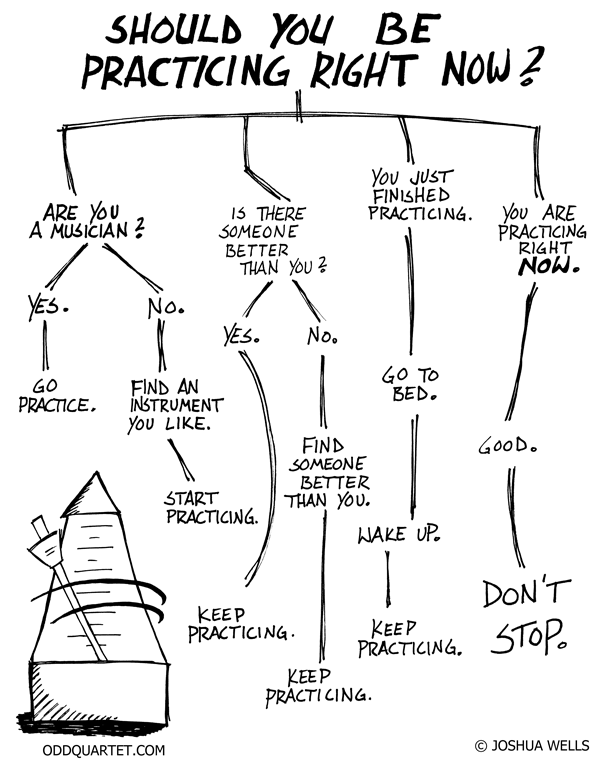
Perhaps quite a strict regime, but if you did follow this chart, you would get good fast!
- The shift or unusual intervals needs slow practice for intonation. Listen to a recording or play the notes on the piano of just that section, until it is set in your head. Really listen to the notes that you are playing. Sometimes, if you are really paying attention, bending the note slightly sharp then flat can help settle the true note into your ear. Once the intonation is solid, then start refining the sound, making sure the tone and dynamics are right. You might find that after adding dynamics you might need to work on the intonation again.
- For fast passages, once you have nutted out the intonation, start building up the speed. This really does require vigilant use of a metronome. Start slow, it seems obvious but you would be surprised, slow means slow, take the speed that you feel you can play it and reduce it by 5-10 notches. Now it's just repetition, gradually increasing the speed a few notches at a time (only when you have mastered the passage at the slower speed). You may find that you hit a wall at a certain speed, that's ok, you will gradually push it up further over time.
Practising with a dotted rhythm, and then the reverse rhythm is often very helpful in conjunction with the metronome.
These are just 2 examples of ways to practice specific elements or passages. Both involve much repetition and attention to detail. And that can be applied to all practice. The 3 time rule is also a good thing to stick by: to get something perfect 3 times in a row, is actually harder than it sounds, so you keep working it until you do.
The last thing I want to mention which I feel often gets neglected in favour of everything I have mentioned above, is the physical. Being aware of physical stance, posture, how you are using your hands, arms, face, is as important as the rest. You can't do the rest effectively without using your body in the right way. Pay attention to how it feels to produce the notes, do you have the right balance and weight in your arms for example, are you sitting (or standing) correctly. Notice how it feels when you get the notes right, not just how it sounds, it will make it easier to replicate next time.
This all seems like a lot of hard work I guess, and learning an instrument is, hard work, but also fun and rewarding and many other things besides. And remember you don't have to do it all at once. As I mentioned before, regular small practises are going to get you further than the occasional marathon. Alternate between the detailed practice and playing through (it keeps you in context of the bigger picture, and is usually more fun) and when time allows devote yourself to a big session.
Keep your goals in mind and remember nothing really worthwhile is particularly easy.
Practice makes better ... eventually
Practice is an interesting thing, there are good ways and bad ways to do it, there are also different opinions on what is the best way. I came to the realisation over the last 12 months or so that I needed to brush up on my practice technique and give it the time that it needed. Practice is as much psychological as physical, keep bringing your concentration back to what you are trying to achieve. Only practice as long as you can maintain your full attention on the notes you are working on...
Practice is an interesting thing, there are good ways and bad ways to do it, there are also different opinions on what is the best way. When you take up something new there is a steep learning curve, everything is uncharted territory. as you get better at it, the basic elements you learnt at the start become easier, even second nature, that you no longer think of them. This improvement continues more gradually until you reach a certain point where you can achieve many things, albeit in a mediocre way, with little to no practice. Of course this happens slowly over time, and along the way somewhere you lose the ability to practice with the same attention and vigour as when you started.
I have come to this realisation myself over the last 12 or so months, a somewhat rude awakening, I knew deep down that I was not practicing to the best of my ability, but most of what I played was 'good enough' with the bare minimum of work, my repertoire I kept to the same old favourites I had played for years.
It wasn't until I found myself in the situation of wanting to tackle some much more complex repertoire, and simultaneously (for an entirely different project) needing to learn music by ear and improvise, that I realised I needed to brush up on my practice technique and give it the time that it needed, rather than allocating arbitrary amounts of time I felt I could reasonably take out of my schedule.
In concentrating my efforts on quality practice where it was needed, and no longer simply running through from the top every time, religious use of a metronome, meticulously learning small chunks at a time and really listening to the quality and intonation of each and every note, practice time can easily expand to several hours at a time. My concentration span quickly grew and so long as my hands could hold out I can keep going to a point where improvement has plateaud for the day. Very quickly the results of this quality practice have shown a vast improvement over the years of mediocrity that preceded it.
Quality practice is as much psychological as physical. Listen intently to everything that you play, hold yourself to the highest of standards. Perfection is generally impossible to achieve however it makes for an ideal target point. I think this is hardest to instil in younger people, children do need encouragement and can easily become disenchanted with music if they feel they are not improving, they often need instant gratification of some kind or else it becomes too hard and they can get bored. Having said this though, constant praise is not the answer here either, there needs to be a balance where a job well done is recognised but equally where areas for improvement are kindly pointed out otherwise in the long term the student will not develop the self criticism necessary to achieve greater things.
“Simplicity is the final achievement. After one has played a vast quantity of notes and more notes, it is simplicity that emerges as the crowning reward of art.”
A lot of what is needed in good practice is down to mind over matter. Keep bringing your concentration back to what you are trying to achieve. Only practice as long as you can maintain your full attention on the notes you are working on. In every practice session the improvement of the technique or passage you are trying to perfect plateaus at some point. You must pay attention and notice when this occurs, move on to a different passage and come back to it later. And never try to run before you can walk. Having recently taken the step to relearn the piano as part of becoming a better musician, I know full well the frustration when you hit a road block and suddenly it gets hard. Take a breath, slow it down, baby steps, it will come eventually.
Most of all enjoy it. Playing music is amazing, but we all have to practice constantly to play our best. It is a life long journey. Relish every improvement, every notch up on the metronome, let yourself take great satisfaction for each passage mastered, but at the same time being aware that is is never really mastered - 'you've got the notes, now work on the tone'. Be sure to never get complacent, and know that the sky is the limit and each day of good practice you are one step closer.
The next time I will talk about what in my experience are the best ways to approach practicing.
Keep Calm and Carry on ....
Keeping motivated is important for all musicians. Practicing, performing and playing in general can all present us with challenges to a degree that we start to have doubts. If you isolate the problem then there are ways to overcome it....
Keeping motivated is difficult at times, but it is important especially as a musician. Practicing, performing, creating are all self driven. We need to keep motivated to make the most of what we are doing.
I often have many projects on the go at once, writing, teaching, practising, working on new performance opportunities, even maintaining this blog. I have come to the conclusion that there are 3 main things that can stand in the way of getting things done the way we want and these affect our motivation.
Firstly, time, and this is a big one. We all have busy lives, demands of work, study, and everything else, we need to prioritise.We need to make time for our music, work out how much can be dedicated to it, and without a specific goal in mind, I'm mainly talking about practice. Practice is essential to improving as a player, and we must dedicate 'enough' time to it. The principle of quality over quantity applies for certain. When you're just getting started, little and often is best. You will achieve more practising 10 minutes a day than sitting down for an hour once a week. Further down the line when time is short, select a small section to work on really well rather than just playing through a lot of work.

Secondly, confidence. I think everyone has moments where they lose confidence in their ability. It's easy to give in to this and give up, thinking it's too hard, or I'm never going to get this. The better option is to fight it, use the self-doubt to work harder, and get what ever you're trying to learn better. We have to take baby steps, for most of us, learning music is hard, it's going to take some time, don't try and play things beyond your ability and expect instant results, you will just become discouraged. Not so long ago, I was given a brutal critique shortly prior to a big audition, I was given the choice to pull out or to give it a shot anyway. I chose the latter and practised twice as much. I was unsuccessful that time but I knew I had done my best and what I needed to do going forward. And I was reminded that in preparing for any performance we need to get to 120% so that when nerves kick in we can still play at least near to 100%. And remember too, when it feels like you're not getting anywhere, look back at where you have come from, what and how you were playing, then you will see how much you've achieved.
Thirdly, inspiration, music is an art, and we need to be inspired. Whether it be writing some new music, interpreting a piece or even setting some goals, these all succeed better with some good inspiration. For me, my writing gets blocked I can't hear what I want to write, my playing becomes bland and lifeless, and frankly, I stop setting goals altogether. But even in a general sense, when motivation is flagging, get inspired. Listen, find some new music that you love, or turn to the old favorites. Always look to the experts, go to concerts of really great musicians, go to gigs and experience what other people are doing. Discover new styles, and new ways of doing things, it might give you ideas for a new project or change the way you play something. It's important to find what you're into, explore all art forms, go to an art exhibition, sit in on a poetry slam, listen to classical music (Mozart to Prokofiev), jazz (Ellington to Reinhardt), Latin music (Tango), pop (eg, Beck) and the list goes on... There will be sounds and ideas among all of these that will spark the flame and you will eventually find your own inspiration.
Remember to keep working at it, make music part of the daily routine. Even when you there's heaps gong on and I really don't feel like practice, I've got to do a bit, the most important time to practice is when we don't want to. Relish the compliments, take on the criticism. Find what inspires you and allow your enthusiasm to help you reach your goals.
What is it to be a Musician?
The intention of this blog is to share my experiences, ideas and advice to help you to become a better musician. To share techniques and philosophies on how you can improve your playing both physically and mentally.
The intention of this blog is to share my experiences, ideas and advice to help you to become a better musician. To share techniques and philosophies on how you can improve your playing both physically and mentally.
Despite having performed in orchestras and bands since a young age, and having taught since my late teens, for most of my life playing cello has been primarily for pleasure. And this is why I still play. Recently I have decided to embark on a journey to build a career as a cellist.
I really respect people that have become successful musicians, working their way up, scraping together enough to get by, and they keep at it. There are musicians that I know who have made themselves indispensable, be it as a writer/performer, an accompanist, or a backing musician. People want them, for their entertainment, recital or recording. I want to be one of these people.
Being a professional cellist is hard work, don't imagine that it's not. It takes years of lessons and ongoing practise to learn an instrument and advance your technique and musicality. There's always new things to learn and elements to refine. At times there seems to be an element of disdain from other regular 9-5ers who believe that playing music is just a hobby, we do it for fun. But these people may not understand the time and effort that goes into perfecting your art. Of course it is enjoyable, we couldn't do it if it wasn't. One needs to be in the right head space to really make the most of practice time, to really be able to convey those emotions and express what you mean to say with the music.
And this is what it's all about, expressing yourself, expressing passion. Composers have a message of their own to get across, but it is you who is interpreting that message and presenting it in your own words, so the listener can understand. Your job is to invoke memories and emotions, to transport them to another place, to entertain them. You do this through your playing.
If you have persistence and dedication to music, you will develop the tools and techniques to be able to express yourself through playing. Your passion and enjoyment for playing music will provide the motivation to perform and share your art with audiences. Music is there to bring people together. And this is what it is to be a musician.