
How I practice - A Guide to Maximising your Time
Over the summer break I worked out a good routine and schedule for my practice, so now it's easier to drop back into it as time allows.
There are lots of tips and tricks online about effective practicing, but here I describe what a my practice sessions actually look like - the nuts and bolts if you will - sometimes I find it helps to see what those ideas look like in a practical sense, to then adapt it to your own practice.
So the Easter holidays have arrived and the first school term is done. While I do miss the kids (and the income) I do not miss the endless traffic jams I face each day driving around Auckland.
The best thing about the break though - ample time to get back into some solid practice.
This term has been super busy, especially trying to fit in work on my side business (Tricot et Toile) around classes and performances. Regular practice kind of took a back seat. Luckily over the summer I worked out a good routine and schedule for my practice, so it's easier to drop back into it when everything else cools off a bit.
It's easy to find lots of tips and tricks online about practicing and how to practice specific things in more detail, but I haven't found much describing what a good practice session actually looks like - the nuts and bolts if you will - sometimes I find it helps to see what those ideas look like in a practical sense, to then adapt it to your own practice.
Typically, depending on the time I have, I'll do 1 or 2 chunks of 1.5 - 2 hours each -they go a bit like this:
- Tuning (2 mins) - It's important to spend the time to tune properly, 'near enough' is not going to do your intonation any good. I try whenever possible to tune by ear to a concert A, my other strings in perfect fifths. Using the tuner is quicker for sure, but after a while it makes your ear lazy.
- Warm up Scales (10-15mins) - When short on time it's tempting to skip this part, but even just 4 or 5 minutes makes the work you do from then on so much more effective. Scales are such a great way to get you physically and mentally in the zone. I find it's also a good indicator of the day I'm having, if I can crack into it or if I'll need to take things more slowly. I tend to switch between all different types of scales and patterns to keep it interesting.
- Studies (10-20mins each) - I usually have 2 or 3 that I work on at a time. I might spend 1 or 2 weeks looking at it before going on to something else. Studies are an excellent way to target specific areas of technique and develop or maintain skills that are perhaps not as often addressed in the repertoire. Currently I'm working through some Dotzauer studies, but I also like Sevcik and Werner.
- Repertoire (1 hour approx.) - Depending on time and how much there is to cover, I usually divide it up, working 15-20mins on each part. For example:
15 -20 mins each on 2 movements of Symphony
20 mins on Overture
or
15 mins each various excerpts
15 mins each 2 sections of Concerto
This way I can cover a large amount of repertoire, spending time on certain areas or aspects of the music. Rotating through everything over a series of practice sessions. I will of course periodically dedicate a longer time in order to run a whole work or larger section.
When doing 2 sessions in one day. I've found I work best doing one session in the morning, then at least 2 or 3 hours where I can get on with some other work, admin, lesson prep etc. Make something to eat and then return to my cello later in the afternoon. The structure I follow is basically the same but I will vary the material. This way I have more energy and focus, as opposed to doing it all in one hit.
When time is limited, an abridged version of the schedule will leave out the studies and I will be much more selective about choosing the parts of repertoire needing the most attention, either based on technical difficulty and/or performance deadline.
Around 95% of my practice is spent with a metronome.
The most important thing I've found is the quality of practice above quantity. If I'm really focusing, correcting things, listening and feeling everything, the practice is far more effective. For me, I do this better thinking in terms of small chunks. If I sit down for an hour and half to practice just as it comes, it's far too easy to whittle away the time without really achieving much
At a master class with Richard Aaron, professor of cello at Julliard, I remember him saying he'd get his student to set the timer for every 6 minutes and then note down what they had done in that time. Making you hyper aware and accountable for every minute spent. Whilst I'm not quite that disciplined, a little time pressure certainly keeps me focused and motivated.
Here are a couple of nice resources with further tips for good practice:
BBC Bitesize guides - this is aimed at school aged students but the concise pointers can apply to everyone.
Creative Commons article: This longer article goes more in depth with ideas and advice around effective practice techniques.
I hope this inspires and motivates you to work out the best most positive and sustainable practice regime for you. Please do let me know if this was useful and fell free to share any ideas or questions you might have.
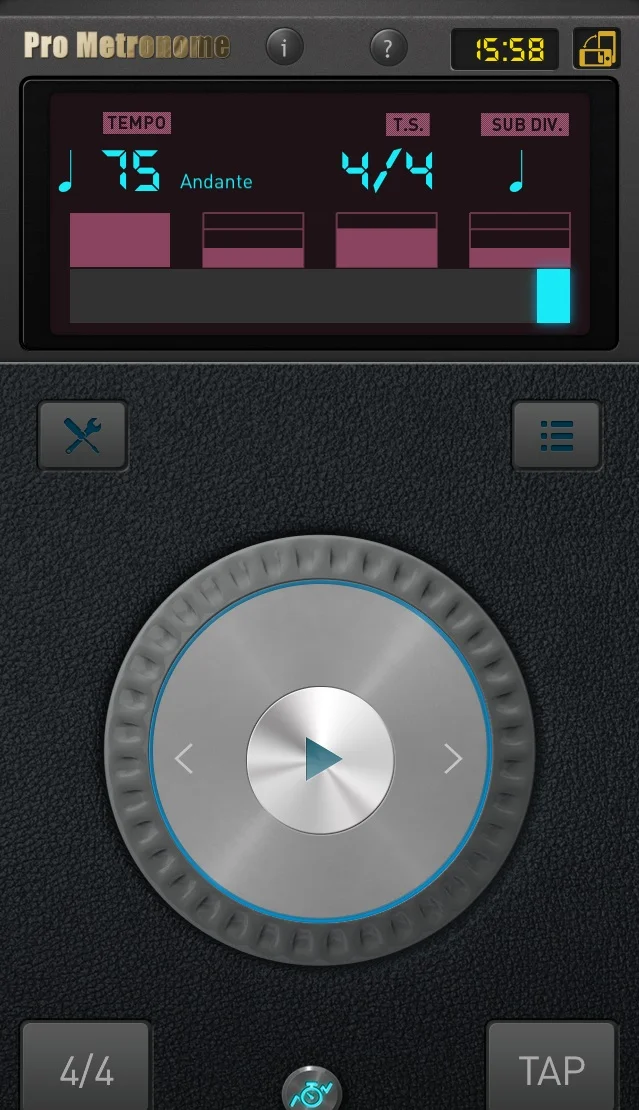
Review - Metronome App - Pro Metronome for iOS
Given that I talk a lot about using a metronome I wanted to tell you about the Metronome App that I use: Pro Metronome by EUMLab
I have looked for other metronomes which can do everything I want, but I can't find one except for Pro Metronome.
So, given that I talk A LOT about using a metronome (often to the sound of student groans) I thought I ought to tell you about the Metronome App that I use: Pro Metronome by EUMLab
Midway through last year my ancient iPhone was dying a slow and painful death. I couldn't quite justify a whole new phone at the time, so I started looking for a metronome which could do everything I wanted it to do, basically what Pro Metronome does - I couldn't find one, at least not without costing me a fortune.Eventually I had to bite the bullet and got myself a shiny iPhone 6 SE - the first thing I installed was...Pro Metronome.
It has a fairly comprehensive set of basic features:
- 13 different sounds + mute/light only so chances are you'll find something you can works with.
- You can set the number of beats (1-16) and time signature (any note length from semibreve down to demi-semi quaver - whole notes to 32nd note)
-Each beat can be controlled individually with 3 levels of sound as a regular beat, sub accent or accent, you can also mute any beats.
- Alongside the beat display, there is a visual light display that can be customised in several ways , from only flashing on accented notes to flashing different colours on all the different levels of beat. Personally I prefer the pendulum mode as when I'm working with some tricky rhythms it gives me some visual anticipation for the next beat.
- Pro Metronome features an impressive speed range from 10-500bpm, combine that with the ability to mute beats and it's really gives a lot of scope to play around - super useful when your trying to work on your internal pulse.
The App has a number of paid add-on features, that you can buy as a bundle (NZ$6.99) but you can also purchase individually (from NZ$1.69), which I think is really good of EUM to do this as I don't necessarily want to pay for features I'm not going to use.
-Sub Divisions:
I use this all the time, as the name suggests, it lets you hear different subdivisions to the beat. There are up to 16 rhythmic variations to choose from, including off beats, syncopations and triplets.
I find this really useful for speed control, rhythmic accuracy and what I call cognitive confusion (I'm sure there's a proper term but I can't find it) where in order to play something straight and even, you practice against an alternative rhythm making it harder to play in time, so when you play again normally it feels easy.
You can also overlay a regular beat click using the accent levels. For example I might set the subdivision to offbeat semi-quavers and set an accent on just the first beat of the bar to keep my own internal beat in check.
With such a large number of combinations, there is something for every style.
-Practice Mode
Another useful paid feature I recently started using. I find it very useful for practising short exercises or passages that are easily repeatable.
I have been mostly using Automator - you can set the duration for each tempo by time or bars, then pick a start tempo and a target tempo and the increment which to increase each round. It then gives you an approximate time to complete. This is great to use as a warm up on a scale or short repeatable exercise, a bit like a musical beep test (but more satisfying and less competitive than the gym version). The only improvement I'd like to see here is that when you press start there be a count in. Using it for a continuous warm up activity, between pressing the start button and having my bow ready to play I miss the first couple of beats - but not a huge issue when I start slow and will be repeating it many times anyway.
The Warm Up setting is a bit more fiddly, for my purposes at least. Here you can set a tempo and then set multiple sections where you choose a multiplier for the tempo (faster or slower) and a time. Given that the things I play have a set number of bars, setting the time is not as useful. It does indicate how much time equals a bar at the given speed, but I found you still have to do a bit of maths so that rounding doesn't catch you out and you have to skip the last half beat of the bar.
It is still a very useful tool, and you do have a bit more control than automator to speed things up and slow down as you wish.
Other paid features are available like Polyrhythm, letting you play multiple rhythms simultaneously and Rhythm Trainer which mutes certain bars to train your internal pulse, but I haven't used these. There is also a tone generator, but I have a specialist Tuner app which I'm very happy with.
On the whole I find the app very user friendly and intuitive with swiping and tapping both getting you to the different menus. The tempo is easily controlled, with multiple manners to adjust it, including a TAP button. The display is clear and simple, and most importantly the sound is loud and clear. I would definitely recommend this app to anyone wanting to work a bit more seriously with the metronome.
You can download Pro Metronome from the App Store
For Android and iOS
If you found this post useful please click the like button below. If you have any questions or comments about this or any other metronomes do leave a comment underneath, I’d be happy to open up the conversation.
I do reviews for practice tools, concerts and other things from time to time, so subscribe to my feed to get the latest updates.
Developing Technique - How, When and Why?
Is 'good' technique imperative to being a successful instrumentalist, or merely a means for artistic musical expression? Considering both my own and my students techniques I find myself somewhat conflicted. Does the effort of prioritising technical mastery find itself at odds with taking the journey through enjoyable and inspirational repertoire?
I have been thinking lately about the importance of technique. Is it imperative to being a successful instrumentalist, or merely a means to an end - that of artistic musical expression?
Following various discussions with colleagues and other teachers, considering both my own and my students techniques I find myself conflicted.
Of course I want my students to develop good technique. But prioritising mastery of technical aspects at the cost of moving through enjoyable and inspirational repertoire? Perhaps this philosophy will never produce any virtuosos, but I do believe music is more about creativity, expression, and sharing and enjoying the art than being technically accurate.
Personally I feel, as a teacher I need to strike the right balance with each student between developing the technical aspects and building a repertoire that is fun and musically satisfying. This varies depending on age, motivations and learning style.
There are differing opinions on when children should start learning, but whatever the age, a child's developmental stage must be catered for. At 6 motor skills and cognitive skills are still developing, gross motor skills come before fine motor skills (which are mostly used in instrumental playing). By 8 or 9 the child should have reasonable dexterity - a good judge could be in handwriting. Yet children are, of course, still developing, things like the fine motor skills are still being refined. On top of this, we all develop at varying rates, a young student may not be physically able to correctly manipulate the bow for example - right at this moment in time, it's just not happening - but that isn't to say that it never will.
I believe little exercises and gentle corrections of technique repeated over the weeks and months will set it in place in the long term. Considering also, social development, young students are starting to find their independence and their own self confidence. Music can help this flourish, but we must balance the criticism with commendation, that students don't lose interest or become frustrated or insecure in their own ability.
For adult beginners I believe the same applies, albeit from a slightly different perspective. In respect to the physical, movements might be more restricted, fingers for example that have never made these movements may find it hard to form the correct shape and to work independently as required. That's not to say you can't teach an old dog new tricks so to speak, it just might take longer, you might need to find some work-arounds. Of course I wouldn't intentionally ignore practicing good technique, but for most adult students, the goal is to do something for themselves, to have fun and enjoy playing. At the start it can be challenging, everything is so new, and as an adult student you must be 100% self motivated, not the same as for the youngsters who have parents reminding them to practice!. So with that in mind, there needs to be some satisfaction in playing right from day one. Finding that balance between technical requirements, enjoyable repertoire and a sense of ongoing improvement, otherwise it becomes a chore, while other commitments and responsibilities take over.
In both cases, particularly considering beginners, the importance of technique is to allow us to achieve a variety of good sounds, and without pain or injury. But there is no one size fits all way of playing. Even among great musicians, beyond certain cornerstones, there are many different ideas about how to achieve certain sounds. Our technique should be allowed to evolve as does our musicianship. Besides, we are all built differently so it would follow that we move around our instruments differently too.
I would tend to approach the development of technique in a slow-burn kind of way, over time muscles will get used to certain movements as the player starts to get the feel for how they can achieve the sounds they want to make. The bottom line - it should feel natural and without tension.
In the meantime working through a variety of repertoire that is at both challenging and satisfying. And, as time goes by we make constant adjustments and improvements. If we turn the learning into an iterative process it seems to me that the brain can come to grips with the new movements. The new ideas musical and technical have time to brew and mature in parallel.
I may be wrong, but I'm not convinced that labouring technique is necessarily that effective. Music is an art after all so I consider that nurturing the enjoyment and musical expression of emotions to be a more pertinent endeavour for the developing musician. A student who is enjoying music is always prone to more and better practice. It's all in finding the right balance for the student I guess.
Please share your thoughts on this in the comments below, it's a worthwhile discussion to have and helps me to improve what I do.
5 Things to do with a Metronome
For some, the metronome is the bane of their existence, something to be groaned at. But not me, for me it's one of the most useful tools I have for a good practice session. These are my top 5 creative uses to get the best out of that little ticking box.
For some, the metronome is the bane of their existence, something to be groaned at. But not me, for me it's one of the most useful tools I have for a good practice session. And particularly after attending a series of masterclasses at Waikato University where Richard Aaron from Juilliard was one of the visiting professors, he really reignited my creativity when it came to getting the best use out of that little ticking box.
Here is my top 5 ways to make the most out of your metronome.
5. A classic method of use, it's an oldie but a goodie. Setting the beat to a specific tempo that is required, so you know you are playing the piece at the right speed. In the case that the correct tempo cannot yet be achieved - set a slower tempo and gradually working it up. Gets the job done, simple as that.
4. Set the metronome to click on the smallest denomination. For most things semi-quavers should do the trick - but if the piece has demi-semi quavers for example you'd want to set it for that. This method forces you to subdivide accurately. It really helps suss out tricky rhythms, and to place notes well, for example with dotted rhythms, and even when there are a lot of longer notes , it's easy to get complacent and a bit elastic when it comes to changing notes - the metronome won't let you get away with it.
Having an internal pulse is super important and especially in orchestral playing, this is a great way to practice so it sets you up with solid subdivisions when it comes to following the conductor and keeping the section tight.
It's worth mentioning that this way of practice can be a little off putting at first, especiallly at quicker tempos (the metronome can turn into some sort of machine gun sound effect) but when you work up to it gradually, the subdivisions become more of a 'feeling' than hearing each and every click.
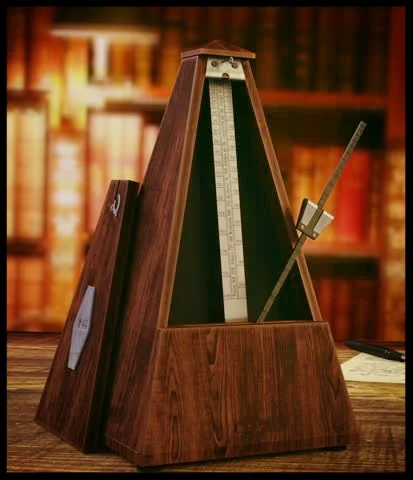
3. The metronome beats only on the first beat of the phrase. This will mean usually 4 bars, but depending on the music you could get away with 2, 3 or more. This is sort of an extension on number 4. It really tests your internal pulse and rhythm of the piece. Obviously the longer the phrases are the harder it is to land at the same time as the metronome. It helps identify phrases that might be dragging, or rushing. It also allows for some more musical shaping than the previous method, while still keeping a steady pulse. But be warned it sounds a lot easier than it is.
2. Set the metronome to alternative rhythms. I've been experimenting with this method since learning about finding and playing different jazz rhythmic feels. The main idea is to set some sort of irregular click going, something different to the main pulse and even sub-divisions, for example off beat quavers, a swung (tripletised) rhythm, a dotted rhythm or even something as simple as beat 2 and 4. In the first instance setting any alternative click to a piece will help solidify the rhythm, if for no other reason than it messes a bit with your head and you have to really concentrate on placing notes correctly.
More interesting though, is if you look really closely at the piece, where do the phrases lie, what is the rhythmic shape, what is the style and feel of the piece. Then choose a setting that fits into one of those elements.
I'll explain; for example if a piece makes a feature of triplets, setting a swung click will feed into those triplets and everything else will have to be carefully placed and fit into that same feel, unifying the whole theme, rather than the triplets sticking out.
Another example; a piece has a straight rhythm nothing unusual, but there are several semiquaver runs that start on the second half of the beat, stick on an off beat click, the runs will then start on a click, and everything else will move along with that same sort of syncopated feel.
Now these are just examples, and not everything will really work, but try some different things and you might find that some alternative rhythmic feel might inject a spark into the piece which is just what it needed.
1. Set the metronome clicks really really far apart. This one is taken directly from Richard Aaron's masterclass, and quite frankly it's genius, ever since, I have been using it often with many of my young students, his advice: to practice this regularly from an early age and it will develop a stellar internal pulse.
So the idea is to space out the clicks far apart, maybe 4 bars or more apart, then you listen to a couple, try and work out some subdivisions that work so you can clap on the next click - for most people, this is really hard. The trick is to keep a quick and steady internal pulse going in between each click keeping track of how many 'beats' or bars are in between. - Give it a go!
The students I've been doing this with haven't got it spot on yet, but they have improved dramatically at keeping a steady rhythm and following the beat in orchestra.
Remember - the metronome is your FRIEND. My advice would be to get a metronome that has many different functions, so you can set different rhythms, subdivisions and turn on and off beats and has the biggest range of speeds available.
A great app I use is Pro Metronome, has heaps of functions I need for free, and a heap more for purchase - the best thing, that you only purchase the bits you want, and not the ones you don't. Its available on the iTunes store and on Android.
And if you have any other nifty tricks you like to use , let me know in the comments section, I always love to learn new ways to make the most of my metronome!
Mindfulness for Musicians
Most of us know music is an artistic, emotional and often spiritual expression of ourselves. Listening to music can get us excited, cheer us up, it can equally be relaxing and conciliatory.
Playing music can be a reprieve from the daily grind but we can put enormous pressure on ourselves, and this can result in a lot of tensions and anxiety relating to our music.
There has been a lot of publicity about 'Mindfulness' in recent times, I find the idea of focus in the moment and non-judgmental awareness fits in very well in music practice.
Most of us know music is an artistic, emotional and often spiritual expression of ourselves. Listening to music can get us excited, cheer us up, it can equally be relaxing and conciliatory.
Playing music can be a reprieve from the daily grind, it can lift our spirits and be an emotional outlet. But as musicians, whether starting out or trying to make a living, we can put enormous pressure on ourselves, and this can result in a lot of tensions and anxiety relating to our music.
There has been a lot of publicity about 'Mindfulness' in recent times. It has become trendy, seems like everyone is jumping on the bandwagon so to speak. While I do not agree with all of it, having read bits and pieces on meditation, mainly from a Buddhist tradition, along with various ideas and strategies to improve mental health, I find the idea of focus in the moment and non-judgmental awareness fits in very well in music practice.
In today's world of constant pressures of work and life, everything moves so fast we hardly get time to notice. Mindfulness brings back to us this awareness of ourselves and our surroundings, experiencing every moment. Giving us a break from worrying about the past or the future.
Music too is like this, a great piece of music can hold our attention and draw us in to the moment. The cliche of the 'tortured artist', isn't always too far from the truth. There are many things that can be easier to express through art or music than actual words, for whatever reason. But we can still find ourselves putting pressure on ourselves to practice more, to perform better, and this can get very frustrating, to the point that it's no longer enjoyable, or good... the more frustrated we get the worse it sounds.

Incorporate some 'mindful' activities to combat these moments:
BREATH
Practice breathing,
1. While still and;
2. While slowly making the movements that you use to play.
Unless you actually need to breath to play, for example, singers, wind or brass players where the music is going to determine much of your breathing pattern. Others such as string players, pianists, guitarists, percussionists, harpists etc... we must make a conscious effort to breath.
Try this: Play a simple exercise such as a scale. Practice breathing, much as you would control your breath whilst running long distance, time your breath in and out with the movement of the bow or per octave.
As you do this, feel every movement, notice every muscle, how it moves, if it is holding tension, is your weight distributed evenly, is the weight being transferred as it should be into the instrument.
As you notice each of these things, try to adjust them, release the tense muscles, transfer the weight, economise and optimise your effort, control the movements.
The next thing you will be noticing is the quality of the sound as you make these adjustments, hopefully it is improving, but perhaps at times it is not, continue adjusting, focusing your attention on that area.
Note that this is contrary to the main principle of mindfulness; being that you notice all , but make no judgement. But, in order to improve our playing, the practice session must have some critical objective judgement involved. Use specific and descriptive words when you do this exercise ie. the notes could be more smooth, or the sound more even. Try to avoid pejorative terms.
This can in some sense be likened to the practice of a walking meditation. Noticing the movement and feel of muscles and senses.
FOCUS
A lot of meditation practice is about discipline, focus and concentration. This certainly holds for music practice too.
- Try to make sure you have as little distractions as possible that may interrupt your flow.
- Set an alarm for a certain amount of time to work on an activity. This is especially useful if you have limited time available to practice and makes sure that you can cover everything you want to and don't get stuck on one particular thing. For example working away at a particularly difficult exercise, the alarm goes to remind you to move on: you avoid getting to a point of frustration and start to undo your good work by over-working it.
- Try to notice how many times your mind drifts away from what you are playing during each exercise or piece. Even the fact of deciding to do this can help focus your mind on what you are playing, and if you notice there is more drifting than focusing, you might have done enough for the day.
- All this focus can make for very good quality practice, but it can be mentally tiring. Take little breaks, just for a minute, stand up, walk around, then get back into it. And... know when your done - if you've lost concentration it can be counter productive. (See previous point). You know your ow limits and how long you can maintain effective concentration on one activity.
VISUALISE
Visualisation is as important in practice stages as in performance and it is a two fold concept:
1. Visualise in your mind how the piece is going to sound, how does the very first note begin, hear it in your mind, think of the pulse and rhythm the tone and dynamics. Visualise the movement of your bow and fingers and hear the sound that is produced. take a couple of good deep breaths, feel everything relax in.
2. Visualise the piece in your mind before you start , feel the surroundings, you are aware of your audience yet not thinking about them. Draw on your musical inspiration from some imagery you can associate with the music. Focus on any accompaniment to bring your attention to the music. Always be thinking about the line you are playing, not worrying about a really hard bit on the next page or that high note you missed a few bars back, absorb yourself in what is happening now.
PERSERVERE
Almost everything is difficult at some point and there are times for all of us that certain things seem well beyond our capabilities. Perhaps they are, but it doesn't help to throw in the towel. As my mother often says, "take a deep breath, and get on with it".
Well... yes, easier said than done in the context of practicing. But do BREATH, deeply and slowly feel the air through your nostrils, filling your lungs and breathing out feel everything relax and sink down. As many times as you need, then go back to what you were working on, but this time taking it back a notch, break it down, processing every movement and note with a careful awareness.
Even if it is not as fast or loud or whatever it needs to be, as it was before, you are still better off. Psychologically, you finish the session playing it well, you feel better about coming back to it next time.

If all his is very unfamiliar to you Mindfulness in Plain English by Venerable Henepola Gunaratana is a very good, easy to read and practical book to get you started.
Also check out your local Buhddist Temple, they often have meditation and mindfulness courses or will welcome you to attend a session. You don't hve to buy into all of it, but you will get enough understanding of the practice to apply it to your own practice.
New Year's Resolution: A Practice Plan
New years resolutions that get made in the relaxed and festive 'bubble' of the holiday season, inevitably get forgotten, once the all the parties are over and the reality of life returns.
The antidote might be to make an actual plan - something to work towards and a way to get there. And what better than a plan for practice?
Last January I wrote about giving the practice routine a shake up and how simply going through the motions is simply not enough to see real progress. And I feel that despite periods of extreme time constraints, I have managed to keep up a level of focus, efficiency and precision with the way I practice.
Now, it seems any new years resolutions that get made in the relaxed and festive 'bubble' of the holiday season, inevitably get forgotten, are too hard or become totally impractical once the all the parties are over and the reality of life returns.
The antidote to this might be to not make a resolution as such, those idealist and far fetched notions; make an actual plan - something to work towards and a way to get there. And what better than a plan for practice?
Over the break, it's a great time to reflect on what you want to achieve in the year. I have had some time to do this and so far ... so good (albeit only 5 days in...)
So here we go (and actually write it down... you'll be able to refer back to it through the year and give yourself a big pat on the back when you've smashed them out at the other end of it)
1. Work out the top 3 things you want to work on, or rather think you need to improve.
If this plan is going to last a whole year it is better to be generalised things that you can work on in may different ways and apply to different things.
A year might seem a long time to work on something, but in the scheme of things, we spend many years trying to perfect our playing, so focusing on certain aspects of technique for one year is not so outrageous.
2. Brainstorm all the specific elements of that technique that are causing difficulties.
Try and be as specific as possible here, this will help focus the work to be done in the right places. Remember to think about physiological and psychological elements as well as the physical or musical elements of the technique itself.
Considering as many 'causes' or issues as possible to do with the technique can help dig down to the root of the issue, and to address the fundamental aspects making this technique difficult. we can also find links between the physiological, metal and physical elements.
3. Note down some ideas on which excersizes can be used to target these techniques.
This can be a small list to start with and can develop over time as the technique develops and improves.
REMEMBER - Scales can address a multitude of sins.
4. Consider what repertoire you can work on that will compliment your work on each specific technique.
Often we choose repertoire we want to play and then work on the appropriate technique according to those works. By turning it round we can search out new repertoire and find works that we might not normally approach, putting into practice the techniques we are working on.
This is a great exercise to plan and improve our own work, but also to do for/with students.
Often we get stuck into nutting out exam pieces, orchestral and school ensemble repertoire, and sometimes certain techniques can get neglected if they don't often arise often enough.
For new students, have these technical goals be a mixture of things the student struggles with and techniques that they really enjoy or come somewhat naturally. That way, the years work can include addressing difficult or challenging areas as well as advancing the mastery of others.
You can see here a list I made for my own practice regime, other areas to look at could include things like, sound/tone production, vibrato, rhythm and pulse, shifting, physical tensions, coordination, musical interpretation etc.
When considering a plan for more established students it would be helpful to look at all their strengths and weaknesses and shortlist what needs the most attention and is most relevant to what they are currently working towards.
We all know that making a plan to reach our goals is a great way to keep ourselves on track. All we need is for once to just stick with it!!
Are you Listening?...Now I'll begin
When we really listen to music, we are paying attention, it's not just going on in the background while we think of what we are having for tea or ticking things off the To Do list. We notice the rhythm and harmonies, changes in key or tempo.
When you are playing the music, you must be aware of all these things as well as create them.
It takes concentration...
If you have read my previous posts, you will know how crucial listening is. Of course we are talking about music, so this might seem obvious, but listening is a lot different from hearing.
I've been playing all sorts of different things recently with lots of different people; good musicians, students, a whole mixture. The common thread of whether the ensemble and the music works is the level of listening that is going on. A bunch of people playing instruments at the same time does not an ensemble make.
Small groups, especially when talking about classical music, are often referred to as an 'ensemble'. This comes from the French meaning 'together'. When everyone is listening, and reacting, the music comes together, it becomes music not just notes, the different parts bounce off each other and blend, and a musical energy is created. Essentially all the feeling and emotion from music can be thought of as energy.
The word there that makes the difference is 'reacting'. When we really listen to music, we are paying attention, it's not just going on in the background while we think of what we are having for tea or ticking things off the To Do list. We notice the rhythm and harmonies, changes in key or tempo.
When you are playing the music, you must be aware of all these things as well as create them.
It takes concentration:
- Listen to everything that is going on around you (in the music that is)
- Fit in with the rhythm, pitch and dynamics of the other players. If you have sheet music it should all be written there for you, but it is often elastic, especially tempo and dynamics.
- React to what you are hearing, if another part has the lead (or tune), follow, if you have it, lead the others.
- Anticipate the changes, you can hear when things are building, harmonies often lead into one another. When reading music always be looking a bar ahead.
Think of it as a jigsaw puzzle where each person has only some of the pieces, everyone must put the right pieces in the right spot for it to all join together and make a picture.
Each players pieces are made up of their own intonation, tone, rhythm, dynamics, expression etc. even lyrics.
When all the pieces fit, you have some great music.
As I mentioned in an earlier post Ear Training Part II what you hear and can react to depends on what you are familiar with, there are so many different rhythmic patterns and harmonies that are involved in creating the right feel for any given piece of music. Classical, pop, jazz etc all have different rules and conventions that make up the texture and style of the music.
If we are not familiar with that particular style it can be very difficult to fit in with it. You can be listening and concentrating but it can still be difficult to slot your part into the puzzle.
It takes time, in the same way as learning a new language. If you have ever been in a foriegn country, even having studied your phrase book, you can't differentiate where one word ends and the next begins. After a while your ear becomes familiar with the sounds and you can start understanding more of the words.
Listen to recordings, listen to the other parts, listen to how your part fits in with the other parts, listen out for cue notes, beats or words. Take notice of the harmonies, where are the parts working together, where are they doing their own thing, where are they heading?
Pay attention to the changes in energy, it would be dull if it were the same the whole way through. there are ups and downs, louds and softs, angry parts, peaceful parts, happy and sad parts, take note of how these make you feel and then replicate it.
For musicians who don't often play in a group, there is not always the same need or opportunity to develop these accute listening skills. For example;
- A pianist can play in his own style and the feel will be consistent, he can always keep in time with himself,
- A singer can have one or more instrumentalists accompanying her who will follow her, and how she interpretes every phrase.
In my opinion every musician should hone their listening skills, being aware of everything going on, to be able to react and fit in with the other parts. I do admit it is a case of practice, and it is hard to do that if you are not putting it into practice, so to speak.
But you will become a better musician for it.
Are you paying attention?
As we get back into work and school for the year it is the perfect time to start developing good habits... or renew the good habits that have been let slide over the holidays.
The key to successful and productive practice is routine and quality. I'm not talking about the quality of the playing but rather the quality of the practice...
Continuing on with the theme of practice, as we get back into work and school for the year it is the perfect time to start developing good habits... or renew the good habits that have been let slide over the holidays.
The key to successful and productive practice is routine and quality. I'm not talking about the quality of the playing but rather the quality of the practice.
Sticking to a regular practice routine is important in that, for one thing, if there are long gaps between your practice sessions it's a bit like taking one step forward, two steps back, as you forget what you were doing last time, and certainly your muscles have forgotten what they learnt.
Apart from that though, a regular routine helps keep you motivated, it becomes part of your day, something that generally you should look forward to. And by practising regularly, you achieve a great deal more, and can see, or rather hear, the improvements in your playing.
Quality is a slightly more abstract concept when it comes to practice. Unless you are practising something in totally the wrong way, for example playing the wrong notes, I think almost any practice is of some value. But certainly some ways of practising are more effective than others.
It is important to really pay attention, at all times. As I have said in the previous post, when your concentration starts to fade it's probably time to stop.
When practising any instrument there are many things to think about: Notes, intonation, rhythm, dynamics, form, tone, phrasing etc...... it is hard to be thinking about them all at once. So to help keep our heads from overloading, focus on one thing at a time. It might be a big shift, some odd intervals, a passage of fast notes, or very slow notes, or it might be all of these; break it down into smaller chunks.
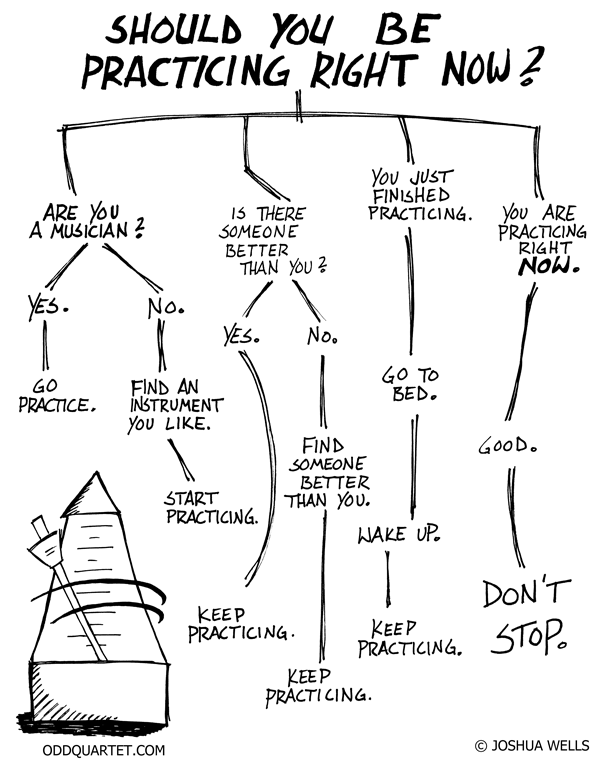
Perhaps quite a strict regime, but if you did follow this chart, you would get good fast!
- The shift or unusual intervals needs slow practice for intonation. Listen to a recording or play the notes on the piano of just that section, until it is set in your head. Really listen to the notes that you are playing. Sometimes, if you are really paying attention, bending the note slightly sharp then flat can help settle the true note into your ear. Once the intonation is solid, then start refining the sound, making sure the tone and dynamics are right. You might find that after adding dynamics you might need to work on the intonation again.
- For fast passages, once you have nutted out the intonation, start building up the speed. This really does require vigilant use of a metronome. Start slow, it seems obvious but you would be surprised, slow means slow, take the speed that you feel you can play it and reduce it by 5-10 notches. Now it's just repetition, gradually increasing the speed a few notches at a time (only when you have mastered the passage at the slower speed). You may find that you hit a wall at a certain speed, that's ok, you will gradually push it up further over time.
Practising with a dotted rhythm, and then the reverse rhythm is often very helpful in conjunction with the metronome.
These are just 2 examples of ways to practice specific elements or passages. Both involve much repetition and attention to detail. And that can be applied to all practice. The 3 time rule is also a good thing to stick by: to get something perfect 3 times in a row, is actually harder than it sounds, so you keep working it until you do.
The last thing I want to mention which I feel often gets neglected in favour of everything I have mentioned above, is the physical. Being aware of physical stance, posture, how you are using your hands, arms, face, is as important as the rest. You can't do the rest effectively without using your body in the right way. Pay attention to how it feels to produce the notes, do you have the right balance and weight in your arms for example, are you sitting (or standing) correctly. Notice how it feels when you get the notes right, not just how it sounds, it will make it easier to replicate next time.
This all seems like a lot of hard work I guess, and learning an instrument is, hard work, but also fun and rewarding and many other things besides. And remember you don't have to do it all at once. As I mentioned before, regular small practises are going to get you further than the occasional marathon. Alternate between the detailed practice and playing through (it keeps you in context of the bigger picture, and is usually more fun) and when time allows devote yourself to a big session.
Keep your goals in mind and remember nothing really worthwhile is particularly easy.
Practice makes better ... eventually
Practice is an interesting thing, there are good ways and bad ways to do it, there are also different opinions on what is the best way. I came to the realisation over the last 12 months or so that I needed to brush up on my practice technique and give it the time that it needed. Practice is as much psychological as physical, keep bringing your concentration back to what you are trying to achieve. Only practice as long as you can maintain your full attention on the notes you are working on...
Practice is an interesting thing, there are good ways and bad ways to do it, there are also different opinions on what is the best way. When you take up something new there is a steep learning curve, everything is uncharted territory. as you get better at it, the basic elements you learnt at the start become easier, even second nature, that you no longer think of them. This improvement continues more gradually until you reach a certain point where you can achieve many things, albeit in a mediocre way, with little to no practice. Of course this happens slowly over time, and along the way somewhere you lose the ability to practice with the same attention and vigour as when you started.
I have come to this realisation myself over the last 12 or so months, a somewhat rude awakening, I knew deep down that I was not practicing to the best of my ability, but most of what I played was 'good enough' with the bare minimum of work, my repertoire I kept to the same old favourites I had played for years.
It wasn't until I found myself in the situation of wanting to tackle some much more complex repertoire, and simultaneously (for an entirely different project) needing to learn music by ear and improvise, that I realised I needed to brush up on my practice technique and give it the time that it needed, rather than allocating arbitrary amounts of time I felt I could reasonably take out of my schedule.
In concentrating my efforts on quality practice where it was needed, and no longer simply running through from the top every time, religious use of a metronome, meticulously learning small chunks at a time and really listening to the quality and intonation of each and every note, practice time can easily expand to several hours at a time. My concentration span quickly grew and so long as my hands could hold out I can keep going to a point where improvement has plateaud for the day. Very quickly the results of this quality practice have shown a vast improvement over the years of mediocrity that preceded it.
Quality practice is as much psychological as physical. Listen intently to everything that you play, hold yourself to the highest of standards. Perfection is generally impossible to achieve however it makes for an ideal target point. I think this is hardest to instil in younger people, children do need encouragement and can easily become disenchanted with music if they feel they are not improving, they often need instant gratification of some kind or else it becomes too hard and they can get bored. Having said this though, constant praise is not the answer here either, there needs to be a balance where a job well done is recognised but equally where areas for improvement are kindly pointed out otherwise in the long term the student will not develop the self criticism necessary to achieve greater things.
“Simplicity is the final achievement. After one has played a vast quantity of notes and more notes, it is simplicity that emerges as the crowning reward of art.”
A lot of what is needed in good practice is down to mind over matter. Keep bringing your concentration back to what you are trying to achieve. Only practice as long as you can maintain your full attention on the notes you are working on. In every practice session the improvement of the technique or passage you are trying to perfect plateaus at some point. You must pay attention and notice when this occurs, move on to a different passage and come back to it later. And never try to run before you can walk. Having recently taken the step to relearn the piano as part of becoming a better musician, I know full well the frustration when you hit a road block and suddenly it gets hard. Take a breath, slow it down, baby steps, it will come eventually.
Most of all enjoy it. Playing music is amazing, but we all have to practice constantly to play our best. It is a life long journey. Relish every improvement, every notch up on the metronome, let yourself take great satisfaction for each passage mastered, but at the same time being aware that is is never really mastered - 'you've got the notes, now work on the tone'. Be sure to never get complacent, and know that the sky is the limit and each day of good practice you are one step closer.
The next time I will talk about what in my experience are the best ways to approach practicing.
Keep Calm and Carry on ....
Keeping motivated is important for all musicians. Practicing, performing and playing in general can all present us with challenges to a degree that we start to have doubts. If you isolate the problem then there are ways to overcome it....
Keeping motivated is difficult at times, but it is important especially as a musician. Practicing, performing, creating are all self driven. We need to keep motivated to make the most of what we are doing.
I often have many projects on the go at once, writing, teaching, practising, working on new performance opportunities, even maintaining this blog. I have come to the conclusion that there are 3 main things that can stand in the way of getting things done the way we want and these affect our motivation.
Firstly, time, and this is a big one. We all have busy lives, demands of work, study, and everything else, we need to prioritise.We need to make time for our music, work out how much can be dedicated to it, and without a specific goal in mind, I'm mainly talking about practice. Practice is essential to improving as a player, and we must dedicate 'enough' time to it. The principle of quality over quantity applies for certain. When you're just getting started, little and often is best. You will achieve more practising 10 minutes a day than sitting down for an hour once a week. Further down the line when time is short, select a small section to work on really well rather than just playing through a lot of work.

Secondly, confidence. I think everyone has moments where they lose confidence in their ability. It's easy to give in to this and give up, thinking it's too hard, or I'm never going to get this. The better option is to fight it, use the self-doubt to work harder, and get what ever you're trying to learn better. We have to take baby steps, for most of us, learning music is hard, it's going to take some time, don't try and play things beyond your ability and expect instant results, you will just become discouraged. Not so long ago, I was given a brutal critique shortly prior to a big audition, I was given the choice to pull out or to give it a shot anyway. I chose the latter and practised twice as much. I was unsuccessful that time but I knew I had done my best and what I needed to do going forward. And I was reminded that in preparing for any performance we need to get to 120% so that when nerves kick in we can still play at least near to 100%. And remember too, when it feels like you're not getting anywhere, look back at where you have come from, what and how you were playing, then you will see how much you've achieved.
Thirdly, inspiration, music is an art, and we need to be inspired. Whether it be writing some new music, interpreting a piece or even setting some goals, these all succeed better with some good inspiration. For me, my writing gets blocked I can't hear what I want to write, my playing becomes bland and lifeless, and frankly, I stop setting goals altogether. But even in a general sense, when motivation is flagging, get inspired. Listen, find some new music that you love, or turn to the old favorites. Always look to the experts, go to concerts of really great musicians, go to gigs and experience what other people are doing. Discover new styles, and new ways of doing things, it might give you ideas for a new project or change the way you play something. It's important to find what you're into, explore all art forms, go to an art exhibition, sit in on a poetry slam, listen to classical music (Mozart to Prokofiev), jazz (Ellington to Reinhardt), Latin music (Tango), pop (eg, Beck) and the list goes on... There will be sounds and ideas among all of these that will spark the flame and you will eventually find your own inspiration.
Remember to keep working at it, make music part of the daily routine. Even when you there's heaps gong on and I really don't feel like practice, I've got to do a bit, the most important time to practice is when we don't want to. Relish the compliments, take on the criticism. Find what inspires you and allow your enthusiasm to help you reach your goals.
An Ear for Music - Part III
Learning an instrument can involve many physical challenges and it is often necessary to find a certain level of familiarity in navigating it before things like tone and accuracy can really be fine tuned. However, there are simple exercises that can be practised to simultaneously develop the ear that need only a little technical skill. These are just as important as learning where the notes are on the stave or where to put your fingers.
At the beginning, a new student's technical ability may not be strong enough to always play in tune. Learning an instrument can involve many physical challenges and it is often necessary to find a certain level of familiarity in navigating it before things like tone and accuracy can really be fine tuned. However, there are simple exercises that can be practised to simultaneously develop the ear that need only a little technical skill. These are just as important as learning where the notes are on the stave or where to put your fingers.
- Scales. These are critical in both technical training and ear training. A single octave up and down is achievable by most students after a few lessons. C major scale for example, having no sharps or flats, falls under the fingers easily. With guidance from a teacher, you can start to really hear the key of the scale, the tones and semitones. Remember 'Doe a Deer' from The Sound Of Music, this is a C major scale. Over time you progress to other scales D and F major etc. start to introduce minor scales, these have a different tonality again, the tones and semitones are different, and then increase to 2 octaves, and so on. There are many scales with increasing numbers of sharps and flats, and for a cellist, increasing technical difficulty.
Scales are not usually considered fun, but they are very useful and very necessary. Take them slowly, and really listen. It is important to adjust the notes as you go until they are in tune, if you can hear it's not in tune, that's great, but you need to be able to correct it too.
- Pitching Notes. Not all instrumentalists feel they can sing, but it is an important skill to develop for all musicians, even if you are never prepared to sing in front of anyone. You need to be able to pitch the notes in your head before you play them, otherwise once you have played the note and realised it's wrong , it's often too late. Brass players for example, must know how to pitch notes well as several notes can be made with the same combination of valves. When you sit music exams, there is a portion of the exams dedicated to Aural Tests. Whether doing an exam or not, these exercises are useful to practice these skills.
As a teacher I use simple exercises playing together with the student or using the piano. I have the student sing or play back a single note or short phrase. Progressing to finding intervals from a given note. So when you see the notes on the page you can have a very good idea of how it should sound when you play it. these can also be modified into fun games with younger students, using different media and tools, gives a variety to the lesson, and helps them to understand the written music better.
- Check. When you are practising at home by yourself it can be difficult to always be sure if you are in tune, as you are likely to have little to hear it in relation to. With stringed instruments we have open strings. When learning a new or difficult piece, look out for all the A's, D's, G's and C's (in the case of viola or cello) and each time you play these notes, check them with your open string, it may be at a different octave but you can clearly hear when the two notes are in tune.
When you are practising a big shift, use your note pitching to sing the interval (in your head) and then play the shift alone over and over until it is perfect every time.
It can also be useful is to play along with a recording from time to time. As mentioned in Part II, being very familiar with the piece played in full helps enormously to understand the tonality and intervals in the piece. When you play along with it , you will notice any notes that are not quite right. But this is not a substitute for careful and diligent practice.
From there it comes down to fine tuning each and every note. This takes time and patience, play the notes slowly, avoid vibrato, and listen really carefully. I find it sometimes helpful to bend the note a bit, roll my finger slowly back forth like a super slow-motion vibrato to force the note flatter and sharper, there will be a note somewhere in the middle that sounds just right, like fine tuning the radio.
A musicians ear is one of the most valuable things they have. At the end of the day it is down to the student to practice 'hearing' what they play, this actually goes for every musician at any level. It is one of those things you have to work at for yourself, no-one else can hear just what you are hearing, and it takes constant practice.
If you want some extra help there are a myriad of apps offering ear training, they generally test you on intervals, chords and other pitch related excersizes. Here is a review I found of 6 with varying prices and functionalities, but as I say there are loads of them, they will all help, just depends how far you want to take it.
6 Apps & Websites to get your Ear in Shape
Remember, even if you think you have a terrible ear, you can train it, it just takes time diligence and focus. I would love to hear of any other techniques that you might use, either for your own ear training or for your students. And I'm certainly open to any questions, this is a big and complex topic.
An Ear for Music - Part II
The foundations of the intonation that we hear is somewhat intuitive, it depends a lot on one's musical exposure. Listening to most western music, be it popular or classical, these combinations of sounds, intervals and chords will sound 'right' to your ear. If however you listen to a lot of jazz or world music your ear will likely be more attuned to different types of harmonies.
The foundations of the intonation that we hear is somewhat intuitive, it depends a lot on one's musical exposure. Most western music that we hear all around, is based around the diatonic scale, a musical convention stemming from Greek times. So listening to this, be it popular or classical, these combinations of sounds, intervals and chords will sound 'right' to your ear. If however you listen to a lot of jazz or world music your ear will likely be more attuned to different types of harmonies, hearing sounds that may not even exist in western music.

I grew up in a music filled household, listening to all sorts, from Beethoven to Bob Dylan, Marianne Faithful to the Memphis Jug Band. Family get-togethers usually devolved into a cacophony of irish tunes where someone yelled out the key and after some 'discussion' on the actual name of the reel, everyone would join in , mostly it was great, sometimes not so much. In all I was lucky to be exposed to so much music. But as I mentioned in Part 1, you can practice and train your ear to hear things better.
Practice hearing not just listening. For starters, getting your ear used to the sound of what you are attempting to play. The sound of the harmonies and intervals will become second nature after listening to a piece several times, so that when you play it you know when you are playing it right. It is always helpful to follow the music at the same time, for one thing it increases your concentration on what you are hearing, and it also gives a visual reference for the shape of the music and the intervals between the notes.
As additional training, I have found it very helpful to listen and play (or sing) along with all sorts of different music, on the radio, different EP's or singles that I like. Perhaps start off with the tune, but trying to find the harmonies is a great deal more beneficial. Find a long note that fits with everything else going on, when it no longer fits, find the next one and so on....you have now found the chords changes. Most of the time the most prominent note (probably the one that you found) is the tonic, the base note of the chord, the 3rd and 5th notes will also fit, these 3 notes make up the triad, the basic chord.
After a time the ear starts to pick out these notes more easily, and to eventually predict what the next notes are going to be. As a result, anything that you play, you are anticipating the notes and harmonies, you know where you are going and what it should sound like.
The next and final part will investigate some more practical exercises that should be incorporated into any music practice to actively improve intonation.
An Ear for Music - Part I
Having a good ear is crucial for all musicians. There are a lucky few who have perfect, or absolute, pitch. I am related to at least one of these people, but unfortunately, I was not lucky enough to inherit that particular gene. So, like most, I have had to learn to develop 'relative pitch'.
Having a good ear is crucial for all musicians. There are a lucky few who have perfect, or absolute, pitch. This means they can identify the name of any note, recognising a car horn as a 'D' for example, or instantly playing back a ring tone on the piano.
I am related to at least one of these people, but unfortunately, I was not lucky enough to inherit that particular gene. So, like most, I have had to learn to develop 'relative pitch'. This allows me to pitch intervals from a given reference note and to play notes in tune in relation to accompanying chords. The importance of being able to pitch notes and maintain accurate intonation is hopefully evident. No doubt as a teacher, a musician or even as a listener, you have heard at one time or other, singers or instrumentalists that are quite out of tune. The notes and harmonies clash, the tune does not sound right.
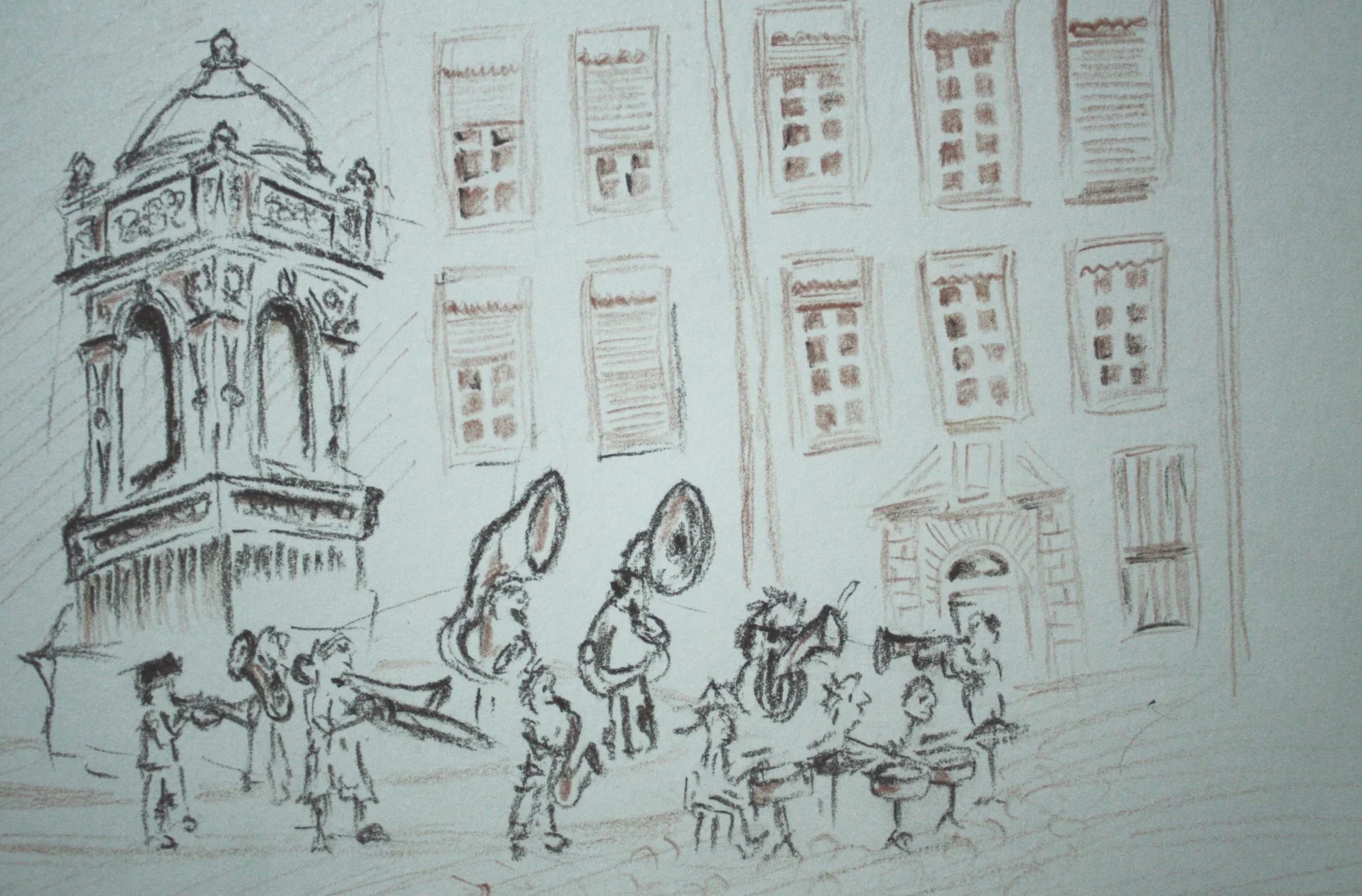
Sketch of street performers in Lyon - by J Khan (these guys were very in tune)
As someone that does not have the natural gift of perfect pitch, it takes vigilance to really listen and hear the notes, sometimes needing constant adjustment to get each note just right. One needs a lot of attention to detail, "near enough" is in fact not near enough. If you let incorrect tuning pass unaltered, your ear can get lazy and over time it can become harder to hear what is in tune and what is not. Inevitably from time to time we will let our attention slip but this must be overcome. The key is to be listening and training your ear as much as possible.
I don't profess to have all the answers and there is no silver bullet to fix an intonation problem, hearing when you are in tune is quite different from the execution of it on your instrument. But in Part 2 I will go into my discoveries improving my own intonation and experiences teaching others to improve their ear.