
Keep Calm and Carry on ....
Keeping motivated is important for all musicians. Practicing, performing and playing in general can all present us with challenges to a degree that we start to have doubts. If you isolate the problem then there are ways to overcome it....
Keeping motivated is difficult at times, but it is important especially as a musician. Practicing, performing, creating are all self driven. We need to keep motivated to make the most of what we are doing.
I often have many projects on the go at once, writing, teaching, practising, working on new performance opportunities, even maintaining this blog. I have come to the conclusion that there are 3 main things that can stand in the way of getting things done the way we want and these affect our motivation.
Firstly, time, and this is a big one. We all have busy lives, demands of work, study, and everything else, we need to prioritise.We need to make time for our music, work out how much can be dedicated to it, and without a specific goal in mind, I'm mainly talking about practice. Practice is essential to improving as a player, and we must dedicate 'enough' time to it. The principle of quality over quantity applies for certain. When you're just getting started, little and often is best. You will achieve more practising 10 minutes a day than sitting down for an hour once a week. Further down the line when time is short, select a small section to work on really well rather than just playing through a lot of work.

Secondly, confidence. I think everyone has moments where they lose confidence in their ability. It's easy to give in to this and give up, thinking it's too hard, or I'm never going to get this. The better option is to fight it, use the self-doubt to work harder, and get what ever you're trying to learn better. We have to take baby steps, for most of us, learning music is hard, it's going to take some time, don't try and play things beyond your ability and expect instant results, you will just become discouraged. Not so long ago, I was given a brutal critique shortly prior to a big audition, I was given the choice to pull out or to give it a shot anyway. I chose the latter and practised twice as much. I was unsuccessful that time but I knew I had done my best and what I needed to do going forward. And I was reminded that in preparing for any performance we need to get to 120% so that when nerves kick in we can still play at least near to 100%. And remember too, when it feels like you're not getting anywhere, look back at where you have come from, what and how you were playing, then you will see how much you've achieved.
Thirdly, inspiration, music is an art, and we need to be inspired. Whether it be writing some new music, interpreting a piece or even setting some goals, these all succeed better with some good inspiration. For me, my writing gets blocked I can't hear what I want to write, my playing becomes bland and lifeless, and frankly, I stop setting goals altogether. But even in a general sense, when motivation is flagging, get inspired. Listen, find some new music that you love, or turn to the old favorites. Always look to the experts, go to concerts of really great musicians, go to gigs and experience what other people are doing. Discover new styles, and new ways of doing things, it might give you ideas for a new project or change the way you play something. It's important to find what you're into, explore all art forms, go to an art exhibition, sit in on a poetry slam, listen to classical music (Mozart to Prokofiev), jazz (Ellington to Reinhardt), Latin music (Tango), pop (eg, Beck) and the list goes on... There will be sounds and ideas among all of these that will spark the flame and you will eventually find your own inspiration.
Remember to keep working at it, make music part of the daily routine. Even when you there's heaps gong on and I really don't feel like practice, I've got to do a bit, the most important time to practice is when we don't want to. Relish the compliments, take on the criticism. Find what inspires you and allow your enthusiasm to help you reach your goals.
An Ear for Music - Part III
Learning an instrument can involve many physical challenges and it is often necessary to find a certain level of familiarity in navigating it before things like tone and accuracy can really be fine tuned. However, there are simple exercises that can be practised to simultaneously develop the ear that need only a little technical skill. These are just as important as learning where the notes are on the stave or where to put your fingers.
At the beginning, a new student's technical ability may not be strong enough to always play in tune. Learning an instrument can involve many physical challenges and it is often necessary to find a certain level of familiarity in navigating it before things like tone and accuracy can really be fine tuned. However, there are simple exercises that can be practised to simultaneously develop the ear that need only a little technical skill. These are just as important as learning where the notes are on the stave or where to put your fingers.
- Scales. These are critical in both technical training and ear training. A single octave up and down is achievable by most students after a few lessons. C major scale for example, having no sharps or flats, falls under the fingers easily. With guidance from a teacher, you can start to really hear the key of the scale, the tones and semitones. Remember 'Doe a Deer' from The Sound Of Music, this is a C major scale. Over time you progress to other scales D and F major etc. start to introduce minor scales, these have a different tonality again, the tones and semitones are different, and then increase to 2 octaves, and so on. There are many scales with increasing numbers of sharps and flats, and for a cellist, increasing technical difficulty.
Scales are not usually considered fun, but they are very useful and very necessary. Take them slowly, and really listen. It is important to adjust the notes as you go until they are in tune, if you can hear it's not in tune, that's great, but you need to be able to correct it too.
- Pitching Notes. Not all instrumentalists feel they can sing, but it is an important skill to develop for all musicians, even if you are never prepared to sing in front of anyone. You need to be able to pitch the notes in your head before you play them, otherwise once you have played the note and realised it's wrong , it's often too late. Brass players for example, must know how to pitch notes well as several notes can be made with the same combination of valves. When you sit music exams, there is a portion of the exams dedicated to Aural Tests. Whether doing an exam or not, these exercises are useful to practice these skills.
As a teacher I use simple exercises playing together with the student or using the piano. I have the student sing or play back a single note or short phrase. Progressing to finding intervals from a given note. So when you see the notes on the page you can have a very good idea of how it should sound when you play it. these can also be modified into fun games with younger students, using different media and tools, gives a variety to the lesson, and helps them to understand the written music better.
- Check. When you are practising at home by yourself it can be difficult to always be sure if you are in tune, as you are likely to have little to hear it in relation to. With stringed instruments we have open strings. When learning a new or difficult piece, look out for all the A's, D's, G's and C's (in the case of viola or cello) and each time you play these notes, check them with your open string, it may be at a different octave but you can clearly hear when the two notes are in tune.
When you are practising a big shift, use your note pitching to sing the interval (in your head) and then play the shift alone over and over until it is perfect every time.
It can also be useful is to play along with a recording from time to time. As mentioned in Part II, being very familiar with the piece played in full helps enormously to understand the tonality and intervals in the piece. When you play along with it , you will notice any notes that are not quite right. But this is not a substitute for careful and diligent practice.
From there it comes down to fine tuning each and every note. This takes time and patience, play the notes slowly, avoid vibrato, and listen really carefully. I find it sometimes helpful to bend the note a bit, roll my finger slowly back forth like a super slow-motion vibrato to force the note flatter and sharper, there will be a note somewhere in the middle that sounds just right, like fine tuning the radio.
A musicians ear is one of the most valuable things they have. At the end of the day it is down to the student to practice 'hearing' what they play, this actually goes for every musician at any level. It is one of those things you have to work at for yourself, no-one else can hear just what you are hearing, and it takes constant practice.
If you want some extra help there are a myriad of apps offering ear training, they generally test you on intervals, chords and other pitch related excersizes. Here is a review I found of 6 with varying prices and functionalities, but as I say there are loads of them, they will all help, just depends how far you want to take it.
6 Apps & Websites to get your Ear in Shape
Remember, even if you think you have a terrible ear, you can train it, it just takes time diligence and focus. I would love to hear of any other techniques that you might use, either for your own ear training or for your students. And I'm certainly open to any questions, this is a big and complex topic.
An Ear for Music - Part II
The foundations of the intonation that we hear is somewhat intuitive, it depends a lot on one's musical exposure. Listening to most western music, be it popular or classical, these combinations of sounds, intervals and chords will sound 'right' to your ear. If however you listen to a lot of jazz or world music your ear will likely be more attuned to different types of harmonies.
The foundations of the intonation that we hear is somewhat intuitive, it depends a lot on one's musical exposure. Most western music that we hear all around, is based around the diatonic scale, a musical convention stemming from Greek times. So listening to this, be it popular or classical, these combinations of sounds, intervals and chords will sound 'right' to your ear. If however you listen to a lot of jazz or world music your ear will likely be more attuned to different types of harmonies, hearing sounds that may not even exist in western music.

I grew up in a music filled household, listening to all sorts, from Beethoven to Bob Dylan, Marianne Faithful to the Memphis Jug Band. Family get-togethers usually devolved into a cacophony of irish tunes where someone yelled out the key and after some 'discussion' on the actual name of the reel, everyone would join in , mostly it was great, sometimes not so much. In all I was lucky to be exposed to so much music. But as I mentioned in Part 1, you can practice and train your ear to hear things better.
Practice hearing not just listening. For starters, getting your ear used to the sound of what you are attempting to play. The sound of the harmonies and intervals will become second nature after listening to a piece several times, so that when you play it you know when you are playing it right. It is always helpful to follow the music at the same time, for one thing it increases your concentration on what you are hearing, and it also gives a visual reference for the shape of the music and the intervals between the notes.
As additional training, I have found it very helpful to listen and play (or sing) along with all sorts of different music, on the radio, different EP's or singles that I like. Perhaps start off with the tune, but trying to find the harmonies is a great deal more beneficial. Find a long note that fits with everything else going on, when it no longer fits, find the next one and so on....you have now found the chords changes. Most of the time the most prominent note (probably the one that you found) is the tonic, the base note of the chord, the 3rd and 5th notes will also fit, these 3 notes make up the triad, the basic chord.
After a time the ear starts to pick out these notes more easily, and to eventually predict what the next notes are going to be. As a result, anything that you play, you are anticipating the notes and harmonies, you know where you are going and what it should sound like.
The next and final part will investigate some more practical exercises that should be incorporated into any music practice to actively improve intonation.
An Ear for Music - Part I
Having a good ear is crucial for all musicians. There are a lucky few who have perfect, or absolute, pitch. I am related to at least one of these people, but unfortunately, I was not lucky enough to inherit that particular gene. So, like most, I have had to learn to develop 'relative pitch'.
Having a good ear is crucial for all musicians. There are a lucky few who have perfect, or absolute, pitch. This means they can identify the name of any note, recognising a car horn as a 'D' for example, or instantly playing back a ring tone on the piano.
I am related to at least one of these people, but unfortunately, I was not lucky enough to inherit that particular gene. So, like most, I have had to learn to develop 'relative pitch'. This allows me to pitch intervals from a given reference note and to play notes in tune in relation to accompanying chords. The importance of being able to pitch notes and maintain accurate intonation is hopefully evident. No doubt as a teacher, a musician or even as a listener, you have heard at one time or other, singers or instrumentalists that are quite out of tune. The notes and harmonies clash, the tune does not sound right.
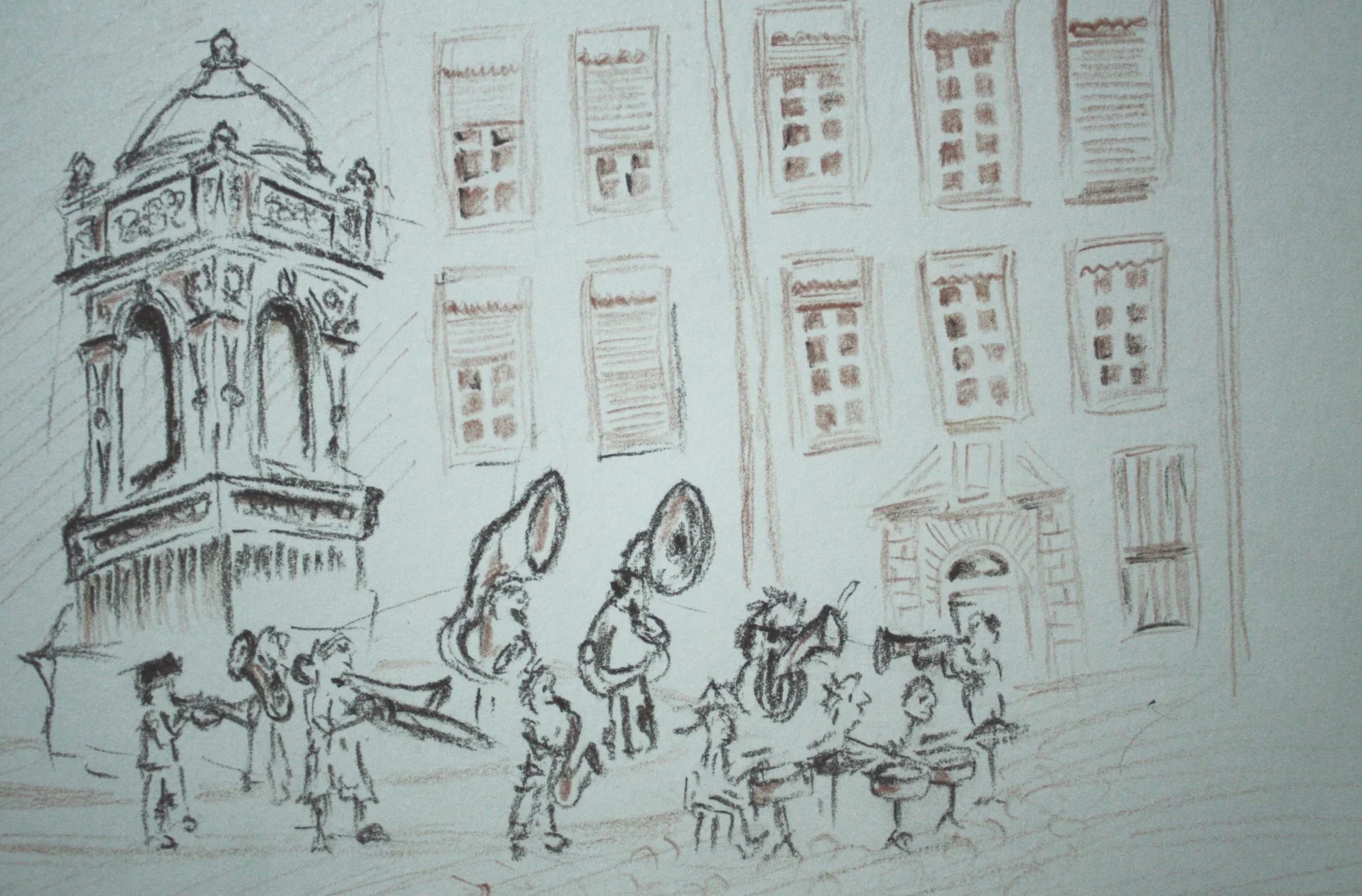
Sketch of street performers in Lyon - by J Khan (these guys were very in tune)
As someone that does not have the natural gift of perfect pitch, it takes vigilance to really listen and hear the notes, sometimes needing constant adjustment to get each note just right. One needs a lot of attention to detail, "near enough" is in fact not near enough. If you let incorrect tuning pass unaltered, your ear can get lazy and over time it can become harder to hear what is in tune and what is not. Inevitably from time to time we will let our attention slip but this must be overcome. The key is to be listening and training your ear as much as possible.
I don't profess to have all the answers and there is no silver bullet to fix an intonation problem, hearing when you are in tune is quite different from the execution of it on your instrument. But in Part 2 I will go into my discoveries improving my own intonation and experiences teaching others to improve their ear.
What is it to be a Musician?
The intention of this blog is to share my experiences, ideas and advice to help you to become a better musician. To share techniques and philosophies on how you can improve your playing both physically and mentally.
The intention of this blog is to share my experiences, ideas and advice to help you to become a better musician. To share techniques and philosophies on how you can improve your playing both physically and mentally.
Despite having performed in orchestras and bands since a young age, and having taught since my late teens, for most of my life playing cello has been primarily for pleasure. And this is why I still play. Recently I have decided to embark on a journey to build a career as a cellist.
I really respect people that have become successful musicians, working their way up, scraping together enough to get by, and they keep at it. There are musicians that I know who have made themselves indispensable, be it as a writer/performer, an accompanist, or a backing musician. People want them, for their entertainment, recital or recording. I want to be one of these people.
Being a professional cellist is hard work, don't imagine that it's not. It takes years of lessons and ongoing practise to learn an instrument and advance your technique and musicality. There's always new things to learn and elements to refine. At times there seems to be an element of disdain from other regular 9-5ers who believe that playing music is just a hobby, we do it for fun. But these people may not understand the time and effort that goes into perfecting your art. Of course it is enjoyable, we couldn't do it if it wasn't. One needs to be in the right head space to really make the most of practice time, to really be able to convey those emotions and express what you mean to say with the music.
And this is what it's all about, expressing yourself, expressing passion. Composers have a message of their own to get across, but it is you who is interpreting that message and presenting it in your own words, so the listener can understand. Your job is to invoke memories and emotions, to transport them to another place, to entertain them. You do this through your playing.
If you have persistence and dedication to music, you will develop the tools and techniques to be able to express yourself through playing. Your passion and enjoyment for playing music will provide the motivation to perform and share your art with audiences. Music is there to bring people together. And this is what it is to be a musician.